> USA karate story : Chuck Norris - Joe Lewis - Bill Wallace

dimanche 25 octobre 2009

Netherlands: fights pioneers in Europe

Introduction :

It's surprising that a so little pacifist and rich country provides a such large number of fighting champions. Although since the eighties, the current champions are often from immigrant backgrounds, Netherlands continue to be the best in these sports.

The purpose of this article is to narrate the beginnings of martial arts with KO, until 1980, and determine the reasons for this success.

At the end of this article is compiled a list of major competitions held by the Batavian fighters and their results.

History :

It is very difficult to match the claims of interested persons and the reality.

We will base our text on the excellent document called "De verharding van het wedstrijdvechten" (unofficial translation : The Hardening of Sport Fights) by Maarten van Bottenburg and Johan Heilbron, investigating for the Ministerie VWS (free translation : Ministry for Health, Welfare and Sport). This document is available on Internet at this address : hbo-kennisbank.uvt.nl/cgi/fontys/show.cgi? Fid = 3637.

We will also refer on various newspaper articles of the time, quoted in the text.

Furthermore, we will mention the contradictions between the various versions of the events.

A character of legend :

Jon Bluming was born in 1933. He fought at least 1 boxing fight, circa in 1946, then joined the army and was sent to Korea during the war, in 1950. He learned Judo, Karate Kyokushinkai with Mas Oyama and various other martial arts, during his stays in Asia.

He returned to the Netherlands in 1953 and taught in a club named Jen Tung. Jon Bluming says he was part of the team winning the European Championship of Judo in September 1956, in Amsterdam. We note that no European Championship were held in 1956. In 1957, the Championships were held in Rotterdam and Bluming name does not appear on the record, nor in other European or World Championships. Maybe Jon Bluming's team took part in a Club European Championships.

Bluming, 6'5'' for 220 pounds, claims to have beaten the famous Japanese Kaminaga, via a strangulation, in May 1960. In a December 1966 Black-Belt Magazine article, he claims to have beaten Kaminaga at the Kodokan in 1961, during a workout.

Jon Bluming
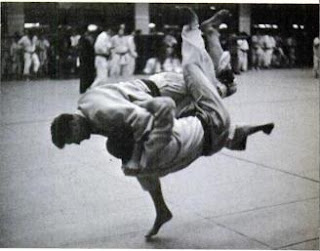
Jon Bluming, during a Judo training session at the Kodokan

Bluming is not participating in the World Championships in Paris, in December 1961. His Dutch rival, Anton Geesink, won the gold medal.

According to the January 1969 Black-Belt Magazine article, Bluming was from a federation called "Nederland Amateur Judo Associatie" and Geesink from the "Nederland Jujitsu and Judo Bond". Bluming said that Geesink had refused to meet him on a tatami and only fighters from the Geesink's Federation could participate in international championships.

Bluming has coached Willem Ruska, 1972 Olympic and 1967 and 1971 World Champion.

Bluming founded a Kyokushinkai Federation in January 1962 and runs various championships.

In January 1965, Bluming have received a 6th dan from Mas Oyama, in Kyokushinkai. Oyama would have promise USD 100,000 .-- for the winner of Bluming, and also promise to withdraw his black belt from Bluming for this futur defeat.

Currently, Bluming is a 10th dan black belt in Kyokushinkai and a 9th dan in Judo.

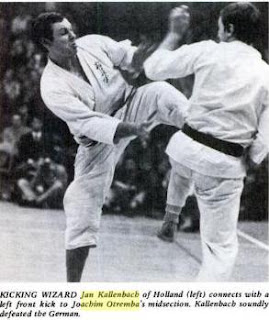
In karate, he coached Jan Plas, Tom Harinck and Jan Kallenbach. Kallenbach began with Judo, always with Jon Bluming as a professor. Kallenbach won the 1974 gold medal at the European Championships of Traditional Karate, in the Open Category, against the Francis Didier.

Jan Kallenbach

Jan Kallenbach (left) in 1972

Tom Harinck :

Born in 1943, Tom Harinck begins with judo and boxing during his time in the army, with 22 amateur fights, for only 1 loss on points. He works on a boat and discovers the Savate French boxing.

Harinck trains with Jon Bluming in Kyokushinkai. He says he got a 6th dan in Kyokushinkai. Harinck acknowledged in an interview that Bluming was giving belts too easily.

In 1972, Harinck began teaching the fight science in his team named Chakuriki (in Japanese, this word would mean "The power derived from"). His fighters are known among others, for their red kimono.

In 1975, the Chakuriki team meets a Savate French boxing team, in Paris. We don't know the results of the fights. The details of these fighters are mentioned in the list below.

Tom Harinck Chakuriki

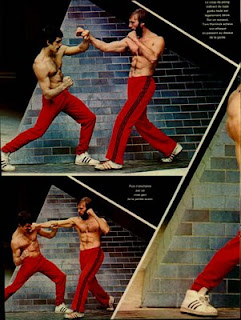
Tom Harinck (right)

From the French Karate Magazine

The same year, Harinck received his diplom of Savate french boxing professor, from the the French Federation. In 1976, he founded the NKBB (Nederlands kickboxing Bond), with Jan Plas.

The first kick-boxing fights are held in Netherlands in 1976 and are detailed in the results list below.

Invited in August 1978 in Thailand, the Chakuriki team loses its 5 fights against the Thais. The details are mentioned later. The fighters are coming back in Holland, but Tom Harinck stayed in Thailand to learn the Muay-Thai.

Teams of Thai boxers are also coming to the Netherlands to be confronted with Chakuriki.

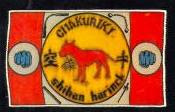
Tom Harinck Chakuriki logo Tom Harinck Chakuriki logo

Tom Harinck Chakuriki logoFour Chakuriki logos

Note the graphic changing between this four Chakuriki logos. On the two last version, fighting dogs are with an olive branch (peace logo). On the last version, the name of Shihan (Professor or Model in Japanese) has disappeared. The term Savate has been changed with the term Free-Fight.

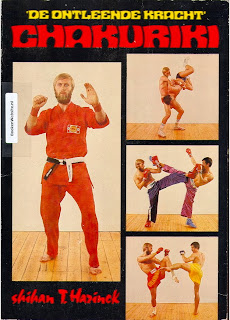
Tom Harinck has published a book in 1980, called "De ontleende kracht". The free translation can be "The borrowed strengh", maybe a synonym of the Japanese term Chakuriki. Harinck has published a second book, named "Muay Thai or Thai Boxing". He has also published a training video, named "Born to Fight". Short video from this edition : http://www.youtube.com/watch?v=3kfa3rbgiZ0

Tom Harinck book

Tom Harinck's book

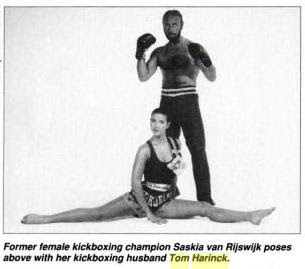
Without wishing to become people, we report that in the June 1991 Black Belt Magazine article, Tom Harinck is mentioned as the husband of Saskia Van Rijswijk, famous Dutch fighter woman, in the 1980s. The latter fought against the also famous Lilly Rodriguez, in 1982 (see article over Benny Urquidez).

Saskia Van Rijswijk Tom Harinck
Saskia Van Rijswijk and Tom Harinck

Jan Plas :

Jan Plas practices first Karate Kyokushinkai with Jon Bluming.

For the European Championships of Traditional Karate in 1974 in London, Jan Plas loses before the final against Geert Leemens/Belgium, in the middleweights.

At the same time, Jan Plas has trained with Tom Harinck, in his Dojo, as seen on this picture.


Tom Harinck (left) and Jan Plas

In 1975, Jan Plas visited Tokyo and trained in the Kenji Kurosaki dojo. Kurosaki is a former Kyokushinkai practitioner with Mas Oyama. Kurosaki founded his own fighting style called kickboxing. Kurosaki is related with Jon Bluming and has taught with him in Holland. They have writen together a book about the Karate Kuykushinkai. Kurosaki's Dojo is named Mejiro Gym, given its location in the district of the same name.

The similarity of evolution between Dutch and Japanese Kyokushinkai practitioners is interresting, with this move towards more complete and effective practices.

Back in the Netherlands, Jan Plas founded his own Mejiro Gym.

Jan Plas Platje Tom Harinck

January Plas (right), vs Platje in 1976.

The referee is Tom Harinck

Shortly after the Chakuriki journey in Thailand, the Mejiro Gym will also travel to Thailand to confront with the Thai fighters.

Jan Plas was the professor for Fred Royer, Lucien Carbin, Rob Kaman, Andre Brilleman and Johan Vos, who will found later the famous Vos Gym. We only mention these fighters, because they will have their golden days after 1980, deadline for the period studied here.

The first Dutch performance :

May 17, 1974. during the first tournament of the European professional karate, organized in Berlin by Georg Bruckner (see article: Professional Karate Debuts in Europe), the Dutch are present. In the heavyweights, Frank Brodar/Germany or Yugoslavia, def Ivan Oliviari/Netherlands. The winners will fight against the American selection in Los Angeles (see article: Los Angeles 09.14.1974).

The same day, some European fighters are opposed to an US selection, still with points fights. The American fighters wear protections, while the Europeans are not fitted. In the heavyweights, Jim Butin beats Ivan Oliviari, surrogate for the European Champion, Franc Brodar, injured at his hand.

The US team also visits Holland, at a meeting organized by Jan Stoker, in The Hague. The US fighters first beat a Dutch Taekwondo team, by 25/0.

The Americans also beat a Dutch Kyokushinkai team, composed of practitioners of a rank below the black belt. It has been proposed to the Dutch to fight black belts from their school, but Peter Kredijt, Kyokushinkai team leader, reportedly replied that the Americans were not fighters and that the black belts were too strong for them.

After some hesitation, Peter Kredijt accepts a challenge from Jeff Smith. Kredijt is then sent to the canvas three times, for the count.

1975. Meeting with Savate French boxing in Paris (possibly at the Meridien Hotel) between a Chakuriki team and French fighters. Robbie Harinck, Ron Kuyt, Gerard Bakker, Jan Kunst and Jhon de Ruyter have participated in these fights, but we don't know their results.

Jhon de Ruyter

Jhon de Ruyter (right), 1975 in Paris

during combat in Savate

September 21, 1975. At the Deutschlandarena Berlin, a tournament called the European All Style Karate Championships is organized by Bruckner and Mike Anderson, the latter engaged in the production of the event (see article: Full-Contact Development in Europe). It's possible that the Dutch Jan Kunst and Ron Kuyt have won at this tournament?

1976. In an interview given to a German newspaper named Karate Budo, Tom Harinck mentions that in 1976 in Schiedam, Kuyt, De Graaf and Kunst became Europe Champions, possibly in Kick-Boxing or Full Contact ? We found no trace of this European Championship.

May 2, 1976. At Gelsenkirchen, Germany, a tournament called full-contact European Championship is held. (see article: Full-Contact Development in Europe). In the 63-69 kg category, the French Roger Paschy, former member of the Frech Traditional Karate team, won this tournament. He defeated first the Jhon de Ruyter by ko. The appointed Kuyj is mentioned as the 3rd in this category. It could be Ron Kuyt.

The Dutch V.D. Velden (-90.5 kg), and Tuhirima (-63k) finish 1st and 3rd respectively, in their weight classes.

May 31, 1976. A first kick-boxing gala is held in Amsterdam between the Chakuriki and the Mejiro Gym.

We found an article published in Germany, stating the following fights :

De Ruyter (Chakuriki) beats R. Janson (Mejiro) by ko in the 2nd
W. Galenlamp (Mejiro) beats A. Ekkelsoom on points
T. Severs (Chakuriki) beats RW Leedeman by ko in the 2nd
R. Kuyt (Chakuriki) beats J. Boom by ko in the 3rd
January Plas (Mejiro) beats G. Platje by ko in the 2nd
E. Cairo (Mejiro) beats F. Karakus (Chakuriki) on points
G. Bakker (Chakuriki) beats J. (Johan?) Vos (Mejiro) by ko
Groningen (Mejiro) def Rompa (Chakuriki) by disqualification
Cabin (Lucien Carbin?) (Mejiro) def Harinck (Chakuriki) by kot
Ladenius (Mejiro) beats C. Brugman by kot

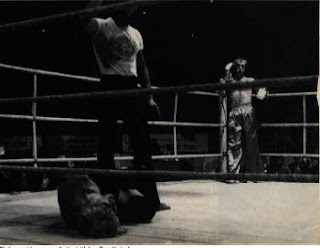
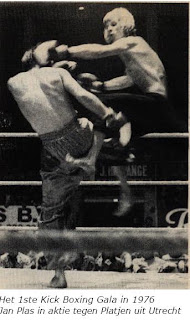
Jan Plas Platje
Jan Plas, left, during the 1st gala kick-boxing,

in 1976, vs Platje

If we make the total of the fights between these two schools, we arrive at 2 wins for Chakuriki and 3 wins for Mejiro Gym.

(For all Championships and Cups WAKO mentioned later, see the articles: First WAKO World Championships and First WAKO European Championships).

April or May 1977. During the first WAKO European Cup, which takes place in Rotterdam/Netherlands, the welterweights final is between George Metz/Netherlands and Slobodan Soboda/Yugoslavia. The light-heavyweights final is between Gerard Bakker/Netherlands and Lip Van de Meer/Netherlands. Hansi Jaensch/West Germany loses against Ivan Menes/Netherlands in the super lightweights final. The Dutch dominated the tournament.

1977. At the 1st European Championships, held by Georg Bruckner in Vienna/Austria, the Dutch obtained the following results : Gold medals : Jan de Graf (+ 84 kg), Gerard Bakker (- 84 kg), H. Rompa in (- 79 kg), Ron Kuyt (- 69 kg). The Netherlands team is ahead of West Germany and Norway.

October 1977. At the 2nd European Cup held in Vienna/Austria, the German lightweight Hans Jaensch beats R. Harinck on points. During the preliminary fights, Kemal Zeriat beats the Dutch Ron Kuyt. Zeriat had lost against him twice before. The Germans dominate the tournament.

August 1978. A Chakuriki team gwent to Bangkok, to fight against Thai boxers. The Thais names are phonetic.
Pasal Sittiboonlert beats Ron Kuyt by ko in the 2nd
Sakata Porntawe beats Robby Harinck by ko in 1st round
Sriprae Kiatsompob def Imro Van Hattan by ko 1st
Satanfah Sor Pratiep beats Faisal Karakus by ko in the 2nd
Ekachai Sitmorart beats K. Ramikisoen by ko 1st

Chakuriki ThailandArticle about the 1978 Chakuriki journey in Thailand
May 1978. During the 2nd European Championships, held in Wolfsburg/West Germany, possibly by Georg Bruckner, Ivan Menes (-63 kg) won the gold medal. For teams, West Germany is ahead of the Netherlands and Yugoslavia.

December 1978. At the 3rd European Cup, which takes place in Basel/Switzerland, a month after the WC of Berlin, Ivan Menes wins the category -63 kg.

1979. During the 3rd European Championships, held in Milan/Italy by Ennio Falsoni, Roufs won the bronze medal - 79 kg.

November 5, 1978. During the first WAKO World Championships in West Berlin, Ivan Menes won the gold medal of the -63 kg category. The US team is first, followed by West Germany and the Dominican Republic, Netherlands are only 4th.

February 25, 1979. In Amsterdam, Patrick Brizon/France beats Ron Kyut for the European kick-boxing title .

3 and November 4, 1979. During the 2nd WAKO World Championships in Tampa/Florida/USA, organized by Mike Anderson, F. Okkonowiak won the bronze medal for the category - 79 kg.

1980. Ron Kuyt loses against Andre Brilleman in kick-boxing before the limit. We will not mention the whole career of Andre Brilleman, which will have a final record of 16-1-1 and beat Howard Jackson in 1984 for the WKA title (see the article on Howard Jackson). Link to the video: http://www.youtube.com/watch?v=HepnXZ-2h-4

Date unknown (before 1978). Amsterdam. A Thai team led by Roger Paschy/France (see the article : Roger Paschy), met the Dutch team. All Thais lose before the limit. Lucien Carbin wins in the 2nd round. Harrinck wins his fight too. Ron Kuyt beats Roger Paschy by retirement for an injury, at the beginning of the 2nd round.

Date unknown (after 1976). Amsterdam. Frans Otten Stadion. A match between Thai boxers against a Dutch selection. All Batavian fighters win their fight, Lucien Carbin vs Srinop, Ron Kuyt vs S. Boonlod, Faisal Karakus vs S. Sangsrithong and Andre Brilleman vs C. Topruska (according to the pub for the meeting). We note that there is a video of a fight between Brilleman and Boonlod, date 4/7/1979. We don't know if this is the same night. Link to video: http://www.youtube.com/watch?v=WacrCyTYhCI

Date unknown (during an evening fight with Dominique Valera and after the fight above mentionned). Ron Kuyt beats Kamel Zeriat/Germany on points and Bakker beats François Petitdemange/France, also on points.

Conclusions :

We see a clear affiliation between Kyokushinkai imported in Holland by Jon Bluming and its legs kicks, with the evolution of its practitioners to kick-boxing with its low-kicks or to Muay Thai, with its knees and elbows kicks, sometimes allowed.

The Dutch have started to practice kick-boxing before the arrival of full-contact in Europe, their first success could be explained by this advance.

Please note that the Dutch fighters dominated full-contact, kick-boxing, Savate French boxing as Thai-boxing.

Moreover, competition between Tom Harinck and Jan Plas, and Johan Vos after 1980, may also explain a part of the Dutch success.

samedi 18 juillet 2009

Everett "Monster Man" Eddy

Introduction :

Everett Eddy was born in 1946 or 1947 and lived in Detroit/USA.

He practiced football and wrestling at school. In the martial arts, he began with Korean karate (Taekwondo), with Johnny Lee, a future opponent for Ross Scott. As competitor, Eddy weighs 235 pounds (107 kg) for 6 feet, or 183 cm. For these reasons, he receives the nickname "Monster Man".

Competition debuts :

In 1971, during the First Midwest Tang Soo Do Championships, Eddy Everett beats Neil Ehrlich, 160 pounds, from the lightweight division, for the Grand Champion title. Previously, Eddy beats James LaRocco, for the heavyweights title.

Eddy is part of the Ohio champion team. In 1972, he is part of the Michigan team champion.

In 1973 or 1974, at the Michigan Invitational, he loses in the finals against Flem Evans, with USD 1,000 .-- for the winner. Both fighters are opposed in a ring and wear protections.

Flem Evans Everett Eddy
Flem Evans, left, vs Everett Eddy

In 1973, at the USKA Grand National , Eddy wins against Shelton Parker.

In 1973, Eddy beats John Natividad in the preliminaries for the Four Seasons Nationals, before losing against Kijewski, for excessive contact.

In 1973 at the Battle of Atlanta, Everett Eddy def Larry Reinhardt, before losing against Jeff Smith in the semi-finals. Thereafter, Everett Eddy finishes third, before Bill Wallace.

In 1973, at the First Annual Open Championships Tae Kwon Do, Eddy Parker wins against Parker Shelton.

In 1973 ?, at the Tri-Cities tournament in Indiana, for the karate pro, Eddy loses against Bill Wallace, for the Grand Champion title.

1974 a successful year :

1974 : Jeff Smith loses against Ernest Russel for the U.S. championships, after defeating Everett Eddy. Smith def Everett Eddy again during the teams tournament.

Early in 1974 at the Battle of Atlanta : Howard Jackson wins the title, defeating Mike Warren in the finals. For the 3rd place, Jeff Smith def Everett Eddy on points 3-2.

In May 1974, at the National Hidy Ochiai's Karate Classic, Eddy wins the Grand Champions against Jeff Smith, after beating Charles Curry, who has defeated Joe Lewis during the same tournament. The Grand Champion wins USD 1,000 .--.

1974: Eddy wins against Dave Ruppert (Ruppart) at the Northern States Karate Championships, with $ 1000 bonus to the winner. Previously, he beats Big Ed Daniel, Flem Evans and Parker Shelton.

In June 1974, Ross Scott def Everett Eddy for the USKA Grand Nationals, managing to send Eddy to the mat during the bout. Scott is only a brown belt and wins the heavyweight title.

In July 1974, during the Top Ten Nationals Professional Karate, Everett Eddy beats Joe Lewis by 6-4. The winner receives USD 500 .--. The score is 2-2 after the first round. Eddy tears up the sleeve of his Gi during the rest. Lewis reachs Eddy with a punch and sends him outside of the canvas. Eddy wins the fight by 6-4. Note that Lewis had taken over 21 lbs since his return to competition, in early May 1974.

 Everett Eddy Joe Lewis
Everett Eddy, left, vs Joe Lewis

During this period of time, Everett Eddy is mentioned as one of the best heavyweights in the U.S. rankings, published by the magazines.

World Series of Martial Arts :

05.161975 : (see the separate article), for the heavyweights, Everett "Monster Man" Eddy beats Sammy Pace by a heavy ko in the 2nd round, with a series of kicks and punch. Thereafter, Dana Goodson beats Ken Bell, by ko in the 3rd. In the finals, Everett Eddy def Dana Goodson. Video : http://www.youtube.com/watch?v=Ba9AgpwW-8c

06.21.1975 : Everett Eddy beats Duke Sabedong, boxer with a record of 17 wins (12 by ko), 16 losses, (4 ko) and 2 draws (ref boxrec). Living in Hawaii, Sabedong is already 45 years old. His career ended in 1964. He lost in 1961, against the young Muhammad Ali (aka Cassius Clay), on points in ten rounds.

Victor Rapoza beats Chris Michael before the limit, during the semifinals.

In the finals, Victor Rapoza beats Eddy, by ko in the 2nd. Rapoza dominates during the first round and both fighters exchange punches in the 2nd round, when a left followed by a right sent Eddy to the canvas, for ten and more.

Everett Eddy Victor RapozaEverett Eddy, after his fight vs Victor Rapoza

Boxing against Full-Contact :

On 06.08.1975, at the World of Fighting Arts Spectacular in Ottawa/Canada, Eddy loses by ko against a boxer named Horst Geisler, during a mixed arts fight.

According to September 1975 Oriental Fighting Arts magazine, Horst Geisler weighs 295 pounds (133 kg) and is 6'9''(ca. 205 cm) with a record of 14 fights, 14 wins before the limit. According to the site Boxrec, Geisler is only 6'6''(196 cm), weighs 258 lbs (117 kg) and has already lost 2 fights for 7 wins, in 1975. His final record will be 12 wins for 6 losses, including one by ko in the first round against Trevor Berbick, opponent of Muhammad Ali and Larry Holmes. In 1977, Geisler wins a fight against Chuck Wepner (another opponent of Muhammad Ali), by ko in the 10th round.

The referees of the match between Eddy and Geisler are Joe Lewis and George Chuvalo, former opponent of Muhammad Ali too. In the first round, Eddy kicks Geisler and can sweep his opponent, who falls to the canvas. In the second round, Geisler ko Eddy with a left hook followed by a right.

Horst Geisler Everett EddyGeisler, left, against Everett Eddy

Full-Contact :

It should be noted that at the end of the first world championship PKA in 1974 (see article about this subject), Everett Eddy is heralded as the future challenger for Joe Lewis.

In 1976, at the Windy City Pro/Am Karate Championships, during the Full-Contact tournament , Everett Eddy fights against Jack Bonner. The latter does not give the six mandatory kicks during the first round. Eddy is counted 4 in the 2nd round. Eddy wins the fight, as Bonner has still not given enough kicks in the 3rd round.

In April 1977, Las-Vegas : Ross Scott def Everett Eddy, by ko in 1st round, for the PKA world title. Video Clip : http://fr.youtube.com/watch?v=HsvqDs30-L4.

We do not know his other full-contact fights.

Wrestling :

In August 1977, during a mixed arts tournament in Tokyo, Everett Eddy meets Antonio Inoki, a Japanese wrestler, who had lived in Brazil. The end result is a win by ko in the 5th round for Inoki. Video clips: http://www.youtube.com/watch?v=5PjbxMC65OU and http://www.youtube.com/watch?v=w7CQ82ej_P8

Antonio Inoki Everett Eddy
Antonio Inoki, left, in front of Everett Eddy, 1st fight

In 1978, a return fight is organized between the two fighters, in Japan. This time, Inoki wins by ko in the 7th round.

Style :

During his fights, Everett Eddy is very fast and also makes flying kicks, what is rare for his weight division. He is often considered too brutal during the competition.

He will also be able to fight under different rules, against very various adversaries, and he will adapt his style.

Conclusions :

Everett Eddy is often mentioned in magazines of the time and is heralded as the future world champion. Despite this announcement, he will never receive the promised glory, losing his most important fights.

mardi 12 mai 2009

First European WAKO championships in 1977 1978 and 1979

Introduction :

The so-called 1976 European Championships Full-Contact, were organized by Georg Bruckner in Gelsenkirchen, see article below "Development of Full-Contact in Europe". They were a selection for the USA vs Europe meeting in Paris and were not recognized by any federation. The WAKO was created only in 1977.

The first European Championships, reserved for amateurs, are an integral part of the WAKO history. The purpose of this article is to detail them and also the various tournaments, which preceded them.

For the WAKO history, please refer to the article "PKA, WAKO, WKA and other federations".

The first European Cup takes place in Rotterdam/Netherlands, around April or May 1977. These partial results are listed in the German Top Ten Karate, published at an unknown date.

For the middleweights final, George Metz/Netherlands is opposed to Slobodan Soboda/Yugoslavia. For the light-heavyweights final, Gerard Bakker/Netherlands is opposed to Lip Van de Meer/Netherlands.

Metz (left) against Soboda

Van de Meer (left) against Bakker

Jorg Schmidt/West Germany (present at Gelsenkirchen and Paris in 1976, see the article cited above) should give up before the final and wins the second place. Hansi Jaensch/West Germany loses against Ivan Menes/Netherlands, in the final for the lightweights. In the flyweights, Lan-Ung Kim/West Germany (present at Gelsenkirchen and Paris in 1976, see the article cited above) loses in the final against the Norwegian Max Mankowitz.

The Dutch dominated the tournament. They are more routine, via their kick-boxing tradition.

The 1st European Championships :

They are organized in 1977 in Vienna/Austria by Georg Bruckner. The results are as follows:

84 + kg:
1) Jan Graf (Netherlands)
2) Kunibert Back (West Germany)
3) Gianni Rugliancic (Italy)

Kunibert Back's career is mentioned in the article "Development of Full-Contact in Europe". Kunibert Back, as Dieter Herdel, Jorg Schmidt and Lan-Ung Kim, has fought against the best professionals in the 1976 tournament USA vs. Europe. They are now present in this amateur competition. It proves an interpenetration of professionals and amateurs at this time.

-84 Kg:
1) Gerad Bakker (Netherlands)
2) Maurice Moore (West Germany)
3) Vittorio Caselli (Italy)

-79 Kg:
1) H. Rompa (Netherlands)
2) Bert de Frel (Netherlands)
3) J. Schepers (Netherlands)

-74 Kg:
1) Peter Harbrecht (West Germany)
2) Serge Metz (Netherlands)
3) Aalstede (Netherlands)

-69 Kg:
1) Ron Kuyt (Netherlands)
2) Kemal Zeriat (West Germany)
3) Jorg Schmidt (West Germany)

-63 Kg:
1) Hansi Jaensch (West Germany)
2) Martin Giesselmann (West Germany)
3) Ivan Menes (Netherlands)

Ivan Menes, right, during the Cup in Basel

-57 Kg:
1) Max Mankowitz (Norway)
2) Ali Pehlivan (West Germany)
3) Jerome Canabate (Switzerland)

Teams competition. The Netherlands are first, West Germany second and Norway third.

According to the German Karate newspaper, published at an unknown date, the 2nd European Cup is held in October 1977 in Vienna/Austria. During the preliminary fights, J. Schepers is disqualified against Daryl Tyler. The latter has to leave the tournament in the future. For the flyweights, the German Ali Phelivan beats the Norwegian Max Mankowitz on points. In the lightweights, the German Hans Jaensch beats the Dutch R. Harinck, on points.

In the lightweights, the German Kemal Zeriat beats Alfred Blum via retirement during the 2nd round. During the preliminary fights, Kemal Zeriat beats Ron Kuyt/Netherlands. Zeriat had already lost twice before, against Kyut. The Germans dominate the tournament.

The 2nd European Championships :

They are organized in May 1978, at Wolfsburg/Est Germany, possibly by Georg Bruckner. The results were as follows:

87 + kg:
1) Tom Rissmann (West Germany)
2) Milan Rokvic (Yugoslavia)
3) Manfred Vogt (West Germany)

-87 Kg:
1) Maurice Moore (West Germany)
2) Flavio Galessi (Italy)
3) Gianni Rugliancic (Italy)

-79 Kg:
1) Daryl Tyler (West Germany)
2) Dieter Herdel (West Germany) (present at Gelsenkirchen and Paris in 1976, see the article cited above)
3) Bernd Eggert (West Germany)

-74 Kg:
1) Peter Harbrecht (West Germany)
2) Klaus Lutze (West Germany)
3) Slobodan Sobota (Yugoslavia)

-69 Kg:
1) Omar Salhi (Norway)
2) Javier Muniz (Netherlands)
3) Tone Spiljak (Yugoslavia)

-63 Kg:
1) Ivan Menes (Netherlands)
2) Rafiq Jamali (West Germany)
3) Gunter Dienstl (Austria)

-57 Kg:
1) Ali Pehlivan (West Germany)
2) Constantinos Goris (West Germany)
3) Johnny Canabate (Switzerland)

Teams competition. West Germany beats the Netherlands and Yugoslavia.

A semi-contact Tournament is also organized during these European Championships.

For the first World Championships in Berlin, organized in November 1978, see the article "The first WAKO World Championships".

The 3rd European Cup takes place in Basel, on 9th December, 1978, a month after the Berlin WC. The French Karate newspaper, published at an unknown date, mentions this tournament, deploring the fights low level. This newspaper also states that some fighters are wearing a head protection. That would have been forbidden by the rules.

Poster of the Cup, in 1978, Basel

The winners of their category are Johnny Canabate - 57 kg (Switzerland), Ivan Menes in - 63 kg (Netherlands), Zenaf in - 69 kg (France) - 73 kg Sobota (Yugoslavia), Jean-Marc Tonus - 79 kg (Switzerland), Flavio Galessi - 84 kg (Italy) and Jean-Luc Widehem + 84 kg (France). Jean-Luc Widehem beats Manfred Vogt in the semi-finals.

Zenaf (right)
3rd European Championships :

They are organized in 1979 in Milan/Italy by Ennio Falsoni. The results were as follows:

84 + kg:
1) Tom Rissman (West Germany)
2) Manfred Vogt (West Germany)
3) Rigo Maurizio (Italy)

Manfred Vogt (right) against Ehmann

-84 Kg:
1) Branko Zgaljardic (Yugoslavia)
2) Flavio Galessi (Italy)
3) Hovelsrud (Norway)

Flavio Galessi (right) at the Basel Cup

-79 Kg:
1) Branko Cikatić (Yugoslavia)
2) Jean-Marc Tonus (Switzerland)
3) Roufs (Netherlands)

-74 Kg:
1) Peter Harbrecht (West Germany)
2) Erling (Norway)
3) A. Tommei (Switzerland)

-69 Kg:
1) Mack Ferdinand (West Germany)
2) Kemal Zeriat (West Germany)
3) Colapietro (Belgium)

-63 Kg:
1) Klaus Friedhaber (West Germany)
2) Jimmie Barletta (Belgium)
3) Jorg Leuk-Emden (West Germany)

-57 Kg:
1) Jerome Canabate (Italy)
2) Boffa (Switzerland)
3) Johnny Canabate (Italy)

The Canabate brothers fought previously for Switzerland.

Teams competition. West Germany beats Yugoslavia and Italy.

A semi-contact tournament is also organized during these European Championships.

In autumn 1979, the 2nd WC is organized in Florida, see article "The first WAKO World Championships".

Where are they now ?

Galessi, Herdel, Tonus, Haller, Tyler and Cikatic are mentioned in the article "The first WAKO World Championships".

Conclusions :

The European Cups and Championships allowed European fighters to improve their abilities. The difference between the Americans and the Europeans was obvious at Los Angeles in 1974 and Paris in 1976.

This progress will appear during the 1979 World Championships in Florida, with the lack of success for the American team.

vendredi 20 mars 2009

First WAKO World Championships in 1978 and 1979

Introduction :

The aim of this article is to discover the history of the first World Championships organized by the WAKO. Unfortunately, no video of these tournaments is available.

The WAKO is formed in 1977 and its history is mentioned in the article of this blog (PKA, WAKO, WKA and other associations) devoted to the various federations. In 1976, Georg Bruckner organizes an European Championship, recognized by any federation, in Gelsenkirchen. This event is the subject of another article in this blog (Full-Contact development in Europe).

In 1977, after creating the WAKO, Georg Bruckner organizes the 1st European Championships in Vienna.

5 November 1978: 1st WAKO World Championships in West-Berlin

The competitors are coming from 18 countries.

The fights take place on a platform, without a ring. Fighters wear trousers and are torso naked, without a helmet.

The results in full-contact are :

84 kg:
1) Tony Palmore (USA)
2) Tom Rissman (West Germany)
3) Harold Ehmann (Austria)


Tony palmore vs Renzo Lencioni
Tony Palmore (red trouser) vs. Renzo Lencioni/Italy

-84 Kg:
1) Branko Zgaljardic (Yugoslavia)
2) Dirk Peter (West Germany)
3) Nils Hovlsrud (Norway)

-79 Kg:
1) Daryl Tyler (USA, sometimes referred as West Germany)
2) Nelson Colon (Dominican Republic)
3) Bernd Eggert (West Germany)

Patrick Teugles vs Daryl Tyler
Daryl Tyler, right, vs a Yugoslavian fighter, in full-contact

On 18.07.1978, Daryl Tyler loses against Bill Wallace, for the World Championship pro title, by ko in the 6th round. This shows once more the mix between professionals and amateurs at that time.

-74 Kg:
1) Peter Harbrecht (West Germany)
2) Harold Roth (USA)
3) Enric Gunning (Netherlands)

Peter Harbrecht vs Harold RothLeft, Peter Harbrecht (white trousers) in a preliminary fight.
Right, i
n the finals vs Harold Roth

-69 Kg:
1) Omar Sahli (Norway)
2) Youssef Zenaf (France)
3) Heinz Klupp (West Germany)

-63 Kg:
1) Ivan Menes (Netherlands)
2) Chalabi Bennacef (France)

-57 Kg:
1) Jose Caballos (Dominican Republic)
2) Johnny Canabate (Switzerland)
3) Rachid Alitem (Belgium)

Fort the teams competition, the USA are first, followed by West Germany and the Dominican Republic, the Netherlands are only 4th.

In 1979, in Milan, the 2nd European Championships are organized by Ennio Falsoni.

3 and 4 November 1979, 2nd WAKO World Championships in Tampa/Florida/ USA :

These Championships are organized by Mike Anderson.

Unfortunately, we have no pictures of the full-contact competition. We know nothing about protections and ring.

The results are as follows:

84 kg:
1) Tony Palmore (USA)
2) Harold Ehmann (Austria)
3) Mladen Carevic (Yugoslavia)

Tony Palmore, who starts with judo, wins the USKA Grand National Championship title in traditional karate and the Sunshine State Karate Olympics in 1977. He wins the World Championships in 1978 and becomes professional. He will beat Anthony Elmore for the PKA title. In 1981, he had a record of 20 wins for 2 losses. Tony Palmore seems to have fight in wrestling, one in 1995 in Tokyo, losing against a man named Sting.

-84 Kg:
1) Flavio Galessi (Italy)
2) Branko Zgalijardic (Yugoslavia)
3) Juan Ponce (Switzerland)
3) Gary Sproule (USA)

Flavio Galessi, 2nd in the 1979 European Championships, turns pro. He beats Dominique Valera in November 1980, by tko on injury (see article about Dominique Valera in this blog).

-79 Kg:
1) Jean Marc Tonus (Switzerland)
2) Dieter Herdel (West Germany)
3) Benny Hedlund (Sweden)
3) F. Okkonowiak (Netherlands)

Jean-Marc Tonus becomes world light heavyweights pro champion in 1987, for the ISKA, vs Rob Thurman. He loses a fight against Rob Kaman, for the European title in 1984.

Dieter Herdel loses by ko in the 1st round, against Bill Wallace in 1976, in Paris. Dieter Herdel will be second at the WAKO European Championships in 1981.

-74 Kg:
1) Franz Haller (Italy)
2) Harold Roth (USA)
3) Alfred Tommei (Switzerland)
3) Branko Cikatić (Yugoslavia)

Franz Haller still wins the world title in WAKO pro in 1981, vs Alfred Tommei/Switzerland, on points. He will defend this title many times before losing it against Youssef Zenaf/France, in 1984. He loses again vs Zenaf during the rematch and will still fight for many years.

Branko Cikatić, born in 1954, will have an incredible career, from 1972 to 1999, in full-contact, K1 and MMA.

Branko Cikatić will be European Champion in 1980 in London and in Dublin in 1981, his record has 156 amateur fights, for 152 wins and 4 defeats. In 1981, he becomes WAKO World Champion, in -79 kg.

-69 Kg:
1) Mack Ferdinand (West Germany)
2) Javier Reyes (Dominica)
3) Sandry Ravessoud (Switzerland)
3) Walter Parlovic (Yugoslavia)

-63 Kg:
1) Ali Pehlivan (West Germany)
2) Godfrey Butler (Great Britain)
3) Johnny Mirer (Switzerland)
3) Jimmy Barletta (Belgium)

-57 Kg:
1) Howard Brown (Great Britain)
2) Michael Kuhr (West Germany)
3) Jesus Duran (Dominica)
3) Max Mankowitz (Norway)

For the teams competition, Germany is first, before Italy and the USA.

Conclusions for the World Championships :

The organization of these two World Championships allows the amateur full-contact world to grow and gain recognition, which was at that time only for professionals.

Many fighters will become World Champion in the professional rank.

Jean-Claude Van Damme's enigma :

At the time of this Championship, Jean-Claude Van Damme is still named Jean-Claude Van Vaerenbergh.

Internet Version :

Concerning the JCVD full-contact career, the internet version is that he has a record of 10-0 before participating in the 1979 WAKO Championships in Florida. Sometimes, details are given on Van Damme's fights for these Championships :

In his first fight scheduled for 2 x 2 minutes, Jean-Claude Van Damme would have defeated Sherman Bergman/USA, before the limit, in the 1st round.

In the second match, Jean-Claude Van Damme would have beaten Gilberto Dias/Portugal (Taekwondo) in the 1st round, for injuries.

In the quarter-finals, Van Damme would have lost on points in 2 rounds, vs Patrick Teugels/Belgium.

Corrected version :

Patrick Teugels is at the WAKO World Championships in 1979, but in semi-contact. The results of his weight division are:

-69 Kg:
1) Andreas Brannasch (West Germany)
2) Teugels (Belgium)
3) Goyvaerts (Morocco)

Patrick Teugles vs Andreas BrannaschBrannasch, left, facing Teugels

Teugels' fights at these Championships are :

1. De Coninck Netherlands, won 4-0
2. Wilson/? Ireland, won 6-5
3. Franki Luigi/Italy won 6-4
4. Finals: Andreas Brannasch/West Germany, lost 1-2

Patrick Teugles vs WilsonWilson, left, facing Teugels

Semi-contact or full contact :

If Teugels would have beaten Van Damme, it would have been in semi-contact, and not in full-contact.

No newspaper article mention Jean-Claude Van Damme :

In 1979, Van Damme is still Van Vaerenbergh. An article is published in the newspaper Samurai from Belgium, 25.01.1980, page 13, written in Dutch by André Le Capitaine. This article mentions the presence of the Belgian fighters for the Championships. No Van Vaerenbergh is mentioned. Address to read this article: http://www.patrickteugels.be/interviewwithpatrickteugels.php

A Van Damme is quoted in the article of Samurai, but his Christian name is Rudy (Van Damme). He fights in the -74 kg and Teugels is in the -69kg. Rudy is eliminated in his first match, against an American, still in semi-contact, by 4-6.

We had contact with Patrick Teugels, who confirmed the version on the absence of Jean-Claude Van Damme of these championships. You can read his interview on Internet at the following address: http://www.patrickteugels.be/interviewwithpatrickteugels.php

We have many other articles of the time. They all mention the presence of Rudy Van Damme and do not mention the presence of a Van Vaerenbergh.

Other fights between Teugels and Van Damme :

To be clearer, Teugels beats twice Van Damme in semi-contact before the World Championships in 1979. The first fight is in 1977, during an International Open in Belgium. The second time is in 1978, for the Belgian championships.

Patrick Teugles vs Jean-Claude Van Damme aka Van VaerenberghTeugels, left, vs Jean-Claude Van Damme, aka Van Vaerenbergh, 1978

Van Damme will beat Teugels after the World Championships in full-contact, in another fight in Belgium, via TKO in the 1st round, following a nose injury. This fight takes place in 1980, before the pro title fight between Dan Macaruso and Dominique Valera.

Patrick Teugles vs Jean-Claude Van Damme aka Van Vaerenbergh
Teugels, on the canvas, facing Van Damme.
Teugels standing, wounded in the nose, 1980


Conclusions for Jean-Claude Van Damme :

We can not be affirmative about the presence or absence of Jean-Claude Van Damme in the World Championships in Tampa, but we have found no pictures or video about his presence.

We have found a multitude of newspaper articles referring to the presence of the Belgian team, and none mentions a Jean-Claude Van Damme or Van Vaerenbergh.

After all, the opinion of everyone is free, as in any good democracy ...

mardi 23 décembre 2008

Was American Karate only Taekwondo ?

Introduction :

The purpose of this article is to see if, during the sixties or seventies, American karate was largely made of Korean Taekwondo practitioners, declared or not. This article also mentions the various first Taekwondo World Championships.

Brief history of Taekwondo :

It is very difficult to be sure about the Taekwondo roots. We will not mention the various historical versions, changes of names and schools. It would be too boring.

From the Western Middle Ages time, fighting techniques with bare hands have been developed in Korea. The contributions of Kung-Fu and Karate neighbours are undeniable, given the proximity of China and the invasion by Japan, in the twentieth century.

Released in 1945, Korea was divided into two parts. Traditional martial arts were still alive and not unified. Korean War took place from 1950 to 1953, with a strong U.S. intervention.

Choi Hong Hi :

General Choi is a karate black belt, after a period of his life in Japan, before World War II. At the end of this war, he returns to South Korea and becomes a soldier.

In 1955, Choi Hong Hi, a Chung Do Kwan practitioner, proposes the name of Taekwondo (the kicks and punches way), to several teachers, gathered together to unify the various existing schools (Kwan). The Korean Taekwondo Association is created in 1959 to facilitate the unification. The role played by various military officers during this unification has something to do with the teaching of Taekwondo in the army.

General Choi creates the ITF (International Taekwondo Federation) in 1966. He is forced to leave South Korea in 1971. General Choi wanted to teach Taekwondo in North Korea, but the South refused this project. ITF then moves its headquarters out of South Korea, in Toronto/Canada.


General Choi Hong Hi Taekwondo
General Choi Hong Hi

The WTF (World Taekwondo Federation) is founded in 1973 in South Korea and replaces the ITF in this country. The WTF is recognized by the South Korean government, but many American instructors are not affiliated with this federation. The Olympic Committee recognizes the WTF in 1980.

Un Yong Kim :

Un Yong Kim, former Secretary to the Prime Minister , diplomat and former head of presidential protection forces, is elected president of the Korean Taekwondo Association in 1971. He participates in the building of the Kukkiwon, the World Taekwondo centre. He becomes the WTF president in 1973, at its foundation.

Un Yong Kim is Vice-President of the Organizing Committee for the Seoul Olympics Games in 1988. Taekwondo is introduced during these Games, as a demonstration sport.

He joins the IOC in 1986 and becomes its Vice-President in 1992.

He retires from the WTF in 2004 and from the IOC in 2005, following several cases of corruption. One of this case concerns the determination of the Olympic cities and other concern sport corruption in Korea. Un Yong Kim is ultimately sentenced to 2 years in jail.

Tang Soo Do :

In the United States, the term Tang Soo Do is frequently used during the 60s and 70s. It is very difficult to make a history of this art, which emerge from one of the Kwan above mentioned, the Moo Duk Kwan. This branch has refused the Taekwondo unification. Thereafter, the Tang Soo Do has been divided into various families. The Tang Soo Do techniques have been very influenced by Japanese karate. Tang So Do means "The way of Chinese hand", as the japanese term "Karate Do".

USA :

The presence of U.S. troops in Korea, following the military intervention during Korean war, has allowed many GI to learn Taekwondo and to import this Martial Art in the USA. At the same time, Taekwondo (or the South Korean government) will send Korean instructors, all over the world, to teach their sport.

For example, Jack Hwang practices Taekwondo since his early childhood. After a time in the Korean army, Hwang arrives in 1957 in the USA and teaches martial arts. He has, among others, Mike Stone as a student. Hwang is a Taekwondo (then named Karate) precursor in the U.S. South-West.

Chuck Norris vs Skipper Mullins Taekwondo
Chuck Norris, left, facing Skipper Mullins, both Taekwondo practitioners.

In 1956, Rhee Jhoon (see his article in this blog) arrives in Texas and brings Taekwondo in this country. In reality, he teaches Tang Soo Do and uses the term Karate to describe his sport to the American public. One of his students is Allen Steen.

Allen Steen takes over Jhoon Rhee's school, after the latter's departure to Washington. Steen is considered as the father of karate in Texas. Pat Burleson, already practicing Karate, becomes one of his students.

Allen Steen creates the Texas Karate Institute in 1962, with Richard Jenkins. This 'Made in Texas" Karate, Taekwondo in reality, is known to be tough and with high level of contact.

Steen creates the Southwest Karate Black Belt Association in 1964 in Dallas/Texas. It becomes the American Black Belt Karate Association in 1972 and adds to it the name "Chin Sook Hage Kwan" in 1981. Skipper Mullins and Roy Kurban are his students.

Henry Cho, from Korea, arrives in the USA. in 1958. He teaches Taekwondo in this country, creating many schools all around the country. Henry Cho also organizes the All American Open Tournament of Champions, which includes Taekwondo and Karate.

Byong Yu is an interesting character of this period. This Korean arrives in the USA in 1964. He takes part in many American tournaments, against various bigger and heavier opponents.

Various American Taekwondo fighters :

Chuck Norris (see his article in this blog) is a perfect example of the karate fighter, who was practicing Tang So Doo. He was in the army, in Korea, in 1958.

In 1966, Norris takes part to the Tang Soo Do Invitational Tournament, held in Washington/DC. He loses against John Camanse, in the prelims, in the middleweights division.

In 1967, Norris wins the American Tang Soo Do Championships. It proves that separate competitions existed in the U.S. for Korean Martial Arts practitioners. He defeats Skipper Mullins for the Grand Champion finals. Shorin-Ryu and Burmese Bando Fighters also take part in these championships (Black Belt March 1968).

Chuck Norris wears often a white uniform lined with black, typical of Taekwondo (Dobok).

Ernest H. Lieb Taekwondo
Ernest H. Lieb in action

In 1967, Ernest H Lieb, German born but American naturalized, is in the Army in Korea, from 1962 to 1964. He takes part to various tournaments in the country, wins 12 finals and 3 second places. He wins among others Taesoo-do Championships, in Namsam/Korea, in the lightweights, and Chi Kwan Do Championships. He will create the American Karate Association, after his return to the USA and will compete in karate.

In 1968, in Sacramento/California, a tournament takes place between a Korea team and the USA. Joe Lewis and Ron Marchini are part of the American team. Lewis def Ju Kim Hum, after a violent and unfair fight. Marchini also meets Ju Hum Kim and also wins after a bloody match for Marchini's face. Lewis vs Byung (Byong) Yu, Captain of the Korean team, is violent and Lewis appears to have won. The U.S. wins by 8 victories to 7 defeats (Black Belt November 1968).

Jeff Smith (see his article in this blog) is also a Taekwondo practitioner and a former Jhoon Rhee and Allen Steen's student.

Mitchell Bobrow receives his black belt from Ki Whang Kim in 1965. Bobrow is often mentioned as one of the best karate fighters and is member of the U.S. team during the 1st WUKO World Championships Karate in 1970, in Tokyo. In 1968, in Philadelphia, Bobrow, 17 years old, beats Joe Lewis, at the Tae Gyun Tourney. Joe Lewis was the winner at the end of the fight, but an overtime has been decided, during which Mitchell Bobrow beats his opponent. Bobrow loses in the finals to Dutcher (Black Belt January 1969).

In the 70s, the AAU National Taekwondo Association already exists. The United States Taekwondo Union (USTU) will absorb it, and will become the USA Taekwondo (USAT), linked to the WTF. Henry Cho is one of the members of this association.

WTF World Championships :

The Taekwondo needs to grow and to gain world recognition. To do this, the WTF, newly formed, organizes the World Championships, three years after the WUKO had done the same thing for karate.

May 25 to 27, 1973. Seoul/South Korea.

This paragraph is based on the November 1973 Black Belt magazine.

17 nations take part in this first World Championship, in the Kukkiwon. Fighters wear already a blue or red plastron, without other protection. The punches to the face are forbidden, but the kicks are allowed.

The U.S. Central and West Team are quickly eliminated, the latter vs Mexico.

The U.S. East Team loses his first match against Korea, by 2 to 0. U.S. beats after West Germany and Taiwan, by 3 to 2. In the finals, South Korea wins against the USA East Team, by 3.5 to 1.5. Taiwan finishes 3rd and Mexico 4th.

Team U.S. East Team is composed of Mike Warren, Archie Cole, Joseph Hayes, Albert Cheeks, Jim Butin, and coach Jack Hwang or David Kim ?, depending on the versions.

Fred Abster Taekwondo
Fred Absher, left, at the World Championships.

In the individuals, 2 categories of weight are planned, light and heavyweights, each won by Koreans. You can see the medals record under.

Taekwondo 1973 1st World Championships record

In the heavyweights, Mike Warren loses against Jung Tae Kim in the finals. Albert Almond Cheeks finishes 3rd and Raymond B. Sell 4th.

In the lightweights, Joe Hayes finishes 3rd, beyind Ki-Hyung Lee (Kee-Hyung Lee) and Charero/West Germany ?, and Georg Karrenberg (West-Germany) 4th.
Taekwondo 1973 Un Yong Kim

Un Yong Kim gives the team medal

Mike Warren vs Uee Sung KawgMike Warren, right, face Uee-Sung Kawg, during the team finals.

August, 28 to 31, 1975. Seoul / South Korea.

During the second World Championships, 30 nations are represented. South Korea Team wins the competition, Taiwan is 2nd and Mexico 3rd. The U.S. team is composed by William Felton, Gerard Robbins, Dennis Robinson, Terrance Watson, Frank Rodriguez, Gary Mule, Clark Murphy, Robert Philips and John Holloway.

Taekwondo 1972 2nd World Championships program
Program of the second World Championships

In the individuals, are 8 weight divisions. Only Dennis Robinson wins a medal, a bronze in the bantams. The South Koreans wins 8 gold medals.

ITF World Championships :

Like the karate IAKF Federation, the second World Taekwondo Federation, ITF, organizes its own World Championships.

October 4 to 5, 1974. Montreal / Canada.

This paragraph comes from the February 1975 Black Belt magazine issue.

Four categories of competition are planned, including the breaking, the flying kicks, forms and freesparring.

Javier Dacak Frutos/Argentina wins the gold medal in the breaking.

Anto Nobilo Taekwondo
Anto Nobilo, Croatia, won the silver medal.

In freesparring, the American John L Hooloway wins the gold medal in the heavyweights, Don James/Canada, in the middleweights and Do Hee Lee/Korea, in the lightweights. Hooloway arrives at the second places in breaking. He also takes part in the WTF 1977 and 1979 World Championships, with two bronze medals, still in the heavyweights.

Maurizzo Calizzia Taekwondo

Kang Kwang Ho/Venezuela, left, against Maurizzo Calizzia/Italy

Teams competition. The USA are first, Netherlands 2nd and Canada 3rd.

A question still remains. How strong was the Korea team, because the ITF was very poorly represented in this country. This would explain the poor Korean performances.

September 1978. Oklahoma City / USA.

Javier Dacak Frutos wins the supreme title in his category, as Liam Dandy for Ireland and Benny Rivera/Puerto Rico. Jaime Morales/Dominican Republic, wins the gold medal in the heavyweights and wins the silver medal with his national team.

Mexico :

Daiwon Moon, aka David Moon, begins practicing Tang Soo Do in Korea before emigrating to the USA in 1962. He participates in many tournaments in this country and wins 3 times the United States Karate Champion, organized by Steen. In 1969 he travels to Mexico and develops there Taekwondo, subsequently named Moo Duk Kwan.

The Mexican Taekwondo team during the 1973 WTF World Championships, consisted of Isaias Duenas (see his article in this blog), José Luis Torres Galindo, José Luis Olivares, E Moran, Buika and Antonio Ramiro Guzman, (see the article " Full-contact development in Europe"). Mexico reaches the 4th places.

Ramiro Guzman, who was a student of David Moon in the USA and who followed Moon in Mexico, def Huang Chung-Ming, at the 1973 World Championships. The team finished 4th in Mexico, sometimes also referred to the 3rd . Ramiro Guzman still wins the silver medal in the batamweights in 1975 (3rd place with the Mexican team), the silver medal in 1977 in Chicago/USA and bronze medal in 1979, in Stuttgart/Germany, in the flyweight division.

Ramiro Guzman vs Huang Chung Ming Taekwondo

Ramiro Guzman, right, vs Huang Chung Ming

Full-Contact :

The Mexican school, with Duenas and Guzman and Jeff Smith in the USA, has provided good fighters for the full-contact development, since 1974. This may be due to the use of Taekwondo total contact with the kicks.

Byong Yu's brother, Yu Byong Hong, participates without success to the first PKA full-contact championships in 1974, in Los Angeles.

France :

We have unfortunately very little information about the beginnings of Taekwondo in France. He seems to have been imported in 1969, by Lee Kwan Young. Under his leadership, France will participate in the 1st World Championships in 1973, without results. Unfortunately, we do not know the names of the French fighters.

During the 1975 World Championships, Lee Kwan-Young was manager. Daniel Boumrar (bantam), Jean-Luc Ripault (feather), Ruben Vir Lenc (light) and Laurent Barberon (heavy) were present.

During the first European Taekwondo Championships in Barcelona/ pain in 1976, Eric Gancylus wins a bronze medal in the lightweights. In the 1978 and 1980 European Championship, Patrick Stanzack wins each time a bronze medal, fin the middleweights.

It will take many years before the French Taekwondo Federation becomes independent of the Karate Federation.

Conclusions :

Without denying the role of Japanese karate in the development of the U.S. Karate, Taekwondo, as a Korean karate, also played a big role in the development of this sort of sport.

In addition, many karate champions were Taekwondo practitioner, almost anonymous in front of the Japanese karate fighters. It was easier to advertise under the Japanese name "Karate", already a myth, than under the Korean name "Taekwondo".

It was not until the early seventies that the Taekwondo made its "coming out" and becomes a fully known sport.

jeudi 30 octobre 2008

Roger Paschy, karate, full-contact and Thaï-Boxing

Introduction :

Roger Paschy is born in 1944 and is coming from Vietnam. He arrives in France in 1957 and begins with traditional karate.

Karate :

Paschy practices Shotokan, with Master Taiji Kase, and is very effective in kata.

He is French champion, for the -65 kg, in 1973, 74 and 75, possibly after being a finalist in 1972, facing Patrick Baroux ?

He is three times European champion for the lightweights, in 1972, 1973 and 1975.

In 1972, in Brussels, -65 kg, he beats Mitchell/England, in the finals. The French team also wins in the finals.

In 1973, in Valencia/Spain, Paschy loses against the Italian Paolo Ciotola. He beats Richard Scherer/Germany in the semi-finals after overtime. Paschy def Steve Cattle/England, in the finals.

Roger Paschy vs Scherer
Paschy, left, against Scherer,
1973 European Championships

In 1974 in London, during the teams championships, Paschy loses against the German Wolfgang Ziebart, by Ippon, but the French team wins 3 to 1. In the finals, the French team fights Belgium. These two teams finish with a draw. During sharing fights, Paschy also draws with Lemmens. At the end, French teams wins the tournament.

In individuals, Paschy loses against Richard Scherer, who wins the gold medal. Paschy is not on the podium at this edition.

In 1975, at Ostende/Netherlands, for teams championships, Paschy draws against Wolfgang Ziebart/Germany in the semi-finals. French team wins in the finals, against Switzerland.

In individuals, Paschy beats the German Willy Vos. In semi-finals, he beats Bonvin/Switzerland. In finals, Paschy beats against Vos.

Roger Paschy vs Schnackenberg
Paschy, left, against Schnackenberg,
1975 European Championships

Paschy would be 3 or 4 times European champion karate team, possibly in 1971 ?, 1972, 1974, 1975.

In 1975, Roger Paschy takes part to the WUKO World Championships Long-Beach/California and finishes 4th. In semi-finals, he loses against the Japanese Murakami, (future World Champion) and loses for the third place to the Dominican Pedro Antonio Rivera, who had beaten Dominique Valera.

Full-Contact :

As Dominique Valera, Roger Paschy becomes professional in 1976.

In May 1976, Paschy wins the European full-contact title, in Gelsenkirchen/Germany. In the 63-69 kg category, he beats first the kick boxer Jhon de Ruyter, from Netherlands, by ko. After various other fights, Paschy def Kemal Zeriat in the finals, who is instructor in Germany.

Roger Paschy vs Jhon De Ruyter
Paschy during the European full-contact Championships.
First picture, facing De Ruyter.

Also in 1976, Paschy doesn't participate to the fight in Paris, for USA vs Europe, while he is selected for this evening. Paschy has to met the Mexican Isaias Duenas, PKA World Champion since 1974.

Thaï boxing :

After karate and full-contact, Paschy also practices Thaï Boxing, or Muay Thaï. He has 5 fights in Thaïland.
We know only one result for Paschy. He was beaten, via retirement, at the beginning of the 2nd round against Ron Kuyt, in Amsterdam. We don't know the date of this fight.

Roger Paschy Ron Kuyt
Roger Paschy (right) vs Ron Kuyt

In total, he has established a record of 14 professional fights. Unfortunately, we have no details about these fights.

Roger Paschy Boxe Thai, Thai Boxing Muay Thai
Paschy, left, during a exhibition with Soudareth

In 1978, he organizes a fights evening in the Salle Wagram, in Paris. He leads the Yamatsuki Club, in the 11th arrondissement of Paris.

He broadly participated to the development of the sport in France.

Miscellaneous :

Paschy writes a book called "Karate, techniques et efficacité", published by Chiron and another book named "Kick-Boxing, Muay Thaï", published by Sedirep.

Roger Paschy has played, among others, in the action movie "Doctor Justice", in 1975, with John Phillip Law.

samedi 20 septembre 2008

Joe Lewis (2nd part) Full-Contact and Kick-Boxing

First part of the article, karate traditionnal

Debuts :


The first full contact match takes place on January 17th 1970, at the Long Beach Sports Arena. Joe Lewis beats Greg Baines, in the 2nd round, by KO. Video of the fight : http://fr.youtube.com/watch?v=67NdOX2lj-k. The very muscular Baines is the karate heavyweight's champion of California and practices Kempo. His nickname is possibly "Om". In 1968, during a competition between Mainland and Hawaii, Baines has won two fights, before losing against Rodney Del Pina.

Baines and Lewis wear gloves of 12 ounces. Baines is barefoot and Lewis is wearing sneakers. The fight was announced in the press as "full-contact", but the speaker of the evening speaks about American Kick Boxing, which will remains definition cited for many years.

Joe Lewis claims to have fought the same day, against Chuck Lemmon, for 3 rounds, possibly in traditional karate? Greg Baines died shortly after this fight, during an accident.


Lewis (right) vs Baines

This game takes place during the championships by teams of traditional karate, mentioned above, the 1st US Pro Team Karate Championships, promoted by Lee Faulkner.

Lewis would have defended this title 10 times during the year 1970. Because no federation handled seriously these battles, it is not possible to find all the names of his opponents, but we can include the following :

Usa Pro Open Karate Championships. This paragraph is based on the February 1971 issue of the newspaper Official Karate. On 20 June 1970 in Dallas/Texas, this championship is produced by Lee Faulkner and organized by Allen Steen. Traditional karate fights open the evening. Thereafter, two kick-boxing fights are planned.

The first oppose Jim Harrison to Victor Moore. Ed Parker and Allen Steen are among the judges. The battle takes place in a ring. Jim Harrison wears a t-shirt, while Victor Moore is stripped to the waist. Moore controls the first round by 40 to 32. He touches his opponent in the face. Harrisons' face is bleeding. The doctor controls twice the wounds. At the end of the second round, Victor Moore press Harrison against the ropes and the score is 79 to 68. In the third round, Harrison sweeps Moore, who falls to the canvas. Thereafter, Moore lands a punch to the head of Harrison, and the latter is declared out, after a count of 5 seconds.

Second fight. Joe Lewis meets "Big" Ed Daniel (Daniels), a 6'7'' giant, 35 years old. The latter practice Karate and would come from the famous "Texas school". During the 1969 Grand National Karate Championships, Ed Daniel loses against Dirk Mosig. Daniel was the All-American Champion runnerup in 1967 and has won the same tournament in 1969 ?

Lewis and Daniel are stripped to the waist and barefoot. They wear boxing gloves. Joe Lewis tucks in close to his opponent, who dominates widely in size. Daniel attacks and wins the first round by 38 to 37. In the second round, Lewis lands with a punch, and sends Daniel to the canvas. Daniel is coming up, but after the 5 seconds count and he is declared out. Reporter says that Daniel was reportedly injured and taken to the hospital. According to the Daniel's interview in the october 1978 Karate Illustrated, he stays 17 days in the hospital. A blood vessel had bursted in his brain during the fight, maybe in relation with a problem of blood presure.

A too short video of the fight : http://fr.youtube.com/watch?v=5p_kC1IbB5M

After this fight, Ed Daniel finished 2nd, behind James Butin, after having beaten Billie Simmons, at the First Annual Southwest Open Karate Championships, in 1972. He also met Joe Lewis once again, in traditional karate, with protections, in July 1974, during the Olympics Karate.

Now, Ed Daniel is still teaching karate, possibly the style of Okinawa. In 1974 or 1975, he meet Everett Eddy, in traditional with protection. Ed Daniel floored him in the first round, before loosing during the "sudden death".

In 1970, he beats Wally Slocki, by ko in the 3rd round, in Toronto. Slocki says it was an exhibition. He wears a t-shirt while Joe Lewis is stripped to the waist. In the 2nd round, Lewis put his knee in the face of his opponent. The latter fall on the floor. We are speaking about Wally Slocki's career in the article about the 09.14.1974 evening, in Los-Angeles. To our knowledge, Slocki is the only fighter opposed to Lewis during this period, which made other fights in full-contact.

On January 24th 1971, Lewis fights against Ronnie Barkoot, at the 2nd Annual United Nations Open Karate, organized by Aaron Banks. The fight is scheduled for 4 x 2 minutes, in a ring. The fighters wear gloves and gym shoes. Lewis wins by KO in the 1st round. Ronnie Baarkoot is karate champion of his State and would have a lazy waist at the time of the fight. He is registered as a 10th Dan.

This paragraph is based on the newspaper Martial Arts Illustrated, January 1972 issue. On June 23rd, 1971, Joe Lewis beats Jesse "Atlas" King by ko in the 2nd round (3rd round according to other versions, citing a World Championship Kickboxing Bout ?). The battle is organized by Aaron Banks and took place in a ring. Joe Lewis is stripped to the waist and King wears a t-shirt. Both fighters are wearing boxing gloves and sport shoes. Sources cite Jesse King as practising Taekwondo or Kyokushinkai karate ? Joe Lewis is quoted as the U.S. Kickboxing Champion.

The fighters exchanged firstly side kicks. Joe Lewis hit his opponent with hooks to the face. King falls to the canvas. After the count, the fight resumed and King returned to the canvas, after a kick from Lewis. He will fall for the third time, before the end of the round. During the second round, King returned to the canvas several times before the bout is stopped after 2 minutes 30 seconds. The newspaper Martial Arts Illustrated speaks about a No-Contest ? During the same evening, Dr. Maung Gyi, practising Burma or Bando, beats a boxer named Jeff Joseph (no traces in the boxrec), by ko in the 3rd round. Maung Gyi would not have given kicks because his boxer opponent can't give kicks. The fights of the evening are considered no serious by the newspaper above cited.

Joe Lewis announced his withdrawal from full-contact competition in 1972, returning to fight in traditional karate or professional.

1st Come-Back :

In the early 1974, at the Florida State Championships, Joe Lewis takes part in an full-contact exhibition, with Safe-T kick and punch gears, with Herbie Thompson. Thompson abruptly left the ring, before the end of the five minutes.

On September 14th 1974 held the first international championship of full-contact, organized by the PKA (Professional Karate Association). Joe Lewis struggles against the Yugoslav Franc Brodar. This fight is organised by Mike Anderson. Lewis wins at the 2nd round. At the same evening, Bill Wallace and Jeff Smith also become world champions of full contact. An article is based on this evening, in this blog.

It is difficult to be assertive, but it seems that Joe Lewis has never defended his heavyweights title PKA, thereafter.

06.08.1975. Joe Lewis makes a full-contact demo against Paul Barbeau, in Ottawa.

Tommy Lee's World Series of Martial Arts Championships :

It is a special article in this blog about the WSMAC.

Details of the fights are coming from the Oriental Fighting Arts issue of November 1975.

On July 27th 1975, in Honolulu/Hawaii, Joe Lewis participates to the World Series of Martial Arts, organized by Tommy Lee. Joe Lewis married two days before.

A special feature is noteworthy. As shown on the photos, fighters are wearing protections on the elbows and are allowed to use these body parts to hit their opponent.

In his first match, Joe Lewis beat Ron Clay, purple belt in Kajukenbo. In the first round, Joe Lewis is very confident. He is hit on numerous occasions and even sent to the canvas, before getting up and putting Ron Clay ko, with a blow to the head.


Joe Lewis vs Ron Clay, "The Unknown Marine"

A short excerpt from this match is reproduced in the video "Joe Lewis, American fighting legend". Ron Clay is mentioned as "an unknown Marine". The viewing of this excerpt demonstrates that Ron Clay hits his opponent, but we do not see any knock-down from Joe Lewis.

Ted Limoz :

At the same level of the competition, Ted Limoz beats Ken Bell, by ko in the 1st round, after having sent him 3 times to the canvas.

The two winners meet in the finals. They start with studying each others, in the first round and Joe Lewis wins this part of the fight. In the second round, Ted Limoz takes the kicks and punches from his opponent and continues to face him. Joe Lewis begins to clinch and even receive a warning for head-butting. Ted Limoz makes the forcing in the 3rd and final round. Joe Lewis protects himself and ends up being wounded to the eye. A doctor examines the wound and says that he could continue. Ted Limoz pursues his opponent with his fists and finally wins the last round and the match.


Joe Lewis vs Ted Limoz, very rare pictures.

With this victory, Limoz earns between USD 3,000.-- and 5,000 .--, depending on the versions.

Ted Limoz is a 27 years old professional boxer, (9 fights, 7 wins, 2 loses from 1969 to 1983, in light-heavyweights, against no well-known opponent). As an amateur, he has won the Hawaii state championships in the middleweight division and had tried out for the 1968 Olympic eliminations.

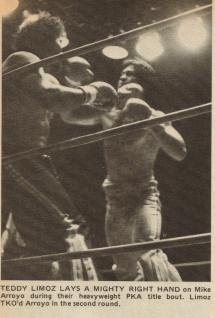
Limoz trains for Karate with Dana Goodson. It is sometimes mentioned that he practices also Kempo. Before this fight, Ted Limoz participates to the First Full-Contact Tournament in Hawaii, in 1975 and beats Augie Evans by ko. Limoz must abandon the tournament, on injury and Evans is qualified to his place, to continue the competition. On 28.08.1976, Limoz beats Mike Arroyo, in Hawaii, during a full-contact fight. Limoz loses the first round, , by not kicking. In the second round, Limoz floors twice Arroyo, a Karate practicioner, with jolting right hands and won by tko.

In all the newspaper articles about Ted Limoz, it is mentioned that he had more street fights than ring fights. He had worked in the building construction.

According to the May 8th, 1990 Honolulu Star Bulletin, Ted Limoz would have been sentenced for manslaughter, to 5 to 10 years term in prison, after a fatal robbery, possibly for drugs (without further clarification and certainty).

He is known as Ted Limoz Sr, (his son is also a boxer) or Teddy, Theodore or Theo Limoz.

Special message :

If you have any information, results, photos about Ted Limoz Sr, or the Tommy Lee's World Series of Martials Arts, in 1974, 1975 or 1976, thank you very much for sending it to me at this address : usakaratestory

Defeat against Scott Ross :

08.24.1975. The match takes place in Atlantic City / New Jersey. Joe Lewis loses against Ross Scott, in a non-title match. Scott Ross has previously disputed only one match in full-contact and can go for a journeyman.

Lewis injures his right shoulder during the match, possibly in the 3rd round, following a blow thrown in the air. The match was stopped for about 5 minutes, leaving time to heal. He continues to fight.

Ross Scott gives numerous kicked in the head of Lewis, who blocked a large number of them. According to "Professional Karate" issue of November-December 1975 and "Fighting Champions" issue of February 1976, and contrary to what has often been reported, Joe Lewis was not penalized for lack of kicking, despite the rule of "Six kicks per round rule " in effect.

Joe Lewis loses on points in 7 rounds, 17-12. Scott won 3 rounds and Lewis 2, the others being considered draw. Both fighters were wounded in the face.

The victory of Ross Scott is a real surprise, Joe Lewis is a precursor of full-contact and seemingly invincible. A very short video of the fight : http://fr.youtube.com/watch?v=RjRxhtFrbQA

Joe Lewis was stripped of his title PKA by Mike Anderson, after these two defeats above cited. His successor is Scott Ross, who beat Johnny Lee for the title, by ko in the 3rd round, in 1976.

His coach :

Joey Orbillo is often cited as Joe Lewis' coach for full-contact. According to the latter, Orbillo would have teach him boxing in 1970, for his first match with ko. Orbillo is also the coach for American fighters, during the evening of September 1974.

Joey Orbillo continues to work with Joe Lewis, until his fight against Ross Scott.

Orbillo is a former professional boxer, with 17 wins, including 9 ko, 4 defeats including one before the limit and a draw. He fights, among others, excellent fighters as Eddie Machen and Jerry Quarry.

Thereafter, Joey Orbillo becomes a policeman in Los Angeles, and after a longshoreman.

2nd Come-Back :

In 1982, Joe Lewis returns to full-contact competition, but never wins the world title. He wins his first fight by ko in the 3rd, against Bill Morrison (10-1 record at this time) in Greenville. Morrison had worked all the day of the fight, then traveled to the fight place. He almost cancelled the fight, but was blackmailed into fighting by the promoter. Morrison said that he was illegally kneed in the face and knocked out. Bill Morrison will end his career with a record of 17-4-1. His defeats were suffered against 4 World Champions, Joe Lewis, Anthony Elmore (2 times) and Demetrius "Oaktree" Edwards. Morrison defeated Big John Jackson in 51 seconds, for the U.S. title. Jackson had taken this title from Ross Scott. Thank you to Bill Morrison for this details.

On February 3rd, 1983, in Charlotte, Lewis beats on points Curtis "Cow-Boy" Crandall (19-2, 10 kos, who has already lost against Don Wilson by tko in the 11th in full-contact, and has two fights, two losses on points in boxing).

Joe Lewis loses (possibly by the way of an injury) against Tom Hall (who lost against Brad Hefton in full contact, on points for the PKA heavyweights title and who has 3, fights, 3 wins by ko in boxing).

Joe Lewis beats Mel Cole (who lost the WKA title against Stan Longinidis, by ko in the first round).

One week before the fight against Roop, for the heavyweight US title, Joe Lewis takes part in an exhibition in 5 rounds, against Anthony Elmore, the PKA Super-Heavyweights World Champion. This exhibition is broadcast on ESPN. Elmore will meet Tony Palmore two weeks after the exhibition, for the world title.

Joe Lewis loses against Kerry Roop and was stopped in the 4th round, by injury above the eye (Kerry Roop has lost three times against Jean-Yves Theriault, two times by ko and once on points and he has also lost against Brad Hefton and Robert Biggs. Roop Kerry has beaten Dan Macaruso for the PKA light-heavyweights title in 1982 and has fought Jeff Smith).

Joe Lewis beats Charlton Young (15-1, 11 kos, practicing Taekwondo) on points in 7 rounds, at the Battle of Atlanta.

Joe Lewis vs Charlton Young

Joe Lewis, left, facing Charlton Young.

Thank you to Tim Ayres for informations. This paragraph is also based on article of the August 1983 Fighting Stars issue.

He makes still a famous exhibition with Bill Wallace in 1990, including the following excerpts: http://www.youtube.com/watch?v=J-bjRT3NQUI

Conclusions :

Many videos about Joe Lewis' fights are available on the Internet. In addition, a video is sold, "Joe Lewis American Fighting Legend" [3], with very short excerpts from his fights.

We note that he had a style, in full-contact, mainly composed of heavy and individually delivered punches.

The iconography is important. However, no site provides an exhaustive list of his fights.

The Joe Lewis's official site makes his personal glory, paints a laudatory career, which excludes any objectivity [4]. This site states that Joe Lewis holds now a black belt 10th dan, and invented a style named Joe Lewis Fighting System. Joe Lewis is quoted as "the greatest fighter of all time", as that would have been awarded by Bruce Lee, or other, depending on the versions.

Record :

It is very difficult to establish with certainty a record for Joe Lewis. According to the various elements, the fights following can be mentioned :

Full Contact, or Kick-Boxing
01.17.1970: GREG BAINES, wko 2 - Long Beach. Kick Boxing Usa
20.06.1970: BIG ED DANIEL, wko 2 Dallas Usa Pro Open
00.00.1970: WALLY SLOCKI, wko 3 Toronto Karate Championship
01.24.1971: RONNIE BARKOOT, wko 1
06.23.1971: ATLAS JESS KING, wko 2 (or wko 3 according to other sources)

1st Come-Back
09.14.1974: FRANK BRODAR, wko 2 Los Angeles-PKA World Champion

Tommy Lee's World Series of Martial Arts, Hawaii
07.27.1975 : RON CLAY, wko1
07.27.1975: TED LIMOZ, lp3

08.24.1975: ROSS SCOTT, lp7 Atlantic-City/N.J.

2nd Come-back :
12.02.1982 : BILL MORRISON w ko 3
00.00.1983 : CURTIS CRANDALL w p
04.16.1983 : TOM HALL, l
07.16.1983 : MEL COLE w
10.00.1983 : ANTHONY ELMORE, exhibition
10.08.1983 : KERRY ROOP, l on cut in the 4hth, for the US heavyweights title
12.07.1983 : CHARLTON YOUNG wp 7
00.00.1990: BILL WALLACE, exhibition

Total final announced in 1990: 18 victories, 3 defeats, 16 kos.
Total found from our sources in 1990 : 15 fights, 11 victories, 4 losses This total is not confirmed in "The Official History of Karate in America" of Al Weiss, which cited 14 fights, 10 victories, 4 losses.

[1] Lewis and his American Karate Systems , Joe Lewis, Jerry Beasley, Paladin Press, 1998
[2] http://www.usadojo.com/articles/history-karate-america.htm
[3] 2006, Masters Martial Arts
[4] http://www.joelewisfightingsystems.com/

dimanche 31 août 2008

"New Gladiators", the karate movie

Introduction :

Without becoming a "must" or a "cult-film", New Gladiators remains as the best karate documentary, concerning the Seventies.

For this article, our sources are the interview with George Waite, included in the DVD, as various articles published on this subject.

Film History :

In 1973, George Waite proposes a movie project about karate to his coach Ed Parker. The latter presents the project to Elvis Presley, his karate student (see article Tournaments and Promoters).

Elvis Presley is excited and gives a check for the film, possibly for USD 50,000 .--. It was decided to follow a US karate team through various journeys in Europe, for tournaments. The initial project also planned to include a karate demonstration, performed by Elvis Presley (see below) and an exhibition, filmed in colour, made by Bruce Lee in 1967, during Ed Parker's Internationals.

Bob Hammer shoots nearly 50 hours of various scenes, in 16 mm of the time. After Elvis Presley's death, in 1977, the sequences have remained nearly 25 years in a car, in George Waite's garage.

Don Warrener, founder of the production company, specialized in Martial Arts, Rising Sun Productions, based in Los Angeles, is a Goju-Ryu practitioner. He was able to decide George Waite to give back his movie. They restore and finally edit a 93 minutes documentary, named "New Gladiators", title possibly inspired by Elvis Presley himself.

David Crosby and Graham Nash, from the famous group Crosby, Still, Nash and Young, made the music.

George Waite was also the editor of numerous documentaries, for example for Disney.

Elvis Presley and karate :

It is very difficult to establish an accurate history of the relationship between Elvis Presley and karate. He started with Shotokan, while on duty in the army. He went to Ed Parker's Kenpo, while also training with Kang Rhee, in Memphis, in a style close to Taekwondo, the Pasaryu. With Kenpo, Elvis has received various degrees, including an 8th dan honorary degree.

Ed Parker and Elvis have organized a seminar in the Tennessee Karate Institute, on July 4th, 1974. Elvis presented also a demonstration in the same Institute, on September 16th, 1974. This demonstration is not part of the film, as planned during the project, for copyright problems. The video also includes a short interview of Jerry Schilling, a producer who worked with Elvis Presley. He explains the history of these images. Bill Wallace makes a short appearance, wearing a Gi similar to the one he wore two days before, during the first PKA championships, on September 14th, 1974.

Elvis Presley et Bill Wallace

The King and Superfoot

According to some sources, Elvis would have even proposed a lot of money to Bill Wallace, for not participating to this championship, for unclear reasons. Video internet address : http://fr.youtube.com/watch?v=qvehGcMMOmY

Elvis also made short demonstrations of Martial Arts, during his concerts in Las Vegas, in August and September 1974.

We will not speak about the lack of seriousness of these exhibitions, but we advise readers to not miss the white shirt with large collar, under the Elvis Gi, as well as his superb red belt. Remember also that according to many sources, Elvis was very generous with his instructors.

The film :

The U.S. team members are John Natividad, Darnell Garcia, Tom Kelly, Ron Marchini and Benny Urquidez and the team is managed by Ed Parker. In 1973, they went to London, possibly at Wembley, for a tournament against the English team, with Eugene Codrington, David Cooper, Ticky Donovan, Graham Mitchell and Toby Francis (phonetic names). The competition took place at the same time that the 10th national championship. Finally, the USA win the confrontation. A short excerpt : http://fr.youtube.com/watch?v=JX5iZRUOBvw&feature=related.

Tom Kelly
Tom Kelly in his works

The same U.S. team then went to Belgium, for a tournament against a team led by Belgian Geert Lemmens. Behind on points, the Americans must win the last fight, disputed between Ron Marchini and Lemmens, to win the teams confrontation. With a hook, Geert Lemmens wounds Marchini's face. The doctors want to stop the fight and referees want to disqualify the Belgian. Marchini refuses and continues to fight. He wins with a kick straight to… his opponent's groin. Without much damage, Lemmens is recovering immediately. Second excerpt : http://fr.youtube.com/watch?v=VGIWdspFxE4&feature=related.

Ron Marchini vs Geert Lemmens

Ron Marchini receives the Geert Lemmens punch

Both confrontations took place without contact and without protection.

Back in the USA. We see the finals, during the 1st Annual Los Angeles Open in 1974. Bob Alegria won these finals.

At the Beverly Hill Invitational, the following fights are represented : Steve Sanders (Muhammad) def Hernandez by disqualification. Roy Kurban beats Blinky Rodriguez, Cecil Peoples and Ray Sua, before beating Steve Sanders during the finals. Fighters are wearing foot protections. Only body contact is allowed.

Finally, during the 1974 U.S. Nationals Championships, with fighters wearing foot and fist protections, light head contact is authorized, as full body contact. Roy Kurban beats first Darnell Garcia, then Benny Urquidez for the finals. Last excerpt : http://fr.youtube.com/watch?v=2ytxHe3YtQg&feature=related.

The April 1975 Black Belt Magazine issue mentions this tournament under the name Western Pro/Am Karate Championships, in Oakland/CA. If the pictures of the fighters in the newspapers are the same as in the film, it is mentioned in Black-Belt that Kurban beats Benny Urquidez in the semi-finals and Darnell Garcia in the finals. This version is confirmed by the March 1975 Professional Karate issue. The movie has probably made the mistake with a false chronology of the semi-finals and finals. The prize-monney for the winner is USD 1,000 .--.

Roy Kurban vs Benny Urquidez
The final bout between Roy Kurban right and Benny Urquidez

The fighters :

Benny Urquidez is the subject of a separate article in this blog.

John Natividad is born in Hawaii. Student of Chuck Norris, practising Tang Soo Do, Natividad retires from the competition in 1975, after winning numerous tournaments in the USA. His most famous battle takes place during Ed Parker's Internationals in Long Beach, in August 1973. He beats Benny Urquidez by 13 to 12, during extra-time.

Steve Muhammad, born Steve Sanders, is one of the BKF founders (Black Karate Federation). He lost a fight against Joe Lewis in 1969. He was possibly stolen. His new federation would have to defend the cause of the Blacks in karate. He is a Kenpo practitioner with Ed Parker and his speed of execution is particularly accurate. More details about his long career are mentioned in this blog in the article about Joe Lewis.

Roy Kurban practices Taekwondo, and retires from competition in 1977, after winning various tournaments. He was an army and police instructor. He also worked as a policeman during 3 years, then served for 16 years as a judge in Texas.

Ron Marchini practices Renbukai (a style near Karate and used mainly in Japan) and lost against Chuck Norris in 1964, during the Tak Kubata's All-Stars Tournament. He later becomes an actor.

Darnell Garcia is an instructor in Chuck Norris's schools. Darnell Garcia wins the Grand Champion Internationals Karate Championships, in 1972, against Joe Lewis. He has written two books, "Explosive Instincts and Mind Power" and "Fighting Art of Tang Soo Do" and worked for various police departments.

Tom Kelly wins the heavyweights All-American Karate Champion title, in 1971, 1972, 1973. In 1972, he lost against Joe Lewis for Grand Champion title ? He practices Kenpo style.

Ticky Donovan was champion of England for many years. He changed style on many occasions, before practicing Isshinryu.

Eugene Codrington, with the United Kingdom team, defeated Japan team, during the 1975 World Championships, in Long-Beach (WUKO). He was silver medallist at the 1977 World Championships, in Tokyo (WUKO).

Geert Lemmens is mentioned in the article about the various federations PKA, WAKO and WKA, for his participation to the WAKO creation. Previously, he took part at the 1970 first karate World Championship in Japan (WUKO).

Conclusions :

The film is described by George Waite, in his interview, as a karate "Endless Summer", cult-film produced in 1966 by Bruce Brown. Like surfers searching the perfect wave, these fighters seek the perfect tournament and opponent throughout this road movie. New Gladiators is less "has been" as Endless Summer, with his long parts without change of pace, and also his annoying comments. The excellent film "Morning of the Earth" by Alby Falzon, produced in 1971, has many similarities with "New Gladiators", more about its music than about its pictures.

We note the huge role played by Ed Parker, in the choice of the fighters (overrepresentation of Kenpo), video with Elvis Presley (his students) and demo with Bruce Lee (made in his tournament).

We could ask about the federation in charge of the U.S. team, presented in the film as the United States of America National Team. This is not the team which takes part at the 1972 Teams World Championships in Paris (WUKO). John Natividad and Ron Marchini have also been released from this team, during the US trials. The fighters of New Gladiators, send to England and Belgium, were not the most famous of the time. Joe Lewis, Bill Wallace, Jeff Smith and Howard Jackson were the top of the list of this period of time.

With this film, we can see Benny Urquidez in traditional karate. At this time, he was not a celebrity. We better understand the slow evolution of the karate to full-contact, in 1974.

dimanche 20 juillet 2008

Karate newspapers history in the USA and France.

Introduction :

Once upon the time, when Internet did not exist and the televisions were not interested in karate or full-contact fights transmission, newspapers were the only source of information about these sports.

Appeared in the USA during the sixties, they arrived in Europe in the early seventies. They sometimes continue to exist even today, after having undergone many changes.

Given the large number of newspapers published between 1960 and 1980, both in the USA and Europe, it is impossible to be complete. We will therefore mention the most famous newspapers, with a short history of their appearance, articles style and interesting examples of coverage.

The newspapers dedicated to several sports will be omitted, except for Black Belt, who, as a precursor, played a big role in the popularization of karate. The federation’s newspapers will not be cited. The "Yearbooks" will not be discussed, even though they were very popular.

We are not able to cite the publication numbers, but these data seem unfortunately not be available so far.

Black Belt :

The most famous of all, Black Belt Magazine, continues to exist today.

The first issue was released in April 1961 and it cost only 50c, subscription for one year amounted to U.S. $ 3 .--. Black Belt was founded in Los Angeles by Mito Uyehara, an aikido practitioner, and his brother Jim.

The newspaper was concerned by many martial arts, as today.

Ring Magazine

In the late sixties, Mito Uyehara has remained alone at the head of the magazine. He also published numerous books, with the Ohara Book Distribution firm and participated in the production of martial arts movies.

In a June 1968 article, Mr. Uyehara complains about the Italian “Cintura Nera” newspaper, (which means black belt too), which copy his Black Belt articles.

Since 1974, Rick Shively becomes publisher of Black Belt, Uyehara remaining chairman.

Mito Uyehara also published Karate Illustrated (see below) and Fighting Stars, dedicated to celebrities practicing martial arts. The Rainbow Publications company was also involved in Black Belt and Karate Illustrated.

Very traditional, Black Belt did not participate in the launch of full-contact, criticizing this practice and stating its dangers for health and the purity of martial arts. It has changed since then.

It should be noted that Black Belt has remained almost 9 years without serious competitor and only the martial arts fever has allowed the emergence of other journals.

This newspaper should not be confused with "Action Black Belt", published between 1974 and 1975. We know nothing about this review.

Black Belt Action

It might be a more “full-contact” Black Belt, published in order to diversify the choices available to readers.

Karate Illustrated :

Also published in 1969 by Mito Uyehara. Dick Hennesy, a former Black Belt employee, is also publisher.

Karate Illustrated

As Official Karate, published shortly before, Karate Illustrated style becomes more incisive. It will also monitor the development of full-contact.

Fighters :

This review was affiliated with Karate Illustrated. More specialized in full-contact, we have found only that copy. It seems to be published between 1974 and 1975.

Fighters

Official Karate :

Al Weiss is the Official Karate founder and he works for it from 1968 to 1986. He was a karate Goju-Ryu black belt, as Aaron Banks, who worked also for this magazine. The first issue we have found is here represented. It could be the number 1, published in June 1969.

Official Karate

The above articles seem very modern, compared to its competitor Black Belt.

This newspaper has been very open to full-contact.

A particular version is also published under the name "Official Karate Special Fighting Champions", from 1974 to 1977 approximately.

Official Karate Fighting Champions

It became increasingly devoted to full-contact, giving many details about the various fights of this time.

Another edition called "Official Karate Defense Combat" presented self-defense techniques.

The Al Weiss book named "The Official History of Karate in America", was about the karate history in the USA, from 1968 to 1986, and was containing former Official Karate articles.

Professional Karate Magazine :

According to our information, the first title was released in the summer 1973. It was published by Mike Anderson (see article devoted to him in this blog, under Tournaments and Promoters).

Professional Karate Magazine

The main feature of this newspaper is the monthly published Top Ten of the best fighters. At the beginning, it was concerning professional karate, and after full-contact, sometimes even mixing the two styles. Previously, Black Belt had only annual rankings.

This newspaper has been heavily influenced by the tournaments organized by Anderson, but it also refers to those promoted by others "matchmakers".

In his 1974 Summer issue, Mike Anderson writes about the irregular publication problems of his newspaper and pledges as Managing Editor John Corcoran, a famous journalist in this sector (see below) and Bob McLaughlin.

This newspaper had still very long articles over fights techniques. Among the contributing editors were Aaron Banks, Joe Lewis or Ed Parker.

Many cite the totally innovative role of this newspaper. It was not always independent of the Professional Karate Association, a time managed by Mike Anderson.

The latest issue seems to be published in 1976. This newspaper has suffered from financial losses.

Oriental Fighting Arts :

This newspaper, published by Abe Gaskin, among others, had as Technical Advisor Aaron Banks (see the article in this blog Tournaments and Promoters). Banks also worked as editor and appears to have played a major role in the magazine, which began in July 1974 and disappeared in 1976.

Oriental Fighting Arts

Firstly dedicated to various martial arts like Kung-Fu, it has diversified in articles on fighting techniques, and then on the results of various tournaments, both in traditional and full-contact, organized by Aaron Banks or other individuals. The magazine was also often dedicated to Aaron Banks’ personality.
A newspaper called "Oriental Combat and Self Defense" was a partner.

World Karate :

The newspaper was also published by Aaron Banks, from 1976 to 1982/1983. One of the coverage is advertised as the official WPKO journal, his federation. The August 1976 issue is represented below.

World Karate

Few articles were devoted to the championships, but rather to the personality of fighters. They were also often devoted to Aaron Banks himself.

Contact Karate & Fighting Stars :

We only know that it was a magazine published during the year 1976.

Contact Karate

His relationship with the newspaper Fighting Stars (see Black Belt) is not known. It could be the temporary unification of Fighting Stars and Action Black Belt (disappeared in 1975), but we must point out that Fighting Stars has continued to appear under this name, after 1976.

John Corcoran :

It is impossible to write about newspapers in the U.S. without citing John Corcoran’s personality, given the number of articles published in various magazines above.

John Corcoran began in Black Belt and Karate Illustrated, in the seventies. Since 1974, he helped Mike Anderson for Professional Karate Magazine. He was accompanied in this transfer by Bob McLaughlin, who took charge of the article about the 14 September 1974 first PKA World Championship, in Los Angeles. John Corcoran has also worked with Bob Wall, for his book "Who's Who in the Martial Arts".

Corcoran has published a reference book called "The Original Martial Arts Encyclopedia", published by Pro-Action in 1993 (130,000 unities sold).

He is considered as one of the best journalist in this style, his qualities of black belt owner giving him a big credibility.

France :

The karate newspapers appeared later in France. We begin by quoting the newspaper Budo. It was the heir of Budo International, which was dedicated to French Judo. Budo, very innovative, is published in 1973, with articles on various martial arts. We can compare it to Black Belt, as a trigger of a journalistic style, for France.

Journal Budo
Budo No. 4, April 73

Karatékas :

Since 1974, a quality newspaper is published under the name Karatékas. Deeply committed to traditional karate, it was highly critical against the full-contact. Here are some covers of this journal. It ceased publication a few years later.

Journal KaratékasThe first issue was written about Europe traditional karate championships and Dominique Valera, with a kata represented on a poster.

Karaté :

The first Karaté newspaper is published in October 1974. Firstly dedicated to traditional karate and the martial arts fever, with Bruce Lee, the newspaper turned to full-contact at the end of 1975. It has long accompanied Dominique Valera in his American journey and learning of this new style.

Journal KarateA character in the newspaper was Rolland Gaillac. The latter, former singer in a band called "The Brummells", became editor of the teenager’s magazine "Salut Les Copains". He also produces for "France Routiers", writing books on trucks, with the famous Max Meynier, from the RTL radio.

Rolland Gaillac will lead Karaté, for many years, interviewing Gochin Yamagushi among other great masters.

The Karaté publisher was Jean Nouailhac, from the Editions de France.

A Karaté international version was published in the USA, Germany and Belgium. For example, Budo Karate Journal is the inheritor of this version. French articles were simply translated into German, with a different cover.

A true phenomenon, Karaté became Karaté Bushido and continues today, having diversified itself in mixed arts, as MMA.

Nostalgia :

The old-fashioned style of these magazines is very impressive. The advertisement was designed and samurai stories occupied many pages.

Besides, the pleasure of seeing the new number in the window of the seller or in his own mailbox was undeniable.

Conclusions :

The tournaments and fights were detailed in such a way the reader can “see” them, without the help of the television.

These magazines had the way to ask every month the same questions, such as "should full-contact be forbidden ?" or "should women fight against men ?" and the traditional "karate should be professional ?".

They did not seem to be independent of the organizers, who were often the editors or owners of these newspapers.

Several reviews were partners, sometimes more specialized in full-contact or self-defense techniques.

The reviews had problems to specify the tournaments dates and their final results, which were never mentioned in the form of a summary, at the end of the article, as in Europe.

The issues date were not accurate. For example, the September 1974 PKA World Championship article was published in the Winter 1975 Professional Karate issue and the May 1975 WPKO World Championship article was published in the September 1975 Oriental Fighting Arts issue. Were the newspapers appearing with an upcoming date of edition to attract customers or did they need several months to publish their articles ? But that's another story...

jeudi 3 juillet 2008

Tommy Lee's World Series of Martial Arts Championships

Introduction :

The Worlds Series of Martial Arts Championships (WSMAC) represented one of the most important development of the fights with ko, even if this series have left less traces than the 1974 first PKA World Championship, for example. It is therefore interesting to go back on these series, which made fighters famous, as Benny Urquidez, for example.

This article is mainly based on November 1975 Oriental Fighting Arts magazine, March and June 1975 Professional Karate magazines and November as December 1975 Black Belt magazines.

Despite this abundant literature, it is difficult to determine the exact dates of these series and the personality of their founder, Tommy Lee. We can not guarantee the accuracy of what is following.

Background :

The first PKA World Championships have already taken place in Los Angeles and the professional American karate is disappearing. At this time, the mixed fights between various sports are not practiced in tournaments.

Tommy Lee :

Tommy Lee, of Asian origin, is known in Honolulu/Hawaii, as a famous surfer and a surf hardware trader. He associated with a producer named Marty Mains (Mardy Mains, possibly a lady).

Tommy Lee, Benny Urquidez, Marty Mains, Everett Eddy

Tommy Lee, Benny Urquidez, ?, Everett Eddy

Rules :

They decided to create a "no-rules" tournament. It seems impossible. Various masters came to Hawaii, to decide rules. The blows are accounted with a points system. The takedowns are accepted, as immobilizations. The win can also come by the way of the ko.

Fighters will be protected with Safe-T, or Jhoon Rhee protections, and all areas intended for delivering blows or strikes must be padded (for example : elbows). It is forbidden to hit some parts of the body .

The fighters may come from various sports.

1st Serie : November 14th and 15th, 1974. Honolulu/Hawaii

This first round has no weight division. A total of USD 10,000 .-- is to divide between the fighters, the last winner won USD 5,000 .-

At the end of the first day, 16 finalists are designated, according to their results :

Blinky Rodriguez beats Dennis Lyttle, video http://fr.youtube.com/watch?v=DvB5xnKF1t0.
Smiley Urquidez loses against Burnis White.

Dana Goodson beats :
Jack Atkins by ko in the 1st round
Blink Ordelies on points
Blinky Rodriguez on points, http://fr.youtube.com/watch?v=xTCRxRcBh48.

Benny Urquidez beats:
Futi Semana, ko in the 2nd
Tom Mossman, in the 2nd
Burnis White by ko in the 2nd
Billy Rosehill by kot in the 3rd. This fight was not the semi-finals, as mentioned in Oriental Martial Arts magazine.

Rosehill practiced Taekwondo (as Judo and Ju-Jitsu) and it is his single combat in WSMAC. This tournament was advertised in Hawaii and he simply enrolled. Thanks to him for information.

In the finals, Benny Urquidez, natural lightweight, beats Dana Goodson on points. Goodson measures 6'1'' and weighs 230 lbs. Urquidez has managed to send his opponent to the canvas and to pin him for 5 seconds. His superior physical condition has enabled Urquidez to dominate his opponent, video http://fr.youtube.com/watch?v=yblJ9VqHW8w. Thanks to Shawn for his marvelous videos.

Benny Urquidez Dana Goodson World Series of Martial Arts Championships
Finals: Benny Urquidez, left, vs Dana Goodson.

This serie is a financial fiasco.

According to the Urquidez record, from his book "King of the Ring", it is possible that there was a fight in Hawaii, for the WSMAC, in December 1974. Benny Urquidez beats Burnis White, by ko in the 4th ?

2nd Serie : May 16th, 1975. Los Angeles Sports Arena

Since this series, weight divisions appear. 7,000 spectators are present.

For the lightweights, Benny Urquidez beats Roland Talton, by ko in the 2nd. Talton is chairman of the BKF (Black Karate Federation, created after a non-deserved defeat of Steve Sanders, alias Sijo, against Joe Lewis, in traditional Karate). Roland Talton had already won by ko against Bill Owens in 1974 at a full-contac tournamentt named The Black Dragon Martial Arts Show. During this same tournament, Talton lost against Sammy Pace, on points.

Bill Henderson (Kung Fu) def on points Manny Charusarn, a Thai kick-boxer. Manny Charusarn has already beaten Steve Fischer on points at the Black Dragon Martial Arts Show in 1974. Charusarn beats Manuel Urquidez in the finals of this tournament.

In the finals of the WSMAC, Urquidez beats Bill Henderson by standing tko in the 2nd round. Video of the fight : http://www.youtube.com/watch?v=iUyyvUF6VUk

In the heavyweights, Everett "Monster Man" Eddy beats Sam Pace (also BKF), with a hard ko in the 2nd round, with a series of kicks and punches. Sammy Pace had already beaten Choo Choo Mayes and Roland Talton at the Black Dragon Martial Arts Show in 1974, a full-contact tournament. Dana Goodson beats Ken Bell, by ko in the 3rd.

In the finals, Everett Eddy beats Dana Goodson. Video of the fight : http://www.youtube.com/watch?v=Ba9AgpwW-8c Thanks to David Leonardo for his details.

Everett Monsterman Eddy Dana Goodson
Everett "Monsterman" Eddy (left) vs Dana Goodson

3rd Serie : June 21st, 1975. Honolulu/Hawaii, H.I.C. Arena

Only 12 fighters are selected for this series. Each division winner receive USD 3,000 .--.

In the lightweights, Benny Urquidez beats Sanun Plypoolsup, a Thai kick-boxer, by tko, who was allegedly the 2nd in the Asian Games. Benny receives kicks in the legs, but his opponent loses, following an face injury.

Benny Urquidez Sanun Plypoolsup
Benny Urquidez (right), in a rare position, pinning Plypoolsup

Burnis White (taekwondo) def Cecil Peoples, on points. In the finals, Urquidez beats White by tko in the 2nd. White had injured his foot.

Farrell Sojot loses against Augie Evans, in the 2nd round. Reggie Padilla beats Duke Domen, by ko in the 1st round.

In the heavyweights, Victor Rapoza, practicing Kenpo of Hawaii and starting in full-contact, beats Chris Michael, by tko.

Victor Rapoza Chris Michael
Victor Rapoza (right) against Chris Michael

Everett Eddy beats on points Duke Sabedong, an old boxer with 17 victories (12 by ko), 16 losses, (4 by ko) and 2 draws. From Hawaii, Sabedong is already 45 years old. He lost on points in ten rounds, in 1961, against the young Muhammad Ali (Cassius Clay at this time). His career has been stopped in 1964.

In the finals, Victor Rapoza beats Eddy, by ko in the 2nd. The latter had already been beaten by ko, on June 8th, 1975, against a boxer named Horst Geisler, during a mixed fight.

4th Serie : July 27th, 1975. Honolulu/Hawaii, HIC Arena

There are 4 weight divisions.

The Thai kick-boxer Buthsombat wins his first match, against Jang Hee Pak. Mike Rodriguez beats Steve Murakami, via disqualification. In the finals, Buthsombat beats Rodriguez.

In the middleweights, Land is disqualified and Sam Pace is qualified, as Burnis White, who has beaten on points Keoni May, a Wado Ryu and Muay Thai practitioner. Keoni May has taken part in three WSMAC and has also fought in his career a total of three times against Burnis White. In 1974, Keoni May has beaten a Win Chu practitioner from Hong Kong, by ko in the 2nd round. Keoni May has also beaten Mike Frazier. He is now an Aikido teacher. Thanks to Keoni May for information. In the WSMAC finals, White beats Sam Pace, by ko.

In the light-heavyweights, Augie Evans wins his first fight and Jeff Smith (PKA full-contact World Champion since 1974) def Ben Wilbor, by tko in the 2nd. In the finals, Smith beats Evans, by tko.

In the heavyweights, Teddy Limoz beats Ken Bell , by tko in the first round.

Joe Lewis (PKA full-contact World Champion since 1974) def Ron Clay, by ko in the 1st round. Link to the video of the fight : http://fr.youtube.com/watch?v=fszI5BJQQKk

In the finals, Ted Limoz beats Joe Lewis, on points. These struggles are detailed in the article devoted to Joe Lewis, in this blog, .

It should be noted that the fighters were wearing protective elbows and therefore had the right to use these body parts to hit their opponent. It does not seem that the projections and immobilizations have been used during the fight. On the video, we note that Ron Clay employs the knee blows.

Serie no ? : 01.10.1976, Hawaii.

We are not sure of what is following. Ross Scott beats Victor Rapoza by ko. According to the March 1980 Black-Belt issue, they made a draw. During the same day, Dana Goodson def Ross Scott by ko. It was not PKA title fights. According to others sources, the Ross Scott vs Dana Goodson fight took place in 1981 ? Burnis White, announced as the world middleweights champion, practicing Tae Kwon Do and Wu Shu Boxing, meets Glenn McMorris.

World Series of Martial Arts Championships posterPoster of 1976 WSMAC

Other WSMAC ? :

Without being able to be affirmative, it is possible that other WSMAC have taken place thereafter. On the Benny Urquidez record, we find :

October 12th, 1975, Los Angeles

Benny Urquidez beats Bill Henderson, by ko in the 2nd ? Is it the same fight as above mentioned ?

June 18th (or August) 1976, Dallas

Benny Urquidez beats Sanun Plypoolsup, on points in 8 rounds.

What for a tournament ?

In the November 1976 Black Belt issue, a report mentions a tournament in Hawaii, with a team of the island against a team from Hong Kong. Burns White beats Mark Costello, by decision in the 1st round, before beating Freddie Avilles in the finals, on points.

A kick-boxer, Charley Juail and a freeform-fighter Cisco Labuanon beat their opponents of Hong Kong, while John Han beats Ho Tung Kai in 35 seconds. Finally, in the heavyweights, James Dwight beats Triplett Honest.

If this meeting is not mentioned as a WSMAC, pictures show fighters with the same protections on the elbows, not to mention that Burnis White was also part of WSMAC.

If you have more information on WSMAC and Tommy Lee,
please send me a message.

Where are they now ? :

We will not talk about Joe Lewis, Jeff Smith and Benny Urquidez. They are each the subject of a separate article in this blog. Ted Limoz is also widely mentioned in the article devoted to Joe Lewis.

Regarding Dana Goodson, in 1975, a tournament is held in Hawaii, under the name First Full-Contact Tournament. Dana Goodson loses against Augie Evans.

Dana Goodson is a practitioner of Kempo Karate. He practises also boxing (4 wins, 1 draw, 1 defeat from 1978 to 1983), Thai-boxing and Full-contact. He loses against Maurice Smith, in a title fight.

Victor Rapoza is a retired fireman, and is working now in the Ice House, at the Wai'anae Small Boat Harbor/Hawaii. We are also looking for information, about his fights record. We know that he has beaten Carlton Morris in 1976.

Burnis White is currently announced as a 6th level of Puma System, "Pacific Unified Martial Arts", a mixture of various American martial arts styles. In 1977, he will lose on points in Hawaii, against Bill Wallace, for the PKA middleweights title. The final record for Mr White is 30 wins (25 ko) and 3 losses. Thank you to him for his information and pictures.

Everett "Monsterman" Eddy is a leading figure of the U.S. karate and full-contact. He will lose against Scott Ross for the title and against Antonio Inoki, in a mixed fight. Cecil Peoples is also a famous fighter of this period.

Conclusions :

We know, unfortunately, nothing about the Tommy Lee's career as an promoter.

It should be noted that a large part of the fighters were coming from Hawaii, and were sometimes beginners.

As a mixed fights background, we mention a fight between boxing and judo, with the fighter Milo Savage (39 years old, 49 wins, 44 lost, 10 drawn) opposed to Gene LeBell, (31 ans), in 1963. This fight ended with the victory of the judoka Lebell , in the 5th round, with a neck choke (or a strangulation). The fight, obviously not fixed, can be seen at : http://www.worldblackbeltvideo.com/video/40/Gene-LeBell-vs-Milo-Savage-34

The WSMAC have been one of the first versions of mixed fights, which become very long after the UFC or MMA. Very precursors, they combined already blows, throws and immobilizations.

It is surprising that, at the end of WSMAC, such a long period has lasted until UFC and other tournaments will come, in the nineties. Various independent initiatives have existed, such as little serious battle between the boxer Muhammad Ali and the wrestler Antonio Inoki, in 1976, or Satoru Sayama (Tiger Mask) vs Mark Costello in 1977.

dimanche 15 juin 2008

First WUKO and IAKF World Championships

Introduction :

This article analyses the creation of the first WUKO and IAKF World Championships from 1970 to 1977, the time during which they had only one weight division.

To remain in the subject, we will not return to the Championships in Europe or Asia. We do not mention the other federations, which have organized other World Championships, given their little importance.

Background :

To fully understand the context of amateur Karate at this time, let remind that a schism has existed for a long time between various Japanese federations, the JKA (Japan Karate Association) and the All-Japan University Karate League. The FAJKO, All Japan Karatedo Federation Organizations, brought together for a short time, most of these divergent federations.

Me Hidetaka Nishiyama :

It is necessary to introduce one of the main characters of Karate at this time, Me Hidetaka Nishiyama. The latter begins his karate learning with Me Gichin Funakoshi himself, in 1943. Nishiyama is one of the founders of the JKA, where was also Me Hirokazu Kanazawa. Nishiyama settled in the USA in 1961 and created the All American Karate Federation (AAKF).

Taiji Kase vs Hidetaka Nishiyama

1950: Taiji Kase (left) vs Hidetaka Nishiyama (right)

USA vs Japan, 1965 :

March 1966 Black Belt magazine. Nishiyama organizes a first meeting between Japan and the USA in 1965, in Los Angeles. It takes place after the National Championships of the All America Karate Federation (AAKF). Japan is represented by the All Japan Collegiate Karate Team. The American team members are Frank Smith, Harry Kresse, Takashi Aoki, Dalke, Jack Webb and the coach is Gene Takahashi. Frank Smith loses against Yoshitomo Nagasawa. The only American winner is Dalke, beating Masaru Tokai. The Japanese are the winners, by 4 to 1.

2nd Goodwill Games, Tokyo, 1967 :

According to January 1968 Black Belt magazine, the All America Karate Federation USA team beats the All Japan Collegiate Karate Federation team in Tokyo, by 3 to 2. Frank Smith meets Tadahiro Kurozumi and Paul White meets Takenobu Okuno.

Frank Smith vs Yoshimoto NagasawaFrank Smith (right) vs Yoshitomo Nagasawa

1968 : World Invitational Karate Tournament

This paragraph is based on the article published in the No. 11/1968 issue of the German Judo/Karate federation journal.

From October 19th to November 14th, 1968, 4 world karate tournaments are held in the USA (Los Angeles, San Francisco, San Diego) and Mexico City. 5 regions are represented, from Europe (Italy, Germany and England), Japan, Mexico, South America (Argentina and Uruguay) and the USA. Me Hidetaka Nishiyama organizes these tournaments. They are open to all styles. It is therefore a first step to the World Championships. The results are:

10.19.1968: Los Angeles. 19th Olympic Commemoration Invitational World Karate Championship Tournament.

The two above mentionned paragraphs are based on the February 1969 Black Belt issue. The Japanese are 7 fighters in their team and Europeans only 6. American Team, almost composed of AAKF fighters, include Frank Smith, John Gehisen, Ray Delk and James Yabe.

Southern California beats Europe (Falson, Ottagio and Paris for Italy, Sherry, for England, Popp in Germany) by 3 to 2.

Japan beats Southern California by 3.5 to 1.5 or 3 to 2, depending on the version.

Frank Smith vs Masayoshi Yamagami

Frank Smith, left, beats Masayoshi Yamagami.

An individual tournament takes place thereafter. Frank Smith loses his second match against Katsuyuki Miara. James Yabe loses against Yanagida. 4 Japanese are in the semi-finals and Tabata beats Ohishi in the finals.

San-Francisco: Goodwill match and Fourth All America Karate Federation Championships.

In individuals :

Frank Smith def Miyake in the semi finals and Sasano/Hawaï in the finals, for AAKF title.

Teams competition :

Europe beats Northern California 3 to 2

Japan beats Northern California 5 to 0

10.25.1968 : San Diego.

Europe beats the United States Collegiate All Team 3 to 2
The All Japan team beats the United States Collegiate Team 3.5 to 1.5

11.04.1968: Mexico: 19th Olympic Commemoration Invitational World Karate Championship Tournament.

The fighters have been selected during national tournaments and form five teams of the above mentioned regions. Results :

1st: Japan (undefeated)
2nd: USA
3rd: Europe
4th: Mexico
5th: South America

A congress is held at the same time in Mexico. The creation of a world federation and of the first World Championships is mentioned.

Ryoichi Sasakawa :

We are obliged to raise this personality at this point of our article. We will avoid sensationalism and we do not pronouncing on the facts of the following. On the Internet, in detailed articles, like those available at the following address, http://www.voltairenet.org/article13907.html, Http://en.wikipedia.org/wiki/Ryoichi_Sasakawa, it is often mentioned that Sasakawa was a member of various Japanese pre-war secret societies, which brought the territories occupied by Japan in cutting-settled.

He was arrested in 1945, as war criminal, before being released in 1948. Member of the yakusas, he put his services to Americans and anti-communist, while developing his economic activities.

Ryoichi Sasakawa Karate WUKO


Mr. Sasakawa's bust in the WHO, Geneva?

He became immensely rich. Sasakawa made philanthropies and sponsored sports activities. He became president of the FAJKO and the WUKO (see below), with his financial capabilities made to their development.

WUKO :

October 1970 : 1st World Championship (Tokyo)

In 1970, Jacques Delcourt/France created the International Karate Union (IKU). He wants to organize the first World Championships in Paris, the same year. Various discussions were held with Ryoichi Sasakawa.

The FAJKO enter into an agreement with the European Federation (EKU), recognizing it as a governing body for Europe and leaving to Japan the task of organizing these first tournament. Championships have already been announced in Paris for 1972.

Details on the Championship are taken from the number of March 1971, Black Belt Magazine and the number 11/1970, German federation Judo journal.

A stormy congress is held before the tournament. The WUKO, World Union of Karate-do Organizations, is nevertheless created at the time.

The championships organization was made during the last months. All major styles of karate are invited. According to some sources, the Japanese masters, based in various countries, selected fighters to send to the championships.

The first World Championships were held on October 10th, 1970.

Team's tournament :

There are 40 Japanese referees and only 2 referees from other countries.

Japan has 5 teams, the USA 4 and the other countries one.

Among the selected U.S., were included Ron Marchini and Mitchell Bobrow, well-known in various U.S. tournaments. Difficulties have existed during the selection of the fighters, between practitioners of typical Japanese or more American styles. The Americans have had to pay themselves, between $ 1,000 and U.S. $ 1,500 .--, to go to Tokyo. The teams are composed of 5 fighters. Results:

The U.S. B team, led by Tonny Tulleners, meets Korea, Hong Kong, France, Team B and E, Japan. Only these two last teams beat the U.S. B team. Tulleners and Takada of Japan remain unbeaten during the team's tournament. Against the Japan Team E, in semi-finals, Bob Shapoff loses against Oishi, James Yabe draws againstYazawa. John Gehlson draws against Tanaka and Tonny Tulleners beats Nakamura via Ippon. In the last fight, Georges Sasano loses against Ida.

The results:

1st Japan E
2nd Japan C
3rd Japan B
4th USA B

It is sometimes mentioned that the French Team wins bronze medal , in 1970 ,in Tokyo. The American newspapers of the time, as Black Belt in February and March 1971, suggested that the team USA B finished 4th, after having beaten France. The first three teams are Japanese. To avoid controversy, we join the page of the newspaper No. 11 of 1970, from the German federation, showing the matches between teams and mentioning the elimination of France in the quarter-finals, http://www. chronik-karate.de/material/1970_11_DJB-Magazin.pdf

Down left, a reference to the elimination of France by the USA.

To be complete, the excellent French site http://senseiruns.free.fr/index.php?page=pionniers presents this image, showing the French team as bronze medalist in 1970 ?

Who was bronze medalist in 1970 ?

Individuals :

In Osaka, 3 days after the teams Championship, the "Friendship Tournament", organized first as a non-title tournament, becomes known thereafter as the first individual World Championship. It is noteworthy that Black Belt Magazine already talked about it as such.

At the individual tournament, only two fighters pro nation are engaged, for a total of 48 fighters.

According to the rules, a waza-ari does not automatically give the win, but can give the decision at the end of the fight. The fight duration has been limited to 2 minutes, with 2 times 2 minutes over-time, if necessary. The results:

For France, Dominique Valera and Gilbert Gruss are present, as the German Richard Scherer and the Belgian Geert Lemmens. For USA, Tonny Tulleners and Ernie Brennecke represent this country. Tulleners was qualified for this Championship, preferably to Marchini and Borbrow, given his victories, without defeats, during 4 teams tournament held earlier in Tokyo. Tulleners is 24 years old and teaches karate. He was before a undercover policeman. Brennecke, qualified in individuals, has not participated to the teams tournament.

It would appear that no representative of the Korean Taekwondo and of Okinawa karate are present.

Quarter-finals :

Tulleners/USA def Takada/Japan. Cemovic is disqualified against Carno/Canada. Valera beats Jorga/ Yugoslavia. Scherer/RFA loses against Wada/Japan

Semi-finals :

Carnio beats Tulleners. Valera loses against Wada.

Finals :

Wada def Carnio.

Wada Dominique Valera Karate
Wada (right) vs Dominique Valera

We mention the presence of a woman from the Philippines team. She get a draw during a fight.

April 1972: 2nd World Championship (Paris)

This paragraph is based mainly on the article published in June 1972 issue of the Black Belt Magazine.

Japanese masters are again responsible for the selection of American fighters, as Me Nishiyama. There is a disagreement between the various American federations.

Regarding American selections, the article in Black Belt, refers to a qualification tournament held on March 5th, 1972, at Los Angeles and organized by AAKF. Several American federations refuse to take part or are not invited.

Mainly followers of traditional Japanese karate are selected. The winners are James Yabe, James Field Jr., Tonny Tulleners, Jerry Morrone, George Byrd, Frank Smith, Dave Vaughan and John Gehlsen. Ron Marchini is eliminated during the finals.

It is noteworthy that John Natividad, practicing Tang Soo Do, a student of Chuck Norris, was disqualified for hitting with to much contact.

In the August 1972 Official Karate issue, Jacques Delcourt, the president of the European Karate Federation, says he had problems to organize an American selection. He asked Mr. Uyehara, manager of the Black Belt magazine, to contact, among others, Ed Parker, Jhoon Rhee and Robert Trias, to organize a all styles selection. It was without success. Jacques Delcourt was contacted by Mr. Nishiyama, who will be responsible for this selection, via the AAU. Jacques Delcourt notes that the professional fighters are not allowed and that there are few Americans among the officials.

The Championships take place in Paris, in the Stade de Coubertin, on the 21st and 22nd April , 1972. The ticket price is between USD 6.-- and 20 .--. Each team member receives USD 22.-- per day, for his expenses. On April 19th, a referees selection will be made, after a clinic. On April 20th, a congress is organized and on April 23rd, a visit in Versailles is planned for the fighters.

Teams tournament :

The England team eliminates Japan. The French eliminate the English, before beating the USA. In the finals, France meets Italy. François Petitdemange beats his opponent, as Alain Setrouk. The Italian Guy Falsione beats Guy Sauvin. Valera gets a draw. Gilbert Gruss beats Schiappacasse. France wins the gold medal.

Gilbert Gruss François Petitdemange Gyu Sauvin Alain Setrouk Dominique Valera France team

1: France (Gilbert Gruss, François Petitdemange, Guy Sauvin, Alain Setrouk and Dominique Valera)
2. : Italy (Parisi, Schiappacasse, Munda, Fassione, Falsoni?)
3: United Kingdom
4: Singapore

Individuals :

According to some versions, Americans, Canadians and Japanese would have withdrawn, given the problems encountered with the referees, during the teams tournament. The results:

1st Luiz Tasuke Watanabe/Brazil
2nd William Higgins/G.B.
3rd Guy Sauvin/France
4th Schupter/Yugoslavia

Luis Tasuke Watanabe was born in 1947 in Japan and has settled as a child in Brazil.. During the tournament, he beats Luciano Parisi/Italy, Bam Bang/Indonesia, Istvan Sipter/Yugoslavia, Ticky Donovan/Great Britain, Ken Wittstock/South Africa, Huber Louis Meyer/Netherlands, Guy Sauvin/France and William Higgins/Great Britain.

Luis Tasuke Watanabe vs William Higgins

Watanabe, left, vs Higgins

William Higgins will be further team gold medallist in Los Angeles in 1975, and will also practice for the AIKF. He practises Wado Ryu style. Guy Sauvin, 28 years old, has already been the same year France and Europe champion. Thereafter, he will remain for many years National Technical Director of the French Karate.

October 1975: 3rd World Championship (Long-Beach)

This article is based, on the February 1976 issue of Karate Illustrated magazine and on the number 1/1976 German federation Karate journal.

Initially, this Championship was scheduled for 1974, but difficulties between federations have postponed it for a year.

For the American selections, a preliminary tournament brought together 26 fighters at Long-Beach. Many among them have paid themselves the costs. Huey Daniels, Kenneth Ferguson and others are selected.

Before the World Championships is held the WUKO congress, on the Queen Mary, in the Los Angeles harbour. The French Jacques Delcourt is the Chairman. Some karate teams are also sleeping on the Queen Mary.

The role of sponsor of President Ryoichi Sasakawa is mentioned on many occasions, with the risks of interference in the decisions, because M. Sasakawa brings his financial help to the WUKO. The role of the Japanese federation FAJKO, inside the WUKO, is observed (the two entities are sharing the same building).

Regarding referees, a clinic is held prior to the competitions. A first session was held in Tokyo, two months earlier. The rules comprise 36 pages. The referees made a written test and a practical test. 46 referees receive their certification.

The fights take place at Memorial Sports Arena, Los Angeles. According to the organizers, during the two days, 6000 people have visited the tournament, for 14,000 seats. Other sources cite only a few hundred spectators.

Teams tournament :

30 teams are present, one for each country. The results:

1st: Great Britain: (Brian Fitkin, Eugene Codrington, William Higgins, Adams and Bennett)
2nd: Japan (J. Hamaguchi, Kazusada Murakami, Yoshikaz Ono, Tsuchiy, Yonimitsu)
3rd: Netherlands

Britain has beaten South Africa, Philippines and Belgium, then Japan in the finals, by 2 to 1. Japan has beaten New Zealand, Switzerland, Singapore and Netherlands. France (title holder) is beaten in the first round by Australia, Germany by Philippines and the U.S.A. by Belgium.

Individuals :

The second day, 130 fighters from 34 nations compete for the title. 4 combatants are allowed pro nation. Following the injuries occurred during the teams tournament, protections hands are introduced. The results:

1st: Kazusada Murakami/Japan
2nd: Juni Chiro Hamaguchi/Japan
3rd: Pedro Antonio Rivera/Dominican Republic
4th: Roger Paschy/France.

Kazusada Murakami

Murakami (right), 1975 World Champion

In semi-finals, Hamaguchi beats Rivera and Murakami def Roger Paschy. Rivera def Paschy for the third place.

Video are available on You Tube, the address: http://fr.youtube.com/watch?v=5ijFbF5SYpI, http://fr.youtube.com/watch?v=pDnfc4aKv1M and http://fr.youtube.com/watch?v=PpJOkj8dzA4.

Demonstrations made by Bill Wallace, Al Dacascos, Fumio Demura and Dan Inosanto, are available on You Tube. Fighting women have taken place during this championship, without further precision. The Championship was a financial failure.

For those who would be interested in the incident created by Dominique Valera, during these championships, please refer to the article which is devoted to this fighter, in this blog.

1977 : Fourth World Championship (Tokyo)

These Championships take place in Tokyo. 400 karatekas from 47 countries are participating.

Teams tournament :

1st: Netherlands, with Fred Royers
2nd: RFA
3rd: France
4th: Iran

Individuals :

1st: Otti Roethoff/Netherlands
2nd: Eugene Codrington/United Kingdom
3rd: Chen Chien/Taiwan
4th: Jean-Pierre Carbila/Spain

Thereafter, the WUKO World Championships will include weight divisions.

IAKF :

Background :

The third WUKO World Championships are scheduled for 1974, also at Long-Beach. Any problems between federations create a schism. Me Nikiyama, former vice-president of the WUKO, then organizes his own World Championship, with representatives of the JKA. He founded the IAKF (International Amateur Karate Federation), focusing on the traditional Karate. Thereafter, both the WUKO and IAKF compete for the IOC recognition.

1975 : 1st World Championships (Los Angeles)

The date and place for this first Championship are very similar to those of the WUKO, because it takes place in Los Angeles at the end of August 1975 (Los Angeles, October 1975 for WUKO). Results:

Teams tournament :

22 participating teams.

1st: Japan
2nd: Germany (West Germany)
3rd: Italy
3rd: Canada

Individuals :

2 fighters pro nation.

Quarter-finals :

Oishi beats O'Grady/Japan. Hedlund/Sweden def Willrodt/Germany. Higgins/GB def. Evans/USA. Tanaka/Japan def Michelis/Italy.

Semi-finals :

Oishi def Hedlund. Tanaka def Higgins.

Finals :

Tanaka def Oishi, for the first place.
Higgins beats Hedlund, for the third place.

Higgins had attended both the WUKO and the IAKF 1975 Championships.

1977 : 2nd World Championship (Tokyo)

These Championship takes place in Tokyo, on 2nd and 3rd July, 1977. This time, too, IAKF chooses the same year and the same city as the WUKO. Results:

Teams tournament :

1st: Japan
2nd: Germany
3rd: Britain
4th: Yugoslavia

Individuals :

1st: Masahiko Tanaka/Japan
2nd: De Michelis/Italy
3rd: Willrodt/Germany
4th: Spoljaril/Australia

Images of a fight between Tanaka and Willrodt: http://fr.youtube.com/watch?v=yhIv8p__1Mk


Tanaka (left) against Wichmann/Germany, teams tournament

during the finals, 1977

Masahiko Tanaka has therefore won the gold medal in individuals at the first two IAKF Championships, then the team gold medal, during the third World IAKF Championships, at Bremen/Germany, 1980.

Conclusions :

The problems between the WUKO and IAKF are very old and are "made in"Japan. These two federations will change their names later, becoming the WKF and ITKF.

Traditional Karate has lived what the USA Karate, Taekwondo, Full-Contact and even boxing, also failed to prevent, the creation of several opposed federations. This way, it was very difficult for the public to recognize this sports.

Finally, the Karate experienced a similar trend to the Judo (broadcast globally well before the Karate). Judo has also created his World Championships, 2 times in Tokyo (1956 and 1958), then in Paris (1960). The periods of time, between the Judo and Karate diffusion and the creation of their respective World Championships, are similar.

dimanche 1 juin 2008

PKA, WAKO, WKA and other associations

Introduction :

It is very difficult to establish the history of the different federations created to manage the full-contact fights, in the U.S. or in Europe, since 1970.

Considering the different versions available about the federations and their creators, it seems illusory to be categorical about their veracity.

Only federations created between 1970 and 1980, in the U.S. or Europe and governing the full-contact karate or kick-boxing, will be discussed.

To avoid any controversy, we will not mention the various versions about the problems between members of these federations, their disputes, widely discussed on the Internet.

Background :

With the development of karate fights with ko, mainly Joe Lewis against Greg Baines in 1970, the need to manage this activity becomes quickly apparent. This first battle took place during a traditional karate tournament.

The same year, the bouts between Joe Lewis and Ed Daniels and between Jim Harrison and Victor Moore, organized by Lee Faulkner, may be regarded as the first attempt to manage such events, even if no federation was involved (see article about Joe Lewis).

Thereafter, Aaron Banks has organized numerous Joe Lewis' fight with ko, during his tournament and outside any federation.

PKA 1974 (Professional Karate Association) :

The PKA was created 2 weeks after the 1974 championships in Los Angeles, which is the subject of a separate article in this blog. Mike Anderson is the creator of this federation, and 2 weeks before the date, he received the help of Don and Judy Quine, for organising the evening. Judy and Don Quine were well introduced in the media.

PKA Professional Karate Association
PKA logo, date unknown

Thereafter, several problems have arisen between the Quine and Anderson. The latter sold them his PKA parts, for one dollar, in 1975.

The PKA was the most recognized federation, between 1974 and 1985. Don and Judy Quine, with Joe Corley, have produced many fights, on ESPN TV.

The PKA has other financial problems, and new promoters take control of it.

Main activities :

The 1974 championships, in Los Angeles, with Joe Lewis, Bill Wallace, Jeff Smith and Isaias Duenas as champions, can not be cited as a PKA organization, created 2 weeks after this date.

The 04.23.1977 fights in Las Vegas, with 3 world titles, Ross Scott against Everett Eddy, Bill Wallace against Blinky Rodriguez and Benny Urquidez against Howard Jackson, were organized by the PKA.

1975 WPKO: (World Professional Karate Organization) :

We have already mentioned this organization and his creator, Aaron Banks, in an article devoted to his tournament in New-York, in 1975. We do not know other activities for the WPKO.

1975? NKL (National Karate League) :

We do not have much information about the NKL, which was created by Larry Scott and Valerie Williams, then headed by Chuck Norris. It is possible that the NKL, with bad financial situation, has been taken over by the WKA, in 1976.

Benny Urquidez fought for this federation, before moving to the WKA.

1976 WMAA (World Martial Arts Association) :

In 1976, Mike Anderson founded the WMAA, after leaving the PKA. His aim was to create a federation for amateurs, for the development of this sport. The federation has changed names several times, before becoming the WAKO.

1977 WAKO (World All-Styles Karate Organization) :

In 1977, in Berlin with his friend Georg Brueckner, Anderson has invited karate officials from 12 countries at a meeting. They became the Council of the WMAA and signed an agreement for the promotion of full-contact and semi-contact. Anderson was elected chairman and will remain 10 years in charge.

Thereafter, the name of the WMAA became WAKO, the World All-Styles Karate Organization. Anderson acknowledges the merit of Georg Brueckner for the development of the WAKO.

It should be noted that, depending on the versions, the role of founder of the WMAA or WAKO, is very different. Some European sites speak more about Georg Brueckner as the true founder of the WAKO, accompanied by Mike Anderson, Jan Stocker and Geert Lemmens, among others.

The WAKO PRO will also be created to manage the activities of professional fighters.

Note that the WAKO, many years and separations later, became the World Association of Kick-Boxing Organizations.

WAKO World Association Kick-Boxing Organizations World All Styles Karate Organization

WAKO current logo

Main activities :

In 1978, the first WAKO World Championships are held in Berlin/Germany, then the second in Tampa/Florida, in 1979.

1976 WKA (World Kick-Boxing Association) :

Howard Hanson and Arnold Urquidez, brother Benny, have created the WKA in autumn 1976. It handles both fighting full-contact kick-boxing.

Howard Hanson has produced fighting for PKA and Quine, after their separation from Mike Anderson.

WKA World Kick-Boxing Association
WKA current logo

Main activities :

The Benny Urquidez' fights, in Japan and in USA.

Various other organizations during this period :

Jhoon Rhee has created the WBBL, the World Black Belt League and Joe Corley the SEPKC, the South East Professional Karate Commission. We know nothing about these federations.

Conclusions :

We can only regret the difficulties encountered by all these federations to manage the full-contact or kick-boxing, since its birth. A single federation would have avoided the plethora of titles and the lack of details about his history.

It is noted that the traditional or professional karate in the U.S. had not previously done differently, like boxing and its multiple federations.

Today, there is still not a single one world federation, for full-contact or kick-boxing.

samedi 17 mai 2008

1975 : WPKO the second World Championships

Introduction :

The main source of this article is the sept 1975 issue of the newspaper "Oriental Fighting Arts".

On May, the 10th, 1975, Aaron Banks, with the help of Bob Arum, organizes at Long-Island, the World Professional Karate Championships (for his federation, the World Professional Karate Organization, WPKO). The fights took place with KO. New world titles are awarded at the end of the tournament. This is the second major tournament of this type, after the September the 14th, 1974, in Los Angeles.

Rules :

The fights took place for 3 rounds, in a ring, something new. Fighters are wearing gloves, but no feet protections. Knee blows are allowed. The combatants are sometimes waist stripped or are wearing a kimono. These details have more to do with Kick-Boxing than with Full-Contact.

A tournament with KO rules is also organized for women during the evening. A fight between a woman, Beth Bussey and a man, Joe Hess, has already taken place at the Oriental World of Self Defense, in June 1974, also organized by Aaron Banks. Joe Hess has put his opponent to the canvas, but she gets up and loses on points. He measures 6'22 ", weighs 270 lbs, and is aged with 35, while Beth Bussey weighs 125 lbs.

Fights :

On May, the 10th, 1975, the ABC TV filmed the event and Ed Parker makes comments.

Various preliminary fights are taking place, between unknown fighters.

Tournament for women or mixed :

Marion Bermudez, Kempo Karate, beats Anthony Suarez (a man practicing Goju-Ryu). The referee is Chuck Norris. Marion Bermudez beats his opponent on points.

Marion Bermudez vs Anthony Suarez referee Chuck Norris
Marion Bermudez (left) vs Anthony Suarez and a well known referee

Beth Bussey fights with Fay Schreibman, practicing Kempo. The two women bleed from the nose after a few blows. Fay Schreibman wins at the beginning of the 3rd round, when her opponent can not answer the bell.

Tournament for men :

Lightweights : Tayari Casel is practicing Kung-Fu or Bando. He has participated in the Oriental World of Self Defense in 1974, losing against Little John Davis, Karate, on points 24-25;t o the Third Staten Island Championships and the Tournament of the Century 1973, where he has beaten Preston Baker. Casel has also participated in the 1974 free style tournament with contact, in New York organized by Fred Hamilton. He beats on points Ronnie Long, and Ronald Bass, before losing against Harry Grump. During this tournament with ko, the fighters were not wearing protection.

For the WPKO, Casel doesn't agree with the fight rules and exits from the ring before the fight. He comes back at the request of organizers. He is opposed to Benny Urquidez, a confirmed champion in traditional fights or full-contact. Casel falls intentionally to the ground and fights his opponent from the canvas. After several blows exchanges, the referee gives Casel a count, and the latter refuses to stand up. At the end of the 3 rounds, Benny Urquidez is declared the winner, on points.

Benny Urquidez vs Tayari Casel
Casel battles from the canvas and Urquidez is standing

Middleweights : Kasim Dubur (Dubar), Yugoslavia Karate champion, has already fought at a full-contact tournament, losing his match. After that, he has trained in boxing. Dubur also participated in the 1974 free style contact tournament, organized by Fred Hamilton and lost against Errol Bennet.

For the WPKO, Dubur meets also Errol Bennet, U.S. National champion, practicing Shotokan. Each fighter falls to the canvas, but Dubur is declared the winner on points. The referee is Chuck Norris.

Light heavyweights : For the WPKO, Fred Miller fights Darnell Garcia, Karate instructor in the Chuck Norris' School. Garcia, in the 3rd round, suffered from a removed shoulder. Fred Miller wins on points.

Miller practices karate, possibly Shotokan and has already took place in a tournament organized by Aaron Banks, Connecticut vs. New York, in 1971. He had finished 2nd. Fred Miller also participated in the 1974 free style tournament organized of Fred Hamilton and had defeated Dennis Davis and Young Jerry Steward.

Heavyweights : Joe Hess, practicing Goju-Ruy, beats by tko Ernest Hyman (Ernest Heyman) practicing the same art. His opponent is unable to answer the bell at the beginning of the 3rd round. During the fight, Joe Hess gives a shuto with his hand, on Hyman's neck. It is prohibited by the rules. Hess is not penalized, while his opponent is severely affected. Hyman had already participated in a tournament organized by Aaron Banks, Connecticut vs. New York, in 1971 and has finished 2nd in the heavyweights.

Joe Hess vs Ernest Hyman
Hess, on the left, gives a knee blow to Hyman

Who are they and where are they now :

Joe Hess practices judo (5th Dan), kung-fu and karate Goju-Ryu (6th Dan). In 1972, he wins the U.S. Karate Champion? He is also an instructor for police department.

Darnel Garcia beats Joe Lewis in 1972 , for the Internationals, organized by Ed Parker. In 1974, he lost against Jeff Smith, also for the Internationals. He appears in the film "New Gladiators", from 1974, with Benny Urquidez. He works for the Los-Angeles police department.

Fred Miller beats Mike Mobley, on points, for the light-heavyweights world title, at the World Professional Karate Championships, in 1976.

Tayari Casel has participated in other Karate tournaments, as the Top Ten Nationals, the AKA Grand Nationals and the Battle of Atlanta. He is currently an Kung-Fu instructor.

In 1974, Marion Bermudez wins the Rocky Mountain Tournament, beating Marlene Beum. The same year, she wins the Ed Parker's Internationals, beating Mikie Rowe. She also wins a free style tournament in Arizona, against men. She also beats Lilly Urquidez, for a match full-contact.

Marion Bermudez was the winner of the 1975 Internationals, as a brown belt.

March 1975 Marion Bermudez has amateur boxing fights, during the Golden Gloves, in Phoenix, against men, beating Edwardo Porras on points, and loosing to Fernando Granillo, in the first round. She is a student in engineering. She also beats a woman, Ersi Arvizu, on points in 3 rounds, at The Lake Tahoe. At this point, Marion Bermudez has a 6-0 record in pro boxing. According to boxrec, she has a record of two fights, two wins, won by ko in 1976 and 1977.

Currently, Anthony Suarez teaches Goju-Ryu Karate. He is a 7th dan.

Benny Urquidez is the subject of a separate article in this blog.

The career of Aaron Banks is mentioned in the article "Tournaments and promoter"

Conclusions :

Organized by Aaron Banks, also practicing Goju-Ryu, this Championship hosts many practitioners of this style. Most of the fighters are coming from New York, the city of Aaron Banks. No detail is given about how they were selected.

Fighters, except Benny Urquidez, will not have after the tournament, a notorious career in Full-Contact.

Many similarities exist between this World Championship and the one organized in 1974 by Mike Anderson, at Los-Angeles. We quote :

- The presence of Chuck Norris as a referee (judge in Los Angeles)
- Only one fighter has a serious experience in fighting with KO, Benny Urquidez (Joe Lewis in Los Angeles)
- The presence of ABC to film the fights, which will create a problem for this channel, already in connection with the PKA, for the same issue of Wide World of Sports.
- The creation of a federation just before the championships, the WPKO (PKA-Los Angeles).

Some opposition also existed between Mike Anderson and Aaron Banks.

We founds no video from the fights.

We are not aware of a possible second edition of the WPKO championships.

vendredi 18 avril 2008

Tournaments and Promoters

Introduction :

American traditional karate tournaments are held on a regular basis since the 1960's. The promoters decide of the qualifications and participants, mostly Americans. In addition, competitors may come from various styles, as karate and Taekwondo. No federation regulates this sport.

The tournaments were often divided into weight classes (light, medium, medium-heavy and heavy). The winners of each category met for the title of Grand Champion.

Major tournaments and organizers :

Ed Parker :

Born in Hawaii, Ed Parker gets a black belt in judo at the age of 15. In 1953, he received his black belt in Kempo, from William Chow.

In 1956, Ed Parker arrives in California / USA, to teach Kempo. He founded the American Kempo Karate, using various techniques from other martial arts. He also creates the IKKA, International Kempo Karate Association.

He becomes a karate instructor, and develops, like others, a franchise system for his schools.

In 1973 and 1974, the film "New Gladiators" is turned. A team of karatekas (Ron Marchini, Benny Urquidez, Darnell Garcia, Tom Kelly and John Natividad) went to Belgium and England. Ed Parker is at the head of this team. Elvis Presley finances the project. A demonstration by Elvis, September 16, 1974, is included in this film.

Ed Parker Elvis Presley

The most famous student of Ed Parker was Elvis Presley,
Bringing here a beautiful red belt ...

Ed Parker died in 1990, at the age of 59.

Videos demonstrations of Ed Parker are available on You Tube at this address :http://fr.youtube.com/watch?v=gFSUPDGvFVM. We also include a video of Elvis Presley, "practicing" karate, http://fr.youtube.com/watch?v=hRJP6I7fAqU , with Bill Wallace for a short time.

Elvis Presley would have received an honorary belt in Kempo 8th Dan, for his promotion.

His tournament :

Since 1964, and for 27 years, Ed Parker is organising the "Internationals Karate Championships."

At the first issue in 1964, won by Mike Stone, Bruce Lee presents a demonstration of punch arrested.

In 1973, an amount of USD 2,500 .-- is offered for the title of Grand Champion. John Natividad, a student of Chuck Norris, beats Benny Urquidez by 13 to 12. This battle is considered as one of the best, in light-contact.

In 1974, 6,000 fighters are participating in the tournament. In 1975, an amount of USD 16'250 is scheduled for the championship Pro/Am. The winner of the katas wins about USD 1,000 .--.

Main results :

1964: Mike Stone winner against Harry Keolanui for the Grand Champion
1965: Mike Stone winner of the Grand Champion, beats Art Pelela and Tony Tulleners
1966: Allen Steen beats Chuck Norris and Joe Lewis.
1967: Chuck Norris beats Joe Lewis for the title of Grand Champion.
1968: Chuck Norris beats Steve Sanders for the Grand Champion. Joe Lewis was disqualified for having struck an opponent. He is also sent to the canvas by Jim Harrison.
1969: Joe Lewis wins Grand Champion
1970: Joe Lewis wins Grand Champion
1971: Joe Lewis loses against John Natividad
1972: Joe Lewis loses against Darnell Garcia, for the Grand Champion
1974: Joe Lewis wins against Steve Sanders, for the Grand Champion.

----------------------------------------------------------------------------------

Allen Steen :

Allen Steen, Texas, practice the Tang Soo Do since 1959. In 1962, he received his black belt from the hands of Jhoon Rhee.

After the Jhoon Rhee's departing for Washington, Allen Steen is teaching Karate in Texas (named Texas Blood and Guts Karate, because of his violence), as well as in franchised schools .

In 1963, Allen Steen eventually gets second place at the World Championships in Chicago. Note that this title is awarded by the organizer of the tournament and has nothing to do with a real title of World Champion.

Allen Steen is the director of the Southwest Black Belt Karate Association, which he founded in 1967. This organization became the American Black Belt Karate Association, in 1972. He also takes care of Texas Karate Institute in Dallas.

In 1966, he won the All American Grand Championship and the International Championships, Grand Champion. He is part of the winning team of US National Karate Team, Hawaii. He withdrew from the competition in 1967.

Allen Steen vs Chuck Norris

Allen Steen (left) vs. Chuck Norris

Steen is one of the few to have beaten Mike Stone, even though he was still brown belt.

Among the student of Steen are included Mike Anderson, Pat Burleson, Skipper Mullins, Fred Weren, Demetrius Havanas, Jim Butin and Roy Kurban.

In 1980, Allen Steen is announced as the 10th Dan black belt.

His tournament :

In 1963, Steen created the "Southwest Karate Championships", which became in 1964 the United States Karate Championships. " According to some sources, Mike Stone, still brown belt, won the black belts tournament and Allen Steen won the Grand Champion. This championship is held for 25 years the second weekend of February and cared by Allen Steen.

In 1964, there are 133 fighters from 32 schools and 2'100 spectators.

In 1965, the tournament is renamed the "US Karate Championships."

In 1973, 1'047 competitors are present, as 8,000 spectators.

Main results :

Grand Champion :
1963: Allen Steen beats Mac Coy
1964: Keith See beats Allen Steen
1965: David Moon beats Corselio. According to other sources, the runner-up was AlGene Caraulia
1966: David Moon def Pat Burleson
1967: David Moon beats Terry Conver
1968: Joe Lewis vs. Chuck Norris
1969: Fred Wren beats Jim Harrison
1970: Fred Wren def Bill Watson
1971: Bill Wallace beats Skipper Mullins
1972: Bob Dunek beats Roy Kurban
1973: Bill Wallace beats Roy Kurban
1974: Bill Wallace beats Flem Evans

----------------------------------------------------------------------------------

Jhoon Rhee :

A section is devoted in this blog to Jhoon Rhee and his invention of the protections, which need not be repeated here.

Jhoon Rhee arrives in the USA in 1956, and teaches the Taekwondo in Texas , then named Tang Soo Do. Among his students, is included Allen Steen.

Jhoon Rhee moved to Washington in 1962. He opens many schools around the world, organizes a variety of demonstrations, including a famous American politicians tournament between seniors.

Jhoon Rhee Jhoon Rhee in action

In full-contact time, Jhoon Rhee created the Black Belt World League/WBBL.

Among his students, we can cite Jeff Smith and Mike Anderson.

On You Tube can be find videos from various Jhoon Rhee : http://fr.youtube.com/watch?v=lUYReyqgh1w.

His tournament :

Jhoon Rhee organizes in 1964, the "US National Karate Championships," in Washington. This is the first tournament filmed by television for the program Wide World of Sports. In 1964, he organizes also the First Southwest Karate Championships in Dallas, Keith See is the winner, facing Allen Steen.

Main results :

1964: Pat Burleson wins the first title, vs Herbert Peters.
1965: Mike Stone def Walt Worthy?, Grand Champion
1966: Joe Lewis wins the title against LaPuppet and wins the katas.
1967: Joe Lewis beats Frank Hargrowe
1968: Joe Lewis wins
1969: Joe Lewis wins
1970: Pat Worley wins the title of Grand Champion.

----------------------------------------------------------------------------------

Henry Cho :

Henry Cho is the 9th dan black belt in taekwondo. The Korean arrived in the USA as a student. He opened a school in New York in 1961 and participated in numerous demonstrations.

In 1974, he founded the branch of Taekwondo in the Amateur Athletic Union, AAU. Thereafter, it will become the USTU, becoming a full member of the US Olympic Committee.

Henri Cho

Henry Cho

His tournament :

Since 1965, he administers the "All American Open Taekwondo/Karate/Kung Fu Championships Tournament." Henry Cho products it during 23 years, at the Madison Square Garden.

Main results :

The winners :
1965: LaPuppet
1966: Julio La Salle
1967: Chuck Norris
1968: Chuck Norris
1969: Mitchell Bobrow
1970: William Swift
1971: Yu Byong Youg
1972: Mike Warren
1973: Albert Cheeks
1974: Michael Warren
1975: George Thanos
1976: Donnie Collins
1977: Michael Warren
1978: Gerard Robbins
1979: Michael Warren

----------------------------------------------------------------------------------

Robert Trias :

With Robert Trias, born in 1923, we encounter one of the US Karate pioneers. He learned this art while serving during World War II in the Solomon Islands. He also practiced boxing and judo. He teaches in the USA, and creates the United States Karate Association / USKA.

Robert Trias

Robert Trias

Among his students, we mention Scott Ross and Victor Moore.

His tournament :

In 1963, Robert Trias organizes the "First World Karate Tournament" in Chicago, primarily to open American fighters, in spite of its name. This tournament becomes the "USKA Nationals" in 1966 and "USKA Grand Nationals" in 1968.

Main results :

1963 : Al Caraulia Gene
1964 : Victor Moore beats the champion from Hawaii. According to other sources, Mike Stone wins over Ray Cooper in the semi-finals and Mill Crenshaw in the finals.
1968 : Victor Moore beats Joe Lewis for the World's Hemisphere Karate Championships, (sometimes called World's Fair) USKA Grand National
1969 : Victor Moore beats Mike Stone, for the World Championships Team
1970 : Victor Moore beats Bill Wallace for the first USKA Professional World Championships
1972 : Bill Wallace beats Joe Lewis
1973 : Bill Wallace beats ?
1974 : Flem Evans beats Bill Wallace
1975 : Flem Evans wins
1976 : Flem Evans wins

----------------------------------------------------------------------------------

Aaron Banks :

Aaron Banks gets his karate black belt in 1962, after having been a student of John Kuhl, practicing Goju Ryu. He opened his own school in New York. Aaron Banks holds his first demonstration in 1963.

Aaron Banks

Aaron Banks

With Al Weiss, he publishes the newspaper Official Karate since 1968, less traditional than Black Belt Magazine. He organizes the Oriental World of Self Defense, itinerant exhibition.

He also takes care of the newspaper World Karate, in the 1970's.

His tournaments :

East Coast vs. West Coast, In 1968, at the Manhattan Center in New York, during a tournament organized by Aaron Banks, the team of the East Coast beats the West Coast team. The winning team, coached by Ed Parker, is represented by Joe Lewis, Steve Sanders, Chuck Norris, and Jerry Taylor. The team from the East, coached by Banks, is represented by Thomas LaPuppet, Joe Hayes, Kazuyoshi Tanaka and Louis Delgado. 3,800 spectators were present at the Manhattan Center. Lewis wins against LaPuppet with a final side-kick and wins also against Louis Delgado. In the same tournament, Delgado beats Norris, Jerry Taylor beats Joseph Hayes, Norris beats LaPuppet, Tanaka beats Sanders and Taylor beat s Tanaka. These could be traditional Karate.

In 1968, Aaron Banks organizes the "Orient vs US" tournament. Joe Lewis lost against N. Tanaka, from Shotokan, and living in the USA. According to the journal "Black Belt" from dec 1968, Joe Lewis was penalized for violent banned blows and had a bad conduct on the canvas. In the same tournament, Joe Hayes beats Bob Chin, a kung-fu man. Dwight "Hawk" Frazier beats Shoen, a Bando style player. Shigeru Numano, Gensei-Ryu style, beats Luis Delgado. Ron Marchini beats Hoy Lee, Bando style. Chuck Norris beats Theodore Wong, Shotokan. US team wins against Orient. The audience had a bad attitude against the Orient Team.

World Professional Karate Championship. The following information is drawn from May 1969 Black Belt issue. This professional karate meeting is organized by Aaron Banks on November 24th 1968. It takes place at the Waldorf-Astoria Hotel in New York. There is possibly 3 rounds per fights.

David Moon, Texas, def Canadian Wally Slocki, by 39 to 38. The match was tight and the crowd enthusiastic. Kazuyoshi Tanaka of Japan meets Skipper Mullins, for the lightweights world title. Skipper Mullins would have earned the title of the lightweights at the professional championship in Dallas, a few weeks ago. Mullins dominates the Japanese and win by 91 to 66.

Chuck Norris wants to take revenge, facing Louis Delgado, his defeat collected the year before, during the encounter between West Coast and East Coast. Delgado is more than 10 years younger than his opponent. Norris sends Delgado to the canvas, with a punch, in the first round. In the second, Delgado sends his opponent to the canvas, with a kick in the mouth. The fight resumed so fierce and in the end, Chuck Norris wins by 101 to 93. According to other versions, Delgado would have suffered from a broken arm.

Mike Stone dominates widely against Bob Taiani, alias Tara Takayuki. At a certain point, the doctor finds that Mike Stone has broken his ankle. Despite this, the game resumed and Stone wins by 93 to 70.

Joe Lewis, presented as the "Bad-Boy from Karate" in the journal Black Belt, meets Victor Moore. Both fighters, dressed in black, use many kicks. Joe Lewis is cut above the eye. In the end, the crowd applauds the fighters and Lewis wins by 84 to 66. Each winner would have earned U.S. $ 600 .--. Only Chuck Norris would have defended his title the following year, against an unknown opponent.

Something is surprising. In this article, the name "World Championships" is used only once, and it concerns only the battle between Tanaka and Mullins. A question remains. When this tournament became a World Championship for all participants, as seems to show the various current enrolment in records.

We should not confuse this tournament with the "World Professional Karate Championships WPKC ", organized in February 1968, in Kansas City, by Jim Harrison.

At the full-contact time, Aaron Banks creates the "World Professional Karate Organization / WPKO" and organizes on May 10, 1975, an evening with 4 World Championships, Joe Hess in the heavyweights, Fred Miller in the light heavyweights, Kasim Dubur (Dubar) in the middleweights and Benny Urquidez in the lightweights. In this blog, a special article is about this tournament.

----------------------------------------------------------------------------------

Mike Anderson :

Born in the USA, he practices various sports, including Taekwondo since 1961. he was a student of Jhoon Rhee.

Mike Anderson is studying in Germany, where he teaches his art. He teaches the Taekwondo to Georg Brückner, head of the Brückner Institut in Berlin, fighting sports pioneer in Germany.

Mike Anderson
Mike Anderson

Mike Anderson participates in various tournaments in Europe, before returning to the USA. He publishes the newspaper "Professional Karate" .

We have already spoken about Mike Anderson in the article about the Sept. 17, 1974 in Los-Angeles and the creation of the PKA, two weeks after.

He leaves PKA, which he created, before founding WMAA. This federation becomes the WAKO, with Anderson as President for many years. Brückner is in charge of the development of the WAKO in Europe.

Thereafter, Anderson will organize various competitions in full-contact, as the evening in Paris in 1976, with the USA team against Europe (mentioned in another article).

His tournament :

Mike Anderson is organizing the tournament named Top-Ten National or Top-Ten Grand National. In 1973, Jhoon Rhee protections are used for the first (or second) time in history, in his tournament. In 1974, the tournament becomes the Top-Ten National Professional Karate and includes a competition of professional Katas.

Main results :

1972: Chuck Loven wins a title and Bill Wallace wins another title
1973: Howard Jackson wins the title of Grand Champion
1974: No title of Grand Champion
Gordon Franks beats Cecil Peoples for the lightweights
Bill Wallace beats Flem Evans for the middleweights
Jim Butin beats Jeff Smith for the light heavyweights
Eddy "Monster Man" Everett beats Joe Lewis for the heavyweights

----------------------------------------------------------------------------------

Joe Corley :

He starts with Tang Soo Do in 1963 and receives his black belt in 1966. He opens his first school in 1967, at age 21.

Joe Corley vs Bill Superfoot Wallace


Joe Corley Wallace met Bill in 1975,
For the world title means PKA in full-contact.

Currently, Joe Corley still teaches karate.

His tournament :

Joe Corley has organized in Atlanta the "Battle of Atlanta"since 1970. At the time, only two weight classes exist, heavyweights and lightweights. The Battle of Atlanta was first organized in traditional karate, and after in professional before introducing the full-contact.

In 1973, 800 fighters took part in the competition. Since then, the tournament has not ceased to grow and be the subject of numerous TV reports.

The name of the tournament is also a famous battle during the Civil War.

Main results :

1970: Joe Lewis beats Mitchell Bobrow for the heavyweights and Joe Hayes for the Grand Championship.
1973: Howard Jackson wins the title.
1974: Howard Jackson wins the title, beating Fred Wren by 8-5 and Jeff Smith by 4-3 . In the final, he beats Mike Warren. For the 3rd place, Jeff Smith beats Eddy Everett 3-2.
In 1975, Joe Corley meets Bill Wallace, for the middleweights title in full-contact, in front of 12,000 spectators. Bill Wallace wins by tko in the 9th rounds.
In 1977, Ross Scott beats Jerry Rhome by ko, in full-contact.

---------------------------------------------------------------------------------

Conclusion :

The success of tournaments corresponded with the emergence of outstanding champions, as Joe or Bill Lewis Wallace, among others. In addition, media coverage has been ensured, surfing with the incredible success of the martial arts, during this time.

lundi 7 avril 2008

Howard Jackson, a very talented champion

Introduction :

Howard Jackson, 5'5'', 145 lbs, was born in 1951, in a poor family of the USA, and very quickly becomes an orphan. He practices Tang Soo Do. He joins the Marines and trains with Chuck Norris and Bob Wall's team.

Traditional Karate :

In 1973, Jeff Smith beats Howard Jackson 7-6.

Jackson wins the Top Ten Grand Champion, in St. Louis in 1973, beating Johnny Lee for the Grand Champion. He twice wins the Grand Champion of the Battle of Atlanta, in 1973 and 1974. In 1973, Jackson beats Glenn Keeney and Bill Wallace, in the semi-finals and Jeff Smith in the finals. In 1974, Howard Jackson beats Fred Wren 8-5 and Jeff Smith by 4-3. In the final, he beats Mike Warren.

Howard Jackson vs Jeff SmithAtlanta, 1973. Jackson, on the canvas, beats Jeff Smith.

In 1974, he wins the US Championships in Dallas, beating Larry Carnahan and Fred Wren.

In July 1974, he loses against Gordon Franks at the Top Ten Nationals. During that match, Howard Jackson is already suffering from a knee injury, suffered during the Rocky Mountain Championships, after rolling on an waste, during a match.

Professional Karate :

In 1974, at the United States Professional Championships in Dallas, Howard Jackson beats Larry Carnahan.

During the tour of the USA team in Europe, to select opponents for Los Angeles, Howard Jackson beats Frank Knittel by 4/0, in Berlin, in May 1974.

Semi-contact or points-karate :

We do not know anything of his career in this sport, few distinct from other at the time. Here is the link to a fight, certainly in semi-contact, disputed by Howard Jackson. Http://fr.youtube.com/watch?v=YWv03e99IxM

Full-contact :

During the first full-contact World Championships, on Sept. 14th 1974, in Los Angeles, Howard Jackson is announced as the big favourite in his category, the lightweights. His opponent in the semi-final is Ramon Smith, 22 years old, of the Dominican Republic. He is hired two weeks before the championships, to replace Jose Luis Olivares, Mexico. The latter is a practitioner of Taekwondo. With Ramiro Guzman and Isaias Duenas, he wins the team bronze medal, at the first World Championships, in Seoul, in 1973.

Ramon Smith also practices Taekwondo, but his name does not appear among those of the medallists, at any World Championships.

Howard Jackson is still injured with his knee. He loses on points against Ramon Smith, in 3 rounds. Throughout the match, the two opponents are trying to put themselves to the ground.

Howard Jackson vs Ramon Smith

Howard Jackson (left) against Ramon Smith

After a return to the competition in 1976 with a points victory over Sam Montgomery, Howard Jackson beats Ricci Wynn, kenpo, in Hawaii. In the first round, Wynn sent Jackson through the ropes. At the end of the round, Jackson connected with a left hook that knocked Wynn out.

Howard Jackson loses by tko in the 4th, against Benny Urquidez, in the lightweights, in Las Vegas, on 04.23.1977. Short video : http://fr.youtube.com/watch?v=sTDYP1qPJ1M.

Howard Jackson beats also Ricci Wynn, Miguel Saunders, Sam Montgomery, Ray McCallum, Jerry Galarza, Tabata and Toshio Arima. He becomes the no 1 challenger, for the WKA and the PKA.

In 1979, Howard Jackson beats on points Richard Jackson.

In 1980, Howard Jackson wins the WKA World Champion title, in the welterweights, beating the Japanese Yoshimitsu Tamashiro, on points, in Las Vegas.

Kick-Boxing :

In 1981, he beats Miyaso Chiba and becomes WKA Kick-Boxing World Champion, in the light middleweights.

He also fights against Toshio Tabata, Arima and Ozaki, without further specification.

Howard Jackson
Howard Jackson (left), during a match kick-boxing

On 04.21.1984, Jackson meets the Dutch Andre Brilleman and loses his WKA full-contact title on points in 12 rounds. At this time, Jackson is unbeaten since 4 years. Http://video.google.com/videoplay?docid=-7269965542845058107.

Jackson is sent to the canvas in the 1st round, after a hook from his opponent, and in the 2nd, after a low-kick.

Andre Brilleman, practicing kick-boxing in the Mejiro Gym, is part of the drugs market and is assassinated in 1985.

Howard Jackson as a record with 23 wins, 2 losses, 1 draw, and 12 ko, according to the Ok's Full Contact Report 1984.

Boxing :

Howard Jackson also practices boxing, with a record of 15 wins (8 kos), 12 losses and 3 draws, from 1977 to 1982, according to boxrec.

One of his opponents, Pete Ranzany, is well known. Jackson loses against him by ko in the 8th. Ranzany disputes and loses, meanwhile, fights against the future or former World Champions, Pipino Cuevas, Sugar Ray Leonard, Wilfred Benitez and Milton McCrory.

Howard Jackson

Howard Jackson boxer (left)

Howard Jackson disputes the title of Nevada Champion, in the welterweights, in 1979. He beats Jimmy Jackson, on points, after 12 rounds, before losing the title on points, also after 12 rounds.

Once, he was ranked No. 6 in the WBA rankings, for the welterweights.

Conclusions :

With his very fast execution, Howard Jackson could beat opponents larger and heavier than him. Many excerpts from his fighting are available at : http://www.howardjackson.net/

He was announced as having won major titles (except World Champion Title), both in karate, semi-contact, full-contact and kick-boxing.

samedi 5 avril 2008

1974: Berlin. European professional karate debuts and not the full-contact.

Introduction :

On May 17th 1974, at the Deutschlandhalle 8, in West Berlin, a Karate all styles European tournament is organized, with 200 participants. In the press, it is advertised as "The First European Professional Karate Championships" and is open to all black belts, whatever their style.

This tournament is organized by Georg Brückner, head of the Karate Institut in Berlin. The advertising state that a seminar also take place on May 18th 1974, with the American fighters. Mike Anderson, head of the newspaper "Professional Karate", was in charge of the production of the event and hired the US fighters. The two aforementioned worked together in Germany during the 1960's, practicing Taekwondo, among others

Special message :

If you have any information about this tournament, please send them to me (articles, photos, results). Thank you.

During the evening, several demonstrations were presented by Byong Yu, Hidy Ochiai and Al Dacascos, who will also be on the agenda of the September 14, 1974, in Los Angeles. The same goes for Jim Harrison and Takayuki Mikami, as referees, and the widow of Bruce Lee, as a special guest.

The tournament between Europeans :

Our sources are the "Professional Karate Magazine" issues of summer 1974 and winter 1975, the "Black Belt" dec 1974, and this version WAKO story. [1].

The fights occurred in 4 categories. The combatants have no protections and the fights take place with contact, but no KO authorized. The winners win $ 400 of the time and are invited to Los Angeles. 7,000 spectators are present.

Bernd Grothe vs Wolfgang Holtkemper

Bernd Grothe, right, vs Wolfgang Holtkemper

The finals results of this first European tournament, sometimes also called the European Championships are as follows :

Lightweights : Frank Knittel/Germany beats ?
Middleweights : Bernd Grothe/Germany beats Wolfgang Holtkemper/Germany
Light heavyweights : Budimir Vejnovic/Germany or Yugoslavia beats Harald Schrader/Germany
Heavyweights : Frank Brodar/Germany or Yugoslavia beats Ivan Oliviari/Netherlands.

We know that Bernd Grothe, 23 years old, is policeman in Berlin. Budimir Vejnovic owns a casino. He will be stabbed a few weeks thereafter, but may participate to the World Championships in Los Angeles. Brodar Frank is 25 years old, measuring 5'11 'and weighs 195 lbs.

Fights against the selection of USA :


Bill Wallace vs Bernd Grothe
Bill Wallace against Bernd Grothe.

Some European fighters are opposed on the same day to a selection of Americans, fights on points. American fighters wear Jhoon Rhee protections, while the Europeans are not so equipped. On iconography, it is easy to recognize pictures of the fights, the Americans are with Gi dressed, in the colours of the USA, while the Europeans are in white.


Howard Jackson vs Frank Knittel

Howard Jackson vs Frank Knittel
And not Howard Johnson in Los Angeles - as mentioned.

The results are as follows :

Lightweights : Howard Jackson beats by Frank Knittel 4 / 0
Middleweights : Bill Wallace beats Bernd Grothe, 5 / 0.
Light heavyweights : Jeff Smith def Harald Schrader, 5 / 0
Heavyweights : Joe Lewis def Budimir Vejnovic, 5/0Par 5 / 0
Heavyweights : Jim Butin beats Ivan Oliviari, the replacement of European heavyweight champion , Franc Brodar, wounded in a hand.

USA vs. Netherlands :

According to the newspapers cited above, the US team also travels to the Netherlands, at a meeting organised by Jan Stoker, of Den Hague. The fights take place without protections. Bill Wallace is back in the USA and Al Dacascos fights at his place.

The USA beat first a Taekwondo Dutch team, 25 / 0.

The Americans also beat a Dutch Kyokushinkai team, composed of fighters with a lower rank than the black belt. It was suggested to the Dutchmen to let fight black belts of their school, but Peter Kredijt, Kyokushinkai team leader, reportedly replied that the Americans were no fighters and that the black belts were too strong for them.

After various verbal exchanges, Peter Kredijt accepts a challenge from Jeff Smith

Kredijt is sent three times to the canvas, and is KO.

Thank you very much to Mike Anderson, for the information he has provided to us.

Where are they now ?

Apart from the fights disputed in Los Angeles, we did not find any trace of the European fighters.

Jim Butin is not selected for the World Championships. On his site, it is mentioned that he won the bronze medal at the first World Championship of Taekwondo in Seoul/Korea, in 1973. This assertion is not confirmed on the site of the World Taekwondo Federation, which cites Joe Hayes and Mike Warren as medallists for the USA. However, the team from the USA, in which Jim Butin is part, won the silver medal.

Jim Butin meets, and sometimes beats, the most famous fighters of the era, like Chuck Norris, Bill Wallace and Joe Lewis. In 1975, he loses to Jeff Smith, by tko in the 5th round, for the PKA title of the light heavyweights.

Georg Brückner, sometimes called George F. Brueckner, set up a full-contact tournament in Berlin in September 1975, with the PKA World Championship between Ramiro Guzman and Gordon Franks. This event is the subject of a separate article.
Georg Brückner
Georg Brückner, referee during a unidentified battle.

He also organizes the so-called first European Championships in Gelsenkirchen in May 1976, which select the European fighters for the US selection. These tests are the subject of an article in this blog. This "European Championship" was not recognised by any federation.

The WAKO is founded in 1977 and organized the first full-contact and light-contact European and World Championships, under the aegis of this federation.

Conclusions :

The winners of the 1974 tournament are among the European fighters selected to meet the USA team at the first full-contact World Championships, which are the subject of a separate article in this blog.

It should be noted that these fighters are Germans or Yugoslavs, all listed on the school's website for Brückner, as having been students of the latter [2], except Brodar. These fighters (Frank Knittel, Bernd Grothe and Budemir Veymovic "Yejnovic, Vejnovic?") are not listed on the excellent website of the German Karate [3], as having been Germany champions.

We found no video of this first European tournament. He was reportedly filmed by a television from Europe and the American Armed Forces Network.


[1] Wako Story at this address : http://www.tungeheuer.de/index.php?id=21

Ross Scott, the man who shot Joe Lewis

Introduction :

Ross Scott was originally from Anderson/Indiana and was born in 1952?. He is 6'2'' tall, which is more than 190 cm. We have no information about his debuts. His trainer was Glenn Keeney.

Traditional Karate :

1974 : Ross Scott meet Darrell Lassiter, during the Midwest Suburban, at Chicago.

1974 : Ross Scott beats Johnny Lee, Eddy Everett and Wayne Washington for the USKA Grand Nationals. Scott is only brown belt at this time and wins the heavyweight title. For the Grand Champion, he loses against Parker Shelton.

1974 : Ross Scott wins the US Karate Team Championships, with the Komokai team from Indiana.

Ross Scott vs Wayne Washington

Against Wayne Washington (on the ground).

Also in traditional Karate, Pat Hardy beats Ross Scott in 1975?.

1975: Ohio State Professional Karate Championships. Ross Scott beats K.A. Jones and wins USD 1,000 .--.

Ross Scott vs Larry Davenport

Against Larry Davenport (right) 1978

Full-Contact :

July 1975 : Ross Scott def Louis Arnold, by TKO, at St. Louis Nationals.

The surprise vs Joe Lewis :

On August 24th 1975 : Atlantic City/New Jersey. Joe Lewis loses against Ross Scott, in a non-title match. Ross Scott has previously disputed only one match in full-contact and can be considered as a journeyman. Joe Lewis, 3 weeks before, has lost on points in a 3 rounds non-title fight, against Ted Limoz, boxer from Hawaii.

Against Ross Scott, Lewis injuries his right shoulder, possibly in the 3rd round, following a missed blow. The match was stopped for about 5 minutes, before returning. Ross Scott gives numerous kick in the head of Lewis, who blocks a large number of them.

Ross Scott vs Joe LewisAgainst Joe Lewis (left)

It is often said that Joe Lewis was penalized for lack of kicking thrown, in violation of the rule "six kicks per round rule." Both the "Professional Karate" Nov.-Dec. 1975 and "Black Belt" of Dec 1975 contradict this version.

Joe Lewis loses on points in 7 rounds, 17-12. Scott wins 3 rounds and Lewis 2, the others being considered draw.

Both fighters are wounded in the face.

Some newspaper of the time mention that Joe Lewis got married on the day before the match and that his father died recently. The victory of Ross Scott is a real surprise, Joe Lewis is the precursor of full-contact and seems invincible.

A short video of the fight : http://fr.youtube.com/watch?v=RjRxhtFrbQA

Others fights :

00.00.1976 : Ross Scott beats Johnny Lee by ko in the 3rd round. Lee has never disputed a full-contact before. The PKA title is vacant, because Joe Lewis was dismissed following his two defeats above mentioned. Johnny Lee replaced at the last moment Ernie "Radar" Smith. Johnny Lee has won the heavyweights title during the 1973 Top Ten, but had lost against Howard Jackson, for the Grand Champion.

1976 : Ross Scott beats one opponent (Merisicum of El Paso ?), in 20 seconds, in Dallas.

1976 : Ross Scott beats Travis Lee Everitt in only two rounds, in Houston.

01.10.1976: World Series of Martial Arts Championships in Hawaii. We are not sure of the following. Ross Scott beats Victor Rapoza by ko ? during a first fight, at this date. According to the March 1980 Black-Belt issue, they made a draw. The same evening, Dana Goodson (or Goodsen) def Ross Scott, by ko ? The fight, according to other sources, would have taken place in 1981 ?

00.02.1977 : Ross Scott def Pat "Hawk" Hardy, by ko in the 1st round. Ross Scott goes to the canvas, at the beginning of the match.

00.03.1977 : Battle of Atlanta : Ross Scott def Jerry Rhome. Ross falls twice in the 3rd round, from punches to the head. In the 7th round, Ross Scott strikes Rhome, which remains defenceless. Short video : http://fr.youtube.com/watch?v=PGhKPdPf6ws.

00.04.1977 : Ross Scott def Everett Eddy, by ko in the first round, for the PKA title, in Las Vegas. Short video : http://fr.youtube.com/watch?v=HsvqDs30-L4

00.00.1978: Cleveland. Jacquet Bazemore beats Scott Ross, in a non-title match. In the Official Karate November 1980 issue, the fight is cited as a one-round non-title fight in a split decision, two years ago ?

15.06.1980: Ross Scott beats Jacquet Bazemore. The fight is stopped in the 3rd round, for the PKA title.

00.08.1980 : Ross Scott loses against Demetrius "Oaktree" Edward, by ko in the 7th round, for the PKA title. Edward has also fought in boxing, competing from 1979 to 1986, (21 fights, 5 victories in the early stages of their careers, 14 defeats and 2 draws).

1983 : John Jackson beats Ross Scott by ko, for the PKA US Nationals.

Ross Scott withdrew in 1988.

Ross Scott vs Joe Lewis

Against Joe Lewis (left)

Record :

Full-contact
1st version : 30 fights and 3 victories for the world title. A second version, mentioned in the newspaper Kick Illustrated in July 1981, gave a record of 17 wins and 3 losses.

Style :

Taking advantage of his superior size and weight, Ross Scott gives numerous heavy kicks, half-height and proceeds with non academic punches. The fights take place on closed rings .

To see videos of his fights: http://www.pka-kickboxing.com/pka-kickboxing-history.html

Currently, Ross Scott is announced as the 5th dan black belt. He teaches karate in the USA.

vendredi 4 avril 2008

Dominique "The King" Valera

Introduction :

Dominique Valera was born on June 18th 1947 in Lyon, France. He is 178 cm tall and is weighs is 82 kg. He begins with the judo, and after the traditional Karate. He becomes on several occasions France Champion, between 1966 and 1975. He also wins 4 titles of European Champion and 4 other titles of European Teams Champion .

In 1968, Valera is second at the European Championships, loosing vs Guy Sauvin, and he is first in 1969, beating Gilbert Gruss.

In 1970, in Hamburg/Germany, Valera loses against Richard Scherer, from the German team and the French team loses also against Germany.

In the individuals, Valera beats Censterdine/England, Veen/Netherlands and Higgins/England. In finals, he beats the French Gilbert Gruss.

Dominique Valera
1970 European Championships pictures

Valera reaches the 3rd place at the first World Karate Championships, in 1970, in Tokyo.Valera beats first Stanley Knighton/England and Sims/New-Zeland. In the quarter-finals, Valera beats Jorga/Yougoslavia. In semi-finals, Valera loses against the Japanese Wada.

Dominique Valera vs Knighton
Valera, rights, vs Knighton, Tokyo 1970.

It is sometimes mentioned that the French Team wins bronze medal, in 1970, in Tokyo. The American newspapers of the time, as Black Belt in March 1971, suggested that the team USA B finished 4th, after having beaten France. The first three teams are Japanese. To avoid controversy, we join the page of the newspaper No. 11 of 1970, from the German federation, showing the matches between teams and mentioning the elimination of France in the quarter-finals, http://www.%20chronik-karate.de/material/1970_11_DJB-Magazin.pdf

Dominique Valera Karate French Team 1970Down left, a reference to the elimination of the French Team by the USA.

To be complete, the excellent French site http://senseiruns.free.fr/index.php?page=pionniers presents this image, showing the French team as bronze medalist in 1970 ?

Dominique Valera Karate French Team 1970

Who was bronze medalist in 1970 ?

It's sometimes mentioned that Dominique Valera wins the Internationals Challenges (or World Cups) in Cannes/France in May 1969 and in New-York in August 1969. It is also stated that it was Karate fights tournaments, with KO on the body authorized.

We have found information about the tournament in New-York, the ICMA Convention and Commemorative Karate Championships in 1969. Valera beats first the Japanese Toyotaro Miyazaki and after beats Hawk Frazier, in a contested bout. Official Karate Magazine tell he had lost the fight and had a bad attitude after the fight. It is not written that contact was allowed during the fights.

Dominique Valera Hawk Frazier
Dominique Valera (with the belt) and Hawk Frazier, to his right, N.Y. 1969

In 1972, during the European Championships in Brussels/Belgium, the weight classes appear for the first time. In +80 kg, Valera def Otremba/Germany, Sturzebecher/Germany and Kallenbach/Netherlands, in the finals. The French team beats England.

Valera also wins the World Teams Champion title in 1972, in Paris.

In 1975, Valera makes his return during the European Championships and beats Willy Vos/Germany. In the finals, French team beats Switzerland.

In the heavyweights during the individuals, Fitkin/England beats Valera for his first fight. Valera loses against Codrington/England, who wins the finals. Valera finishes at the 3rd place.

In all categories, Valera def Günter Mohr/Germany, but loses in the semi-finals against the French Abdiranan, who will win the finals. Valera finishes at the 3rd place.

Long-Beach 1975 :

In 1975, he is disqualified for bad behaviour at the World Championships in Long-Beach/California. After being disqualified for excessive contact against his opponent, P. Antonio Rivera, Dominican Republic, Valera hits some referees. This little riot can be seen here : http://fr.youtube.com/watch?v=wCEvTQeqNn4 and http://fr.youtube.com/watch?v=5ijFbF5SYpI.

Rivera wins the third place at this World Championships. Dominique Valera is excluded of the WUKO.

Dominique Valera vs Antonio Rivera
Antonio Rivera left.

The French team, World Champion titleholder, has already been eliminated in the first round, the day before, against Australia. Dominique Valera has also lost his fight.

Full-Contact :

Dominique Valera visits a full-contact tournament in Berlin, in 1975, during the World Championship between Gordon Franks and Ramiro Guzman. He has an opportunity to make sparring with Bill Wallace. Dominated in this new form of fighting, the Frenchman goes to Memphis/USA, to train with the above cited. The French fighter is largely accompanied in his trip by the French newspaper Karate, which is transforming this journey into a real history.

Back in Europe, Dominica Valera gets various victories facing opponents, also beginners on the matter.

Regarding the difficulties for the implantation of Full-Contact in France, it appears that in 1976, the Directorate of the Sports, from the Ministry of Sports and Youth (MJS), has banned the teaching of Full-Contact. In 1978, the Full-Contact turns into American Boxing, with the creation of a National Committee of American Boxing (CNBA). In 1981, the MJS places CNBA under the authority of the French-Boxing Federation. In 1981, the French Federation of American Boxing is created. In 1982, the National Federation of American Boxing is introduced. The acceptance by the MJS of these federations will come later.

Dominique ValeraDec 1976 Karate issue.
The handcuffs symbolize the ban on the Full-Contact

In 1976, during the match between a team from the USA to a European selection, he participated with the American team, and beats the German Kunibert Back by ko in the first round. Some articles of the time claim that the final blow reached the German after the command of the referee to break. The images are on You Tube: http://fr.youtube.com/watch?v=9Y3rWkAYegc

Dominique Valera vs Kunibert Back
Valera (left) against Kunibert Back

In 1978, he meets Jeff Smith in Paris for the PKA light heavyweights World Title and loses on points, in 9 rounds. The fighters are wearing boxing gloves, and no more full-contact gloves.

Ippon newspaper Jeff Smith Dominique Valera
Ippon newspaper. Jeff Smith beats Dominique Valera

In 1980, Valera is opposed to Dan Maracuso, for the PKA light heavyweights World Title and loses by ko, in the 6th round (3rd round ?).

Dominique Valera vs Dan Maracuso
Against Dan Maracuso (left)

The question of recognition of the European title is set. In the Valera case, it was the WAKO Pro title. Indeed, the status between professionals and amateurs seems not clear at this time. For example, his opponent in 1976, Kunibert Back, fights in many amateur European Championships after his professional match against Valera.

We can find traces of Valera's opponents, only as winners, with the exception of the Norwegian Skog. Smith and Maracuso, World champions, have well-established records. Flavio Galessi has won numerous amateur WAKO championships. Fighters who lost against Dominique Valera seem to have left no trace in sport history. The exception is Kunibert Back, and his record mentioned in the article Full-Contact Development in Europe.

Conclusions :

The Valera nickname at the time was "The King" or "The Big Cat". His full-contact coach was Jacky Gerbet.

In traditional Karate, Dominica Valera is known for his sweeps, a legacy of his years of judo.

Currently, Dominique Valera has various schools and organizes Karate clinics, both traditional (aka Karate-Contact) and full-contact and is announced as a 8th Dan.

Many videos demonstrations against Bill Wallace or Rouffus are available on You Tube.

Record :

Traditional Karate
France Champion
1966/1969/1970/1972/1973 and 1975 (open) and in the heavyweights 72/73/75

European Champion
1968 2nd against Guy Sauvin/France
1969 1st against Gilbert Gruss/France
1970 1st against Gilbert Gruss/France
1971 1st
1972 1st against Kallenbach/France

European Team Champion
1968 1st against of Belgium
1969 1st against the United Kingdom
1970 2nd against Germany
1972 1st against England
1975 1st against Switzerland

1970 World Championships
Third place in the Open, behind Wada/Japan, Carnio/Canada and tied with Tullener/USA.

1972 World Championships
First place with his team, against Italy

Full-Contact :

Dominique Valera says he fought 5 times in the USA, before his return to France.
6. 05.10.1976: beats Basnight by ko in the 2nd round, in Paris
7. 05.25.1976: def K. Back by ko in the 1st round in Paris
8. 10.10.1976: def V. Safranic by ko in the 1st round, in Vienna/Austria, European Championship
9. 12.08.1976: def V. Safranic by ko in the 3rd round in Zagreb/YU, European Championship
10. 06.04.1977: def Angelo Jacquot, retirement in the 3, Paris, European Championship
11. 06.00.1977: lost to Skog, from Norway, by ko, Marseille, European Championship
12. 00.00.1978: def Angelo Jacquot, ko 5, European Championship in Geneva/Switzerland
13. 12.02.1977: win over Mike Lambert, by ko in 3, Lyon
14. 05.22.1978: lost on points in 9 rounds against Jeff Smith, Light heavyweights World Championship, Paris
15. 02.28.1979: def Angelo Jacquot ? by ko, in Madrid, for the European Championship
16. 03.22.1980: lost by ko in the 3rd round against Dan Maracuso, Light heavyweights World Championship, Brussels/Belgium
17. 11.00.1980: lost to Flavio Galessi, on cut, European Championships
18. 00.00.1982: beats Angelo Jacquot, by ko in the 3rd round, the last battle of Valera.

According to the official site of Dominique Valera, Karate Contact :

18 professional full-contact fights (14 wins, 4 losses), including four victorious European Championships (1976 and 1977) and two World Championships attempts (1978 and 1980).

Total (karate and full-contact mixed) :

701 fights, 674 wins, 17 defeats and 10 draws.

According to the newspaper 1982 Karate Magazine, above mentioned, Dominique Valera announced that his 4th fight against Jacquod would be the 700th. As he won, a traditional karate fight ? is missing to reach 701, because we already have the 18 full-contact fights ?

Full-Contact development in Europe

Main dates of full-contact in Europe.
September 21st 1975.

At the Deutschlandarena, in Berlin, a tournament is organized by Bruckner and Mike Anderson, the latter was in charge of the production of the event.

300 fighters arrive from all Europe and fight with protections, in light-contact, according to the newspaper "Karate Illustrated" from March 1976. We know two results, according to Mike Anderson. Thank you to him for the information.


Who knows this fighters, from the 1975 Berlin Tournament ?

Rainer Budich, Germany and Budimir Vejnovich, a man from Serbia living in Germany, won in their respective weights categories. It's possible that Jan Kunst et Ron Kuyt, from Netherlands, also win ? Ron Kuyt (Chakuriki) fights in Gelsenkirchen in 1976 (third place) and during the first WAKO European World Championships in 1978 (1st place), and also in the first Kick-Boxing European Championships in Amsterdam (1st place). In 1980, Jan Kunst fights Andre Brilleman in kick-boxing, and loses before the limit ?

Vejnovich has already won the first professional karate tournament, in 1974, in Berlin in light heavyweights, and fought Joe Lewis thereafter. In Los Angeles, also in 1974, during the first World Championships, he lost against Jeff Smith, still in light heavyweights.

Dominica Valera came to study this new form of fighting. He said that it was no more Karate. Bill Wallace, is holding a session of sparring with Valera. After 10 minutes, the French acknowledged that he had no chance against the American.

The Feb 1976 German Karate newspaper, translation of the French newspaper, does not mention this fight between Valera and Wallace. The newspaper mentions only that Bill Wallace did an exhibition against two of the winners of the amateur categories and gives no results of the tournament.

Special message :

If you have any kind of information about this tournament, please send me photos, results, articles. Thank you in advance.

During the evening, takes place a fight in 8 rounds, between Ramiro Guzman/Mexico and Gordon Franks/USA, for the PKA lightweights World Championships.

Ramiro Guzman vs Gordon Franks
Guzman (left) against Franks.

Ramiro Guzman (born in 1954) practiced first Taekwondo, while living in America. In Houston/Texas, he won the first place in kata, during the 1971 Kim Soo Us Taekwondo Karate Championships. The same year, Ramiro Guzman is at the First Annual Black Belt Grand Championships. Guzman, 16 years old, loses against Joe Hayes on points 2-0. He went to the first World Championships in Korea, in 1973, where he won the bronze medal, with Isaias Duenas, in the teams Championships. Always in the Taekwondo World Championships, in 1975, he won the silver medal in bantamweights. In 1974, he is registered as a student at the Mexico University.

Gordon Franks, (born in 1955) only 18 years old, took part in the US Championships team, in 1973, in which he made a draw against James Buttin, 50 pounds heavier. Franks battled for the Washington/DC team.
In 1973, Franks loses against David Richer at the Tae Kyun Championships lightweight black belt Finals.

In 1974, at the Top Ten Nationals, Gordon Franks beats Cecil Peoples, Mike Warren and Howard Jackson.

In Berlin, Gordon Franks beats Ramiro Guzman on points, in 9 rounds. He is the first black American to win a title. The battle was contested on a platform, without ropes. The images are available on You Tube: http://fr.youtube.com/watch?v=XIcwANJ6Sh8.

Where are they now ?

Thereafter, Gordon Franks defends his title against Tony Lopez, USA, in 12 rounds in Atlanta, on 11.30.1978. Previously, Gordon Franks has only disputed a 3 and a 5 rounds non-title bouts. He loses a fight against Paul Vizzio and wins on points in 7 rounds a non-title fight against Tommy Williams, in 1979. He wins a fight on points against Larry Sanders, in 1980, after a visit to the canvas. In august 1980, Gordon Franks loses his title against Cliff Thomas, by tko in the 3rd round. Video at this address : http://fr.youtube.com/watch?v=B3s3RTp2qVs. His record could be 18-1.

Ramiro Guzman defends his title in 1976 against Kwan Suk, by ko in the 7th round. In 1979, he wins the bronze medal in the flyweights, in the Taekwondo World Championships.

May 2nd 1976.

Source for this paragraph is the official newspaper of French Karate June 1976.

At Gelsenkirchen, Germany, a full-contact tournament is organized, without a ring. 60 to 70 participants are divided into 7 weight categories. The fights took place in 2 rounds of 3 minutes.

In the category 63-69 kg, Paschy Roger, a former member of the French traditional Karate team, wins his weight category. He beats first the Dutch Kick-Boxing fighter Jhon de Ruyter, by ko. In the final, he beats Kemal Zeriat, instructor in Germany. The latter had beaten the French Gros at the same tournament.

In the heavyweights, the German Kunibert Back wins his class when he was only 18 years old and has only a brown belt. The German favourite, Thomas Born, was beaten before the final.

The winners earn the right to go to Paris to meet the team in the United States.

It should be noted that the winner of light heavyweights, Leicester, born in the USA, will be replaced by Koschnick/Germany, for Paris. Similarly, the winner of the super-fly, Arthur Amos, will be replaced by Lair/Germany (Korea).

Some have called this tournament the first full-contact European Championships, but the site of the WAKO does not list it.

During the evening, Dominique Valera performs a exhibition against the French Guy Mialot .


Two fights in Geselkirchen
Cosantino (up and right)

Results :
-57 kg :
1. Arthur Amos , 2. Lair (Lan Ung Kim ?), 3. Ihrig
- 63 kg :
1. Joseph Cosantino, 2. Tuhirima, 3. Anslinger
- 69 kg :
1. Roger Paschy, 2. Kemal Zeriat, 3. Kuyj (Ron Kuyt), 3. Zucarelli
- 75 kg :
1. Dieter Herdel, 2. Grossmann, 3. Reinertsen
- 82.5 kg :
1. Leicester, 2. Koschnick (Koschick, Koschik ?), 3. Sabljic
- 90.5 kg :
1. Kunibert Back, 2. Perless, 3. V.D. Velden
+ 91 kg :
1. Castelain, 2. Krug

May 25th 1976.

Source for this paragraph is the official newspaper of French Karate July 1976.

Palais des Sports in Paris. The French singer Johnny Hallyday promotes this fights and appears on television. The composition of the teams is surprising. The USA's team is composed of 2 Mexicans (Ramiro Guzman and Isaias Duenas), 3 Americans (Gordon Franks, Jeff Smith and Bill Wallace) and a Frenchman, (Dominica Valera).

The European team is composed of people from Germany, Lan Ung Kim , practicing Taekwondo, Giuseppe Cosantino, Arno Koschnick, Jörg Schmidt, Dieter Herdel and Kunibert Back. Only Jörg Schmidt is mentioned as a fighter of the Bruckner Institute. Roger Paschy, who won his selection, waived two days before the fight. He should have met Duenas.

Fights :

Fighters are wearing gloves and foot protections, and a protective helmet. For the headgear, it was decided shortly before the games. Dominica Valera and Kunibert Back refuse to fight with the helmet. The battles take place in 3 rounds, on a platform, without ropes.

Ramiro Guzman beats on points Lan Ung Kim, sometimes referred as Lair. The latter clings throughout the fight. Guzman makes him fall to the ground with many O-Soto-Gari, coming more from judo than from full-contact.

Gordon Franks vs Giuseppe CosantinoGuzman against Kim

Gordon Franks beats Giuseppe Cosantino, on points. Video : http://www.youtube.com/watch?v=s3HiemyMxsY

Jörg Schmidt fights against Isaias Duenas, and leads until the 3rd round. The German has his nose broken and the match is stopped. Victory for Duenas. Video : http://www.youtube.com/watch?v=UP2pkpseSvo

Bill Wallace beats by ko Dieter Herdel, in less than 20 seconds, with a side kick. Video : http://www.youtube.com/watch?v=3d4iCH3b0Us

Jeff Smith beats on points Arno Koschnik, who felt to the ground 6 times.

Jeff Smith vs Koschnick
Jeff Smith vs. Koschnick

Valera, who trains since 7 months in the USA, beats Kunibert Back by KO in the first round. According to some versions, he hits the German when the referee ordered a break : http://fr.youtube.com/watch?v=9Y3rWkAYegc.

According to the newspapers of this time, the audience would have been a little frustrated by the show, too much uneven.

Where are they now ?

Kunibert Back becomes ITF Taekwondo European Champion, in 1977 or 1978 and is the second in the WAKO European full-contact Championships, in 1977. The same year, Jörg Schmidt is the third in his category. In 1978, during the Championships between Bill Wallace and Daryl Tyler, Kunibert Back is intended to fight the Italian Full-Contact Champion, Colantuoni Sandro. We don't know the result of this fight.

Dieter Herdel beats Hans Von der Meer, Netherlands, during the 1978 World Championship between Bill Wallace and Daryl Tyler, in Monaco. Dieter Herdel is second in the WAKO European Championships in 1978, second in the World Championships in 1979 and second in the European Championships in 1980.

Lan Ung Kim is now 8th dan in Taekwondo and teaches in Germany.

Formation :

Sources for this paragraph is the French Newspaper Karate, August 1976.

Before the fights, many courses were led by the American fighters. Participants were mostly Europeans.

The physical condition necessary for the practice of Full-Contact has been highlighted by Jeff Smith. Bill Wallace has explained his "Superfoot" and Joe Lewis the "secrets" of his success.

Conclusions :

Germany has played a central role in the development of full-contact in Europe. German fighters won several medals at the first official WAKO European Championships.

In Europe, it was not until 1978 that the center of gravity moves in France, with Dominique Valera, cited in another article.

The Europeans, who meet the USA, both in 1974 and 1976, were most journeymen as serious contenders.

jeudi 3 avril 2008

Benny "The Jet" Urquidez, simply gifted

Introduction :

For once, this article is suffering more of overabundance of data than of a lack of sources. Despite this, it's always very difficult to analyse information and transform them into certainties. In addition, many fights of Benny Urquidez have been the subject of controversy. Some of them will be mentioned in this article, with a reference to an interview of "The Jet", who describes his version of the events.

Benny "The Jet" Urquidez was born June 20, 1952 in Los Angeles / USA. He was the second of a family of 9 children. His mother Lupe was a wrestler, known as Crazy-Linda, and his father Arnold was a boxer. Benny started boxing at age of 5 and martial arts with 8. He received his black belt in Karate with 14.

Karate :

1967-1972 :

One article in october 1967 Black-Belt issue mentioned the second place of Benny Urquidez (then aged 15) at the All-Star Championships in Los Angeles, in 1967. He was then a white belt and lost to Russell Koontz.

In 1970, during the 7th Annual Internationals in Long Beach, organized by Ed Parker, Benny Urquidez is second of the lightweights, behind Byong Yu.

In 1972, Benny Urquidez fights in the Santa Monica Kempo Open and loses against Brian Strian.

En 1972, Benny Urquidez beats Fred Alegria and Moomijan for the lightweight title ,at the Las Vegas Grand Title. During the tournament for the Grand Champion, Benny Urquidez lost against John Natividad, due to a left ridge hand. Benny Urquidez had already met Natividad before, and each time the score had been close.

Urquidez beats Datu Lowell Manabe, of the Hawaii team.

1973 :

This section is based on the December 1973 Black Belt issue. In August 1973, during the Internationals Karate Championships in Long Beach, organized by Ed Parker, he fights against John Natividad. He received the same premium as the winner, USD 2'500 .--. This battle is considered the best fight ever in points karate. John Natividad, a native of Hawaii, practices Tang Soo Do and is a student of Chuck Norris. Natividad had already won numerous tournaments before this victory.

Benny Urquidez beats Kraig Smith by 3-0 and wins the lightweights title. John Natividad def Choo Choo Mayes for the light-heavyweights title. For the Grand Champion title, Natividad beats Ralph Algegria by 2-0 and Benny Urquidez defeats Bob Burbidge, by 3-2. In the finals, John Natividad wins the first round against Benny Urquidez by 3-2. In the second round, John Natividad received a penalty for a reverse punch, with face contact. Urquidez leads by 6-4 at the end of the 2nd round. In the 3rd round, a spinning back kick ? from Benny Urquidez struck Natividad squarely in the jaw. Urquidez is penalized. At the end of the 3rd round, the fighters are at 12-12. During the overtime, Natividad gives a reverse punch and win the match by 13-12.

Benny Urquidez vs John Natividad
Benny Urquidez John Natividad
Benny Urquidez vs John Natividad
Benny Urquidez vs John NatividadBenny Urquidez (black jacket) vs John Natividad, Internationals, Long Beach, 1973.

In 1973, Benny Urquidez wins Mountains Karate Championships.

1974 :

During the 1974 edition of the Mountains Karate Championships, he beats Buch Batie for the Grand Champion and wins twice USD 500 .--.

In 1974, during the Ed Parker's Internationals d'Ed Parker, Benny finished in the third place, in the lightweights division.

That same year, during the Western Pro/Am Karate Championships in Oakland/CA, Benny Urquidez beats Cornin, before losing against Kurban. At this time, the newspapers call him Benny "The Spitfire".

In 1974, he participates with Ed Parker, in a journey in England and Belgium. A movie was filmed during this trip, with the name "The New Gladiators". A battle is shown between Urquidez and Roy Kurban. Below are the various excerpts: http://fr.youtube.com/watch?v=9mA16yBHcws and http://fr.youtube.com/watch?v=85NtSLSt6LM&feature=related

In may 1974, during the PAWAK tournament, Benny Urquidez lost to Joe Lewis, 4-1.

Tommy Lee's World Series of Martial Arts Championships :

It is a special article about the WSMAC in this blog.

In ca 1974, Bobby Chacon trained in boxing with Bobby Chacon (super-featherweights World champion) and Randy Shields (welter Nord American champion)

November 15th, 1974, Benny Urquidez is involved in the World Series of Martial Arts Championships, in Hawaii, organized by Tommy Lee, a surfer from Asia. This tournament has no weight divisions and full-contact is authorized. The tournament takes place over 2 days. It was a ring. This open championship, organized by Tommy Lee, brings together 58 participants, from many sort of martial arts. Elbow and knee blows are allowed. Fighters wear protections. Urquidez beats Bill Rosehill by ko in the third round, Futi Semanu by ko in the second, Tom Mossman in the second and Burnis White by ko in the second round.

In finals, Urquidez beats Goodson in 3 rounds, on points and not by ko in the 4th, as sometimes mentioned, videos http://fr.youtube.com/watch?v=yblJ9VqHW8w. Thanks to Shawn for his WSMAC videos.

The winner receives $ 5,000 .--. It is sometimes mentioned he had retained his title 3 times after his tournament.

Benny Urquidez (left) vs Dana Goodson

Dana Goodson is a practitioner of Kempo Karate. After this tournament, he also fights in boxing (4 wins, 1 draw, 1 defeat from 1978 to 1983), in thai-boxing, as well as in full-contact. He beats Scott Ross, in a non-title fight, before losing against Maurice Smith, during a title fight.

1975 :

May 16th, 1975, in Los Angeles, at the second edition of the WSMAC, Urquidez beats Roland Talton, BKF, by ko in the 2nd, and Bill Henderson (Kung-Fu), also by ko in the 2nd .

June 21st, 1975, in Hawaii, during the third edition of Tommy Lee's WSMAC, in 1975, Benny Urquidez beats Sanun Plypoolsup, for injury in the 2nd round. For the finals of the lightweights, Benny Urquidez beats Burnis White by tko in the 2nd. White has injured his foot.

In October 1975, again for WSMAC, Benny Urquidez beats Bill Henderson by ko in the 2nd, in Los Angeles. We are not sure of this fight.

In his book "King of the Ring", published in 1995, by Pro Action Publishing, Benny Urquidez mentions having beaten Sanun Plypoolsup in Hawaii in May 1975 and Ken Riley in June 1975, also in Hawaii. The fights and the dates of WSMAC are not identical to those mentioned in the Oriental Fighting Arts of November 1975.

Full-Contact and Kick-Boxing :

On May 10th, 1975, in New York, Aaron Banks organizes 4 championships of the world, crowned by the WPKO. The winners are Joe Hess/NY in the heavyweights, Fred Miller/NY in the light heavyweights, Kasim Dubar/NY in the middleweights and Benny Urquidez/Los Angeles in the lightweights. This show was sold to ABC Wide World of Sport, creating a conflict with the PKA. The latter has also sold its first product at this channel. Urquidez beats Tayari Casel. The latter practice Kung-Fu. It was his first fight in full-contact. Casel spend part of the fight on the ground, from which he tries to strike Urquidez. In this blog, a special article is about this tournament.

Thereafter, Urquidez beats Marcelino Torres by ko in the 1st round, during a match between the USA and Puerto-Rico.

The PKA recognized for a certain period Urquidez as one of its champions, before being dismiss for having participated in various other battles, without authorization.

Benny fought for the NKL National Karate League of Chuck Norris, winning the title of the lightweights, before NKL became later the WKA. In NKL, Benny Urquidez won many battles scheduled for 3 or 5 rounds.

On the May 28th 1975, he beats Eddie Andujar, on points in Los Angeles.

In his book "King of the Ring", Benny Urquidez mentions a NKL fight which took place in December 1975, in Detroit. Urquidez won by ko in the 2nd round. He said he was first disqualified for having put his opponent ko with 4 fist punches. The rules stated a kick for every 3 punches. The match was aired on ABC Sports Reports. The decision was changed later by the NKL, to a victory for Benny Urquidez. The name of his opponent is not mentioned.

1976 :

In June 1976, he beats a second time Sanun Plypollsup, in Dallas, by decision in the 8th round, always for the WSMAC.

Special message :

If you have any information (results, photos, etc.) about Tommy Lee's World Series of Martial Arts, in 1974, 1975 and 1976, thank you very much for sending me this data.

1977 :

Howard Hanson creates WKA and confronts the Japanese kick-boxing champions to Americans full-contact fighters. Benny Urquidez fights for WKA since 1977, after the PKA had removed his title. The WKA allows shots in the legs, unlike the PKA.

Urquidez does not hesitate to meet experienced fighters from kick-boxing or thai-boxing, unlike the other full-contact precursors.

Controversy :

Many fights of Benny Urquidez are the subject of controversy, about their results.

In 1977, he meets Narongnoi Kiatbandit, practising Thai-Boxing. This WKA fight, in Los Angeles, is recorded as a No-Contest in 9 rounds. According to some sources, Kiatbandit has won the fight, while Benny Urquidez claims to have won this match. In his book, he said that the officials had fear of a riot in the Arena (Benny was ahead on points), and gave a No-Contest Decision. John Corcoran confirmed the riot in the Arena, in his book "The Original Martial Arts Encyclopedia" but doesn't mention a decision to avoid the riot.

The fight can be found under these links : http://www.youtube.com/watch?v=kF6CcHEXWlM, http://www.youtube.com/watch?v=ojfJJXAy1CM, http://www.youtube.com/watch?v=6OwhhB3PVWo We can see that both fighters are counted after a trip to the canvas and that the knee blows were banned, given the warnings received by Kiatbandit. Unfortunately, the decision of the judges is not filmed, even if we notice that objects are thrown on the canvas from the attendance.

According to the newspaper August 1977 Karate Illustrated, the knees were banned, but the judges evidently did not take off points from (name used in this newspaper) Narong Noi's total score, until the 7th round. At this point, Noi send Urquidez to the canvas with a knee and the referee threatened to disqualify the Thai. Noi's handlers thought Benny was given too much time and started to pull Noi from the ring in protest.

The referee was Joey Orbillo, former boxer and former coach of Joe Lewis. Before the last round, Urquidez leads with 113-110 and the fight ends with 125-125, after the Urquidez knock down in the final seconds. As the riot began in the arena between various communities, the result is announced as "no decision".

Viewing the film, we see that during the 7th round, the referee, after the knee received by Urquidez, stopped the fight 20 seconds before Narongnoi threated to leave the ring.

Also in timing the film, we see that during the 9th round, the kick that sended Urquidez to the canvas arrived after 1 minutes and 30 seconds. The time used to sent the Thai in the neutral corner and to count Urquidez lasted 17 seconds and must not be counted. The round and the match was then announced as finished. In summary, the round lasted only 1 minutes and 30 seconds, instead of the 2 minutes scheduled round.

In the semi-main event, the Thai Nate (Nade) Saknarong beats Earnst Hart Jr., by ko in the 5th round. Saknarong has been sent to the canvas three times in the 1st round. and each fighter also scored a knock-down in the 4th. This first fight has maybe put the pressure on the attendance before the event between Urquidez and Kiatbandit.

According to Samattapol Uttamayotin, from Thailand, Mr. Sawang Sawangkawat, manager of the above two Thais fighters, reportedly wrote an article in a 1977 weekly newspaper called Boxing. M. Sawangkawat has detailed both fights. His details correspond completely with the version given by the August 1977 Black-Belt Magazine and to the chronometric counting above mentionned. Mr. Sawangkawat reports that fighters must wear foot protections and that the Americans had added legs protections (hidden by their trousers. The Thais wore shorts). The elbow and knee blows were banned, as throwns).

Thanks to Samttapol Uttamayotin for all relevant information regarding these two fights.

1978 :

In 1978, a last controversy, at the end of the first fight with Onuki. Urquidez send his opponent on the ground, with a hip movement and the Japanese seem unable to recover, maybe because a injured shoulder. This first match will be terminated first by a victory of Onuki (see this illegal movement), changed later with an NC. http://www.youtube.com/watch?v=DeVkYvvAcD0. In his biography, Urquidez mentions a victory in the 2nd round.

In 1978, Benny Urquidez meets Prayout Sittiboonlert, also practising Thai-Boxing. This WKA fight, in Japan, was an exhibition on 5 rounds, according to Benny Urquidez, without weigh-in. The decision was first given to Sittiboonlert. After, the result was changed to a No-Contest in 6 rounds. Another version mentions that it was a qualifying match to meet Fujiwara and that Sittiboonlert was declared the winner on points at the end of a real battle, in 6 rounds of 2 minutes. Many knees blows from Sittiboonlert.1 Two Short videos from this fight : http://fr.youtube.com/watch?v=o_TGpwCLqvc and http://fr.youtube.com/watch?v=JcewWVOswpg. In his biography record, Urquidez cites Sittiboonlert as an "unreported thai."

Here are two pictures of an article of the tritten, written in Japanese, which refers to the defeat of Benny Urquidez against Prayout Srisompob (not Sittiboonlert ?) in August 2nd, 1978. It was a fight with 6 rounds of 2 minutes and the Thai often reaches his opponent with knee strikes. Notice the picture showing the raised arm of the Thai. We can't see if the arm of the American is also raised ?

The referee is at the left of Urquidez and he doesn't rise the Thai hand. Please notice that the referee does not hold Urquidez's arm in his other hand. It is therefore not a picture of the decision.

Thank you to Mr Shingo Fukushima, of Japan, for his information.

Benny Urquidez Prayout Sittiboonlert

Benny Urquidez Prayout Sittiboonlert

An Japanese article about the defeat of Urquidez vs Prayout Srisompob ?

1980 :

In 1980, Benny Urquidez meets Billy Jackson, in full-contact, for the WKA. According to the version given by Benny Urquidez in his book, Jackson was a last minute replacement for what was supposed to be non-title bout. The leg kicks have been prohibited, to please Jackson. At the end of the 7 rounds, points would have been deducted to Urquidez for leg kicks. Billy Jackson would have been unfairly declared the winner. According to other sources, Benny Urquidez would have lost on points during a real fight. The decision was changed after to a No-Contest. Urquidez is counted by the referee.1 Short video from this fight : http://fr.youtube.com/watch?v=CSlQemKf0t0

We have no evidence to determine us about these three games, with the exception of the fact that the extracts above mentioned seem to be more fights than exhibitions.

1981 :

In 1981, Benny Urquidez takes part to an American team, headed by WKA President, Howard Hanson, during the "Road to Hong-Kong". In this city, Urquidez fights Kong Fu Tak, a local kung-fu champion and beats him before the end of the fight. It's sometimes mentioned that it was a death match. If you see the video, it is more a fight in kick-boxing style, with protections for the hands and feet and is disputed without a ring, with a referee. http://fr.youtube.com/watch?v=DGhypNLFr6g Kong Fu Tak will beat Billy Chow in a Thai-Boxing fight.

In his record (see below), Benny Urquidez says he has beaten Nobuya Azuka by decision in 5 rounds, in Japan, in April 1989. The fight was maybe an simple exhibition.

Benny Urquidez

The famous back kick.

Record :

Thank you to M. Fukushima Shingo for his information about the Urquidez record.

This record is based on Urquidez' book "King of the Ring" Pro Action Publishing 1995, for his fights and is corrected by us for the dates, places and the results in relations with controversy. Besides, there are even differences between this record and the record found on Urquidez personal website. For this reason, we can not guarantee the accuracy of the data.

WSMAC, Full-Contact or Kick-Boxing

Lightweights :
11.14.1974 : Bill Rosehill, wko 3, Hawaii, WSMAC
11.14.1974 : Futi Semanu, wko2, Hawaii, WSMAC
11.14.1974 : Tom Mossman, w au 2ème, Hawaii, WSMAC
11.15.1974 : Burnis White, wko2, Hawaii, WSMAC
11.15.1974 : Dana Goodson, wp3, Hawaii, WSMAC
12.00.1974 : Burnis White, wko 4, Hawaii, WSMAC
02.00.1975 : Butch Bell, wtko2, Atlanta/USA, NKL
03.00.1975 : Ken Kolodziej, wko 4 (ou 3), Milwauke
03.00.1975 : unreported, wko 2, Atlanta, NKL
04.00.1975 : Demetrius Havanas, wp3, Dallas, NKL
05.10.1975 : Tayari Casel, wp3, New-York, WPKO
05.16.1975 : Ronald Talton, wko 2, Los Angeles, WSMAC
06.21.1975 : Sanun Plypoolsup, wtko2, Hawaii, WSMAC
06.00.1975 : Ken Riley, wko2, Hawaii, WSMAC
06.28.1975 : Eddie Andujar, wp3, NKL Los Angeles, NKL
07.00.1975 : Sammy Pace, wko1, Los Angeles, NKL
08.00.1975 : Marcelino Torres, wko1, Puerto-Rico, NKL
10.00.1975 : Bill Henderson, wko 2, Los Angeles, WSMAC
12.00.1975 : unreported, wko 2, Détroit, NKL
00.00.1976 : unreported, wko 1, Détroit, NKL
00.00.1976 : Ernest Hart Jr, w 1st, Los Angeles, NKL
06.00.1976 : Sanun Plypollsup, wp8, Dallas, WSMAC
00.00.1976 : unreported thaï, wko 3, Tijuana/Mexico, NKL
08.28.1976 : Ernest Hart jr, wp9, Hawaii, NKL
10.01.1976 : Eddie Andujar, wko 8, Los Angeles, PKA
03.12.1977 : Narongnoi Kiatbandit, nc 9, Los Angeles, WKA (controversy)
04.23.1977 : Howard Jackson, wko 4, Las Vegas, PKA
07.00.1977 : unreported, wko 1, Tijuana/Mexico, WKA
Super lightweights :
08.02.1977 : Katsuyuki Suzuki, wko6, Tokyo, WKA/AJKBA
11.14.1977 : Kunimatsu Okao, wko 4, Tokyo, WKA/AJKBA
04.00.1978 : Dave Paul, wkot4, Vancouver, WKA
04.00.1978 : Takeshi Naito, wko 1, Osaka, KATOGI
05.01.1978 : Shinobu Onuki, nc, Tokyo, WKA/AJKBA (controversy)
08.02.1978 : Prayuth Sittiboonlert, nc 6, Tokyo, KATOGI (controversy)
05.02.1979 : Rick Simmerly, wko 6, Lake Tahoe, WKA
09.01.1979 : Frank Holloway, wp 9, Ensenada/Mexico, WKA
10.00.1979, Yoshimitsu Tamashiro, wp 9, Tokyo, WKA
01.02.1980 : Shinobu Onuki, wko 7, Las Vegas, WKA
04.02.1980 : Frank Holloway, wp 9, Vancouver, WKA
08.00.1980 : Billy Jackson, nc 7, Palm-Beach, WKA ou PKA (controversy)
04.00.1981 : Kong Fu Tak , wko 4, Hong-Kong, WKA
06.00.1982 : Yutaka Koshikawa, wtko6, Vancouver, WKA
01.00.1983 : Kunimasa Nagae, wko4, Tokyo, WKA
09.00.1983 : Iron Fujimoto, wko 6, Tokyo, WKA
Welterweights :
01.00.1984 . Ivan Sprang, wtko 6, Amsterdam, MTN
11.00.1985 : Tom Laroche, wp12, Los Angeles, WKA
04.00.1989 : Nobuya Azuka, wp5, Tokyo, AJPW (controversy)
12.00.1993 : Yoshihisa Tagami, wp, Las Vegas, WKA

In full-contact, or kick-boxing, Benny Urquidez has a record of 57 victories, 0 defeat and 0 draw, with 49 ko and 3 no-contests. He claims to have a record of 63-0, with 49 ko.

Kick Illustrated Magazine of July 1981, mentionned a record of 52 wins, 1 defeat, 1 draw and 42 kos. Official Karate Magazine, in November 1984 and September 1985, refers a record of 56 wins, 1 defeat and 1 draw, with 47 ko.

According to his book "king of the Ring", he has 48 fights, 45 wins and 3 NC.

Technical :

Benny Urquidez demonstrates a complete technical with both fists and feet. His brand remains the reverse kick, sometimes skipped. Here is a perfect example of ko with this technical, executed against Takeshi Naito, http://www.youtube.com/watch?v=nITZU2sOy1o

He wore often or always, red trousers, facing opponents in shorts, during kick-boxing fights.

Benny Urquidez created the UKIDOKAN Karate. According to some sources, he hold 9 black belts (judo, kenpo/Hawaiian fighting techniques or developed by Ed Parker, taekwondo, Lima Lama/martial art of Hawaii, kung fu, ju-jitsu, aikido and karate). Other sources report that his family has 9 brothers and sisters, all of whom have a black belt.

In 1984, Benny Urquidez has open with his brother-in-law, Blinky Rodriguez, the famous kick-boxing training place named the "Jet-Center".

Family :

Arnold Urquidez :

Among this family, is Arnold Urquidez, born in 1941 and older than Benny, who allegedly trained him and who has worked for the WKA, as indicated in the article in this blog, devoted to this federation. Arnold took part at a tournament in 1968, in Chicago, losing against James Koncevic. In 1968, during a competition between Mainland and Hawaii, Arnold has won two fights against Yosoke Soga and Stanley Sogai, before losing against Homer Leong. Arnold would have lost against Chuck Norris, during a karate fight. He won the 1970 heavyweight title at the Internationals. He managed the team "Urquidez bros", which took part to teams tournament.

Lilly Urquidez Rodriguez :

Lilly Urquidez Rodriguez, one of the sisters of the family, began with Kenpo, then Shotokan and Judo. She also practiced full-contact, (win against Carlotta Lee, in 1977, via TKO, in the 4th lost against Marion Bermudez, win against Reiko Tachibana in 1977, win against Saskia Van Rijswijk in 1982 and defeat against Lucia Rijkers, by tko in the first, in 1983). She would have a record of 32 fights with 2 defeats.

Lilly has done at least one professional boxing fight, in 1979, winning against Ms. Lear Tony Rodriguez on points, according to boxrec. Ms. Urquidez announces 17 wins and 2 defeats. She mentions a defeat against Lady Tiger.

Lilly was married to William Blinky Rodriguez, full-contact fighter. The wife and her husband have disputed a boxing fight, the same evening, on November 16th, 1979.

Blinky Rodriguez :

Blinky has lost, among others, against Bill Wallace and Rob Kaman (ko 2nd), with one win by ko, against Jean-Yves Theriault. In 1977, he has lost a split decision against Macoto Hirato, in Tokyo. On the March 29th, 1980, Blinky loses on points against Bob Ryan, for the WKA Super-Middleweight World Title. Video of the fight : http://www.youtube.com/watch?v=JHhebxVG38Q

His record is 34 victories, 4 defeats.

Rodriguez has also fought 5 professional boxing fights, 3 wins and 2 defeats, according to boxrec. He announced a record of 7 wins, 1 defeat.

In conclusion, he participated at the first World Series of Martial Arts, in 1974, where he won his first fight against Dennis Lyttle, video http://fr.youtube.com/watch?v=DvB5xnKF1t0 before losing the second on points, against Dana Goodson, video http://fr.youtube.com/watch?v=xTCRxRcBh48.

During these WSMAC, Adam "Smiley" Urquidez, Benny's brother, lost on points against Burnis White. Smiley also lost against Joe Lewis, during the PAWAK tournament, in may 1974. An exhibition at the first WUKO World Championships in 1975, disputed between Adam and Benny, is on You Tube.

In the family are Eva/Alexis, Mando, Linda, Delores, Ruben/Reuben, Alfred and Bruno Urquidez, also practicing martial arts.

Conclusions :

Benny Urquidez fights are available, including on You Tube. He shows the fighting qualities, rare for the time, when faced with other full-contact initiators, who did not appear to completely dominate the fight to ko.

[1] http://images.google.ch/imgres?imgurl=http://www.mikemiles.com/photo%

mercredi 2 avril 2008

Jhoon Rhee's Protections

Introduction.

Jhoon Rhee introduced Taekwondo in the USA, where he came for the first time in 1956, thanks to a program of the Korean army. He returned permanently to America in 1957.

He teaches his art, sometimes under the name of Karate, and executes numerous demonstrations. He opens many schools throughout the country. Around 1964, he founded his own karate tournament, which he renews every year.

According to the February 1973 Black-Belt Magazine, Pat Worley and Byong Yu are the first to use protections for the feet and fists, created by Jhoon Rhee, at the 1972 National All-Star Team Karate Championships. It is reported that most participants did not wear these protections during their match. Each protection weighs 3 ounces.

Pat Worley Byong Yu Jhoon Rhee
Pat Worley (left) and Byong Yu are the first to try theses protections in 1972.

In 1973, his protections, sometimes called Safe-T, are used for the first time, during the US Team Championships in Dallas/Texas, which take place with an authorized, but retained contact.

Jeff Smith vs Demetrias Havanas

Jeff Smith vs. Demetrias Havanas, 1973 US teams Championships.

According to other sources, they are used for the first time during the Top Ten Nationals, in St. Louis, also in 1973. This competition was called "semi-contact" by a journalist.

These protections are manufactured with foam blown and are much lighter than the boxing gloves, sometimes used by Joe Lewis, in his first fights.

On September 14th 1974, these protections became famous during the first full-contact World Championships. They have been used for many years in this sport. Thereafter, the gloves are slowly replaced by boxing gloves. In fact, if these protections are handy for projections and returned blows, they are very minor and do not protect the hands of the fighters, or their body.

Dominique Valera
Gloves open on the bottom and very light.

The helmet was lighter than the boxing headgear. It has been used mainly during the evening of 1976, at the Palais des Sports/Paris/France. It should be noted that Dominique Valera, the only French fighter of the meeting, refused to wear it.

Conclusions :

Jhoon Rhee Muhammad Ali
Apparently, even the "Greatest" was interested in these protections.

Right, Jhoon Rhee.

These protections are the trademark of the full-contact, even though they were first used in traditional karate. It is not surprising that a Korean has invented them, because Taekwondo has always been innovator for protections (plastron and helmet), used since the first world championships in 1973.

mardi 1 avril 2008

Los Angeles, September the 14th 1974 : Beginning of Full-Contact

Introduction :

In the history of full-contact, the night of September 14th 1974, in Los Angeles, can be understood as a starting point, a kind of founding myth or as a step in an ongoing development, or finally as a simple evening.

Without getting into a discussion useless on its historical role, we will mainly talk about his conduct. Regarding the World Champions sacred that evening, we will not return to their careers, already described in previous articles. We will use this text to give some information about their opponents, sometimes even remained completely unknown.

We will also mention the facts preceding and following this evening, as the selection of combatants and the result of their careers.

Background :

Karate is a continuous development in the USA, since the 1960's. First was traditional Karate tournaments, with the points fights. Since 1968, the professional Karate is existing. Blows were exchanged with greater impact. Fighters are paid for their performance. But since 1971, the media coverage of the fighting receded.

In 1970, Joe Lewis began his career as a fighter with KO. Before 1974, he said he had defended his World Champion title, awarded by any recognized organization, and each of its fights takes different forms (barefoot or protection, ring or open platform for the combatants, many different number of rounds, etc.) .

Apart from him, other American fighters are involved in those years with KO fights, as Viktor Moore against Jim Harrison, for example.

These sorts of battles existed for many years in other countries (France/French Boxing, Thailand/Japan or Thai Boxing/Kick-Boxing).

Before the evening :

According to the information retrieved, Don Quine is the manager of Bill Wallace, and also actor and script writer. The couple met Mike Anderson, the latter was trying to organize the first full-contact championships.

Mike Anderson, after a hard juvenile time, learns Taekwondo with Jhoon Rhee, father of the discipline in the USA and inventor of the protections for Karate. Mike Anderson went to Berlin to teach karate and met George Brückner, head of a martial arts school.

He comes back in the USA, and publishes a newspaper named "Professional Karate Magazine" and opens various schools Karate.

Mike Anderson, organizer of the evening, created the PKA (Professional Karate Association), two weeks after the evening in Los-Angeles.

Selections in America :

Three of the four Americans were selected, on the basis of their ranking in the Professional Karate, Wallace, Smith and Howard Jackson. We have already mentioned that Lewis, meanwhile, had an experiment in the fight with KO.

Howard Jackson Ramon Smith

Howard Jackson (left) versus Ramon Smith

Regarding the opponents of American favourites, two Canadians are called, Wally Slocki, which has already lost to Joe Lewis, in a match with KO (which would have been an exhibition according to Slocki). Wally Slocki was announced as having been champion Canada in 1967, 1968 and 1970. He also wins the heavyweights title during the East Coast vs West Coast Open Championship in New-York, in 1969. He beats Panama Jones.

The second Canadian, Daniel Richer, also practices Taekwondo and is the Champion of Canada . He was disqualified during the 1973 Top 10 Nationals, for having knocked out Al Dacascos. Richer has won the 1973 Tae Kyun Championships lightweight title against Gordon Franks, but has lost for the Grand-Champion, against Gerald Robbins.

The Mexican Isaias Duenas, meanwhile, participated in the Taekwondo World Championships in 1973 , in Korea.

Selections in Asia :

A 24-year-old Korean, Byong Yu Hong, practices Taekwondo and is the brother of Yong Byong Yu, who participates in professional Karate competitions, in the USA.

A Japanese, named Ryu Tenji or Ryu Kenji, 20 years old, was announced as the "Open Professional Champion of Japan". It seems to be practicing the Kempo.

Selections in Europe :

On this blog is an article about the selection of European fighters, in Berlin, on May 17, 1974, during a tournament organized by Georg Brückner.

The evening of September 14th 1974 :

The event will be conducted at the "Sports Arena" accommodating 13,000 spectators. 10,000 people are present. The fights took place on a open surface. They are scheduled for 3 rounds of 2 minutes for the playoffs, and 3 rounds of 3 minutes for the finals.

Isaias Duenas Ramon Smith Howard Jackson Byong Yu Daniel Richer Wally Slocki Jeff Smith

From left to right and from up to down : Duenas vs Ramon Smith, Smith vs Howard Jackson, Byong Yu vs Richer and Wally Slocki vs Jeff Smith

Only 4 weight divisions are planned, including lightweights (152 lbs.), middleweights (165 lbs. to 152 lbs.), light heavyweights (182 lbs. to 165 lbs.) and heavyweights (183 lbs. and over).

A total of USD 20,000 .-- premiums, is planned. The winners earn USD 3,000 .--.

The TV rights have been sold to Wide World of Entertainment. ABC retransmits the fights in a special Sports Late Night with commentator Telly Savalas, aka Kojac. This document will be released on December 27, 1974.


Surprisingly, the poster of this meeting has not full-contact fighters, but two bare hands interwoven. Unfortunately, we are not sure in fact if the poster depicted below is the original one's, even if it is presented as such on the site of the PKA [4].

Professional Karate Association
Fights of the evening :

The advertisements speak before the evening of "World Professional Karate Championships" and "Full Contact Rules Knockout Wins."

14 fighters are coming from 8 countries.

The rules stipulate that a knock-down let win the round, the latter being finished after the fall, which is consistent with a very old rule of early English boxing. The KO was declared after 5 seconds. The projections are allowed. The protections, invented by Jhoon Rhee, are laid, as they have already been used since 1973, in traditional Karate.

Wally Slocki vs Kenji Ryu

Wally Slocki vs Ryu Kenji


Playoffs lightweights.
Ramon Smith/Dominican Republic meets Howard Jackson/USA, the favourite of USA. He injured his knee before the fight, rolling waste, in a match. They try to project themselves. Smith wins on points.
Isaias Duenas/Mexico controls the match against Frank Knittel/Germany and wins by ko in the 2nd round. Video of the fight : http://www.youtube.com/watch?v=WIHbej7LtUw

Playoffs middleweights.
Bill Wallace meets Bernd Grothe/Germany. The American leads in the first two rounds and eventually wins the fight.
Daniel Richer/Canada fights with Korean Byong Yu Richer, and wins on points.

Playoffs light heavyweights.
Jeff Smith beats Budimir Yejnovic at the 12th second of the 1st round.
The Canadian Wally Slocki meets Japanese Kenji Ryu. He weighs 30 pounds less than Slocki, who wins the battle.

Lightweights finals :
Isaias Duenas def Ramon Smith by KOT, in the 3rd round, after having dominated the first two rounds.

Middleweights finals :
Bill Walace beats Daniel Richer, on points.

Light heavyweights finals :
Jeff Smith def Wally Slocki, on points, by split decision. The Canadian has a point deducted by the referee, following a failure to observe the rules.

Heavyweights finals :
Joe Lewis meets Franc Brodar/Yugoslavia. Lewis drops his opponent in the first round, thanks to a blow on the nose. He falls in the 2nd round and Lewis wins by KO.

After a vision of videos available on the Internet, it is clear that athletes should not make combinations with their blows, according to the rules. They are obliged to issue a number of kicks per round. The battles are very similar with semi-contact fights, exception made of the power of the blows.

About these videos, we mention first the site of the WAKO (which had nothing to do with this evening). In his video presentation, the WAKO shows some sequences, primarily Isaiah Duenas and Joe Lewis : http://www.wako.org.nz/index.php?option=com_content&task=view&id=14&Itemid=30

Bill Wallace's fights are also available at: http://fr.youtube.com/watch?v=mXRf20idwbY. You will notice how the fights are suspended after falls.

Finally, we will mention the clip of the PKA, which presents excerpts from the fights of the 4 winners: http://www.pka-kickboxing.com/pka-kickboxing-history.html.

Where are they now ?

Wally Slocki gets rematch against Jeff Smith. He will also lose by a split decision (see article about Jeff Smith). Daniel Richer, meanwhile, appears to have taken part in a Taekwondo match between the USA and Canada, in 1975 and at Henry Cho's Tournament in 1976.

Ruy Kenji left no trace. The same goes for all fighters from Germany.

The consequences :

It is interesting to note that newspapers of the era, including the "Karate Illustrated" of January 1975, provide comprehensive reporting of the evening, but without doing a special issue and without mentioning that this evening would have been something else that a competition among others.

Some karate teachers criticize this new form of Karate, saying that it is detrimental to schools. The images were giving the impression that the full-contact was taught in all schools. According to them, the term full-contact Karate should have been replaced by kick-boxing.

He left the PKA in June 1975. His newspaper disappeared a few years later.

Following internal problems and competition, the PKA will be dissolved, and then picked up by other organizers. Other federations like WAKO, will take the upper hand in the organization's full-contact.

Conclusions :

The full-contact, now named kick-boxing in the USA, will take place in a more organized way, even if the federations often change, as well as their regulations.

In addition, the three champions of the World from USA, Lewis, Wallace and Smith became tutelary figures of this sport, not hesitating to stand as true patriarchs, on their respective website.

It is interesting to note that the most common iconography exposes only the three American champions, while a photo exists, with the Mexican. (See below) :


Since 1975, full-contact landed in Europe during competitions, which are the subject of separate articles in this blog.

1. Http://www.wako-deutschland.de/geschichte.htm

2. Http://selbstverteidigung-sl.de/kikboxsen.htm

3. Http://www.chronik-karate.de/

4. Http://www.pkakickboxing.tv/pka_history.htm

dimanche 30 mars 2008

Isaias Duenas, the surprise from Mexico.

Introduction :

Isaias Duenas Riestra was born in Mexico, in 1950. In 1976, Duenas is enrolled as a student in law. He begins by practicing Taekwondo.

In 1973, he takes part in the first Taekwondo World Championship, in South Korea. He doesn't win a medal. By contrast, his team, of which he is the leader, finishes 3rd at the event. Duenas doesn't take part in the following World Championships.

In 1974, his Moo Duk Kwan team wins the championships, in Mexico.

Full Contact :

On Sept. 14th 1974, in Los Angeles, Duenas takes part in the famous event during which the first World Champions PKA are designated. He fights in lightweights. In the first match, he meets the German Frank Knittel. In the middle of the 2nd round, Duenas puts his opponent ko. Video of the fight : http://www.youtube.com/watch?v=WIHbej7LtUw

During his 2nd fight of the evening, Duenas faces Ramon Smith, of the Dominican Republic. In the prelims, Ramon Smith has beaten Howard Jackson, the great favourite from the USA. In the 3rd round, Duenas wins by tko, after winning the first two rounds. He becomes World Champion in the lightweights division.

Isaias Duenas

In 1975, the Professional Karate magazine, now defunct,

Paris/France, May 25th1976. Palais des Sports. The team USA meets Europe. He fights against Jörg Schmidt, Berlin/Germany. The match was stopped in the 3rd round, Schmidt loses because his nose is broken. Throughout the beginning of the fight, Schmidt dominates Duenas. Video of the fight : http://www.youtube.com/watch?v=UP2pkpseSvo

We know no other fight for Duenas.

In December 1976, Duenas is having his title taken away by the PKA., because he had not fought against Benny Urquidez.

Videos and style :

It is possible to see DUENAS on two videos, one on You Tube, during a demonstration against Ramiro Guzman, another Mexican World Champion. This is an excerpt of a broadcast on the French television, serving as a presentation for the fight above cited. http://fr.youtube.com/watch?v=_SZyRrFRMlM. Image below.

Isaias Duenas vs Ramiro Guzman
During this short exhibition, Duenas tents many returned kicks , or even sauteed.

The second is located on the site of the PKA and presents images from the evening of Sept. 14th 1974. http://www.pka-kickboxing.com/pka-kickboxing-history.html.

It has been noted that Duenas, right, does not hesitate to fly in the air.

Isaias Duenas
His nickname is the "Mexico Toro".

Currently, Duenas is presented as a 8th Dan Taekwondo and teaches in his country.

Jeff "The DC Bomber" Smith

Introduction :

As with all our other articles, we have only limited information available. It is necessary to take conditional for everything that follows.

Traditional Karate and Taekwondo :

Jeffrey "Jeff" Smith is a practitioner of Taekwondo. He begins his career in this sport in Texas, before moving to Washington DC, where he trains with Jhoon Rhee. Jeff Smith is 5'11'', or 180 cm.

1970 :

Jeff Smith takes part at the Universal Open and Tournament of Champion, in New-York. His fight with Byron Jones is delayed, because of an accidental eye injury received by Jones.

1971 :

Jeff Smith took part in Mike Warren's Kim Joo II Tournament in Akron, Ohio. According to October 1971 Black-Belt issue, he finishes second in the lightweights ?, losing against Mike Warren.

Thereafter, Jeff Smith takes part in tournaments of traditional Karate.

1972 :

Jeff Smith wins the Grand-Champion of the Pan American Championships in Baltimore.

During the North American Championships in Toronto/Canada, Jeff Smith wins the heavyweights title, but loses against Mike Warren for the Grand-Champion.

1973 :

Battle of Atlanta. Jeff Smith beats Frank Hargrove, John Natividad and Everett Monsterman Eddy in the semi-finals. In finals, Howard Jackson beats Jeff Smith.

05.31.1973 : Jeff Smith beats Bill Wallace 5-1, Fred Wren 5-1, Darnell Garcia 5-1 and Howard jackson 6-5 at the US Pro/Am (or US Open Championships), in Ocean-City.

For the Karate Team Championships, the Texas team is composed of Kurban, Butin, Gotcher, Watson and Havanas, and is coached by Allen and Pat Steen Burleston. The Washington DC team, coached by Jhoon Rhee, is composed of Gordon Franks, Wayne Booth, Wayne Van Buren, Pat Worlen and Jeff Smith. Smith won his match against Havanas 3-0 and the team of Washington beat Texas 6-4.

Jeff Smith vs Demetrias Havanas

Jeff Smith (left) against Demetrias Havanas
US Team Championship 1973

Top Ten Nationals. Jeff Smith beats first John Natividad, and after James Butin for the heavyweights finals, 4-3. For the Grand-Champion, Jeff Smith loses against Johny Lee, during the first fight.

1973 : Jeff Smith beats Howard Jackson 7-6.

1973 : Jeff Smith wins the title of Grand Champion at the first "Professional Karate Tournament", for the West Coast team.

1974 :

Henry Cho's Tournament of Champion. Mike Warren beats Jeff Smith in the finals. Before that, Jeff Smith beats Doo Han Kim and William Oliver.

Jeff Smith loses against Ernest Russel, in the US championships, after a victory over Eddy Everett. Jeff Smith beats Everett Eddy once again during the team tournament and his team from Washington DC wins the title. Jeff Smith gets the trophy Bruce Lee, in the same time.

04.20.1974 : Battle of Atlanta : Jeff Smith def Johnny Lee, 4-3, then lost to Howard Jackson 4-3. For the 3rd place, Jeff Smith beats Eddy Everett, 3-2.

Beginning of may 1974 : On Hidy Ochiai's National Karate Classic, Jeff Smith loses against Eddy Everett, for the title of Grand Champion.

On May 17th 1974, in Berlin, is held the first European Championship Professional Karate. Various European fighters are selected for Los Angeles. At the end of the day, fights take place between the Europeans and the Americans. Jeff Smith def Harald Schrader by 5/0, second in the European middleweights.

A few days later, he beats before the limit Peter Kredijt, a Kyokushinkai practitioner, in a match between the USA and the Netherlands, in Amsterdam.

Jeff Smith vs John Nativitad

Jeff Smith vs. John Nativitad, circa 1973 or 1974.

July ? Augustus ? 1974 : Jeff Smith def Darnell Garcia, in the Ed Parker's Internationals Karate Championships, in Long Beach.

06/15-16.1974 : Parker Shelton beats Jeff Smith 1-0, for the USKA Grand-Nationals.

07.13/14.1974 : Jeff Smith is announced in the US Pro Am Karate Championships, in Ocean-City, as the defending champion. Results ?

07.19.1974 : Jeff Smith beat Fred Wren for the middleweight crown, at the Karate Olympics in Houston. Thank you to Ian McGeachy and Steve Van Dien for this information.

07.20.1974 : Jim Butin beats Jeff Smith 7-5, for the Top Ten Nationals, in St. Louis.

Full Contact :

Sept. 14th 1974 : Los Angeles: The world championship are organized by a new federation, the PKA (Professional Karate Association). Traditional karatekas from the USA and European fighters, are sorted in a unknown manner. Jeff Smith, like all other participants, have no experience of fighting with KO, with the notorious exception of Joe Lewis and Wally Slocki (which have already met in a match with contact).

During the first battle, Jeff Smith def Budimir Vejnovic, Yugoslavia, a resident of Berlin, in the 1st round, with a right hand followed by a kick. Jeff Smith beats Wally Slocki, Canada, on points. Smith wins the first round and Slocki the second. Finally, Smith wins the third round, as a point is deducted against Slocki, following the instructions given by the referee.

That evening, Jeff Smith becomes World Champion of the middleweights for the PKA. Joe Lewis and Bill Wallace also become champions of the World, in their respective categories.

July 1975 : Jeff Smith wins against Jim Butin/USA, by tko in the 5th .

07.27.1975: Jeff Smith def Ben Wilbor and Augie Evans, in Hawaii, each by ko in the 2nd round, during fights planned in 3 rounds. They took place during the 4th Tommy Lee's World Series of Martial Arts. A special feature is noteworthy. As shown on the photos, fighters are wearing protections on the elbows and are allowed to use these body parts to hit their opponent.

10.10.1975 : At the 3rd fight between Muhammad Ali and Joe Frazier in Manila/Philippines, Jeff Smith defends his title on points, in 11 rounds, against Karriem Allah/USA, aka Karriem Abdallah. This game is widely broadcast on television. The title holder wins by a split decision, Allah winning the first rounds and Smith imposing himself towards the end of the battle.

May 25th 1976 : Jeff Smith def Arno Koschnik (Koschik)/Germany, in Paris, at the Palais des Sports, during an evening in which Bill Wallace and Isaiah Duenas also defend their title. Jeff Smith earns on points in 3 rounds, having dropped his opponent 6 times on the ground.

August 2nd 1976 : Jeff Smith def Wally Slocki, on points, by a split decision, at the Battle of Atlanta.

Jeff Smith vs Wally Slocki

Jeff Smith vs. Wally Slocki in Atlanta, 2nd fight.

1977 : Jeff Smith beats Keith Haflick, on points, in Charlotte/NC.

05.21.1977 : Jeff Smith def Jim Horsley.

05.22.1978 : Jeff Smith beats Dominique Valera/France on points, in 9 rounds, in Paris. Dominique Valera, former champion Traditional Karate, practices full-contact since 1975, following his disqualification at the WUKO World Championships in Long Beach. The fighters are wearing boxing gloves and no more full-contact gloves.

Jeff Smith (right) wins against Dominique Valera

1979 : Dan Macaruso, brown belt at this time, but wearing a black belt during the fight, beats Jeff Smith, for the title, on points in 12 rounds, via a split decision. Macaruso will never give a rematch to Jeff Smith. Macaruso will beat Dominique Valera and Carl Beamon. From 1982 to 1985, Macaruso disputes also boxing fights (8 wins, 3 losses, from 1982 to 1985).

00.11.1979 : Jeff Smith def Carl Beamon, on points ?, in their first battle.

1980 : Jeff Smith beats Mark Bunell, in Orlando, ko3. Http://www.youtube.com/watch?v=Dl6sktTovq0&feature=related

1980 : Jeff Smith beats Carl Beamon by tko 3, for the title of US light heavyweights, during the 2nd fight. Carl Beamon is 40 years old and has a record of 20 wins, 5 defeats. Excerpt: http://www.youtube.com/watch?v=SEPS5lniRSI

1980 : Jeff Smith beats Steve Krowell, by ko 3, at the Star Challenge.

00.00.0000 : Jeff Smith has a fight against Kerry Roop ?

Record : 20 victories - 1 defeat ? According to the July 1981 Kick-Illustrated issue, Jeff Smith has a record of 21 wins, 1 defeat, 7 ko.

He defends his title of World Champion 7 times .

Conclusions :

Currently, Jeff Smith is announced as a 9th Dan Taekwondo black belt. He teaches this Martial Art in the USA.

We do not know of a book, video or published about him.

Two videos of his last two fights mentioned above are available on You Tube. Jeff Smith had a tremendous stamina. It has been noted that Jeff Smith is relatively slow and give many blows, donated with full power, in order to put his opponent ko. From that certainly comes the second part of his nickname "DC Bomber", the capital Washington/DC is the raison for the first part. .

samedi 29 mars 2008

Bill Wallace : traditional karate and full-contact

Introduction:

As with all other articles of this blog, we sorely lack of reliable sources on the Bill Wallace's career. Our sources are based on his book [1], and "The Original Martial Arts Encyclopedia" of John Corcoran, and "The Official History of Karate in America" of Al Weiss, old issues of karate magazines, and on various websites, including the history of the USA Karate, Usadojo. Com [2].

Bill Wallace was born on 1st December 1945 in the USA, and measures 5ft 10 inch, or about 178 cm, with a weight of about 72 to 75 kg.

He learned Shorin Ryu Karate, since 1966, when it was incorporated in the US Air Force. He received his black belt in a year. Previously, he practiced judo, but stops after a serious injury to the ligaments of his right knee. His injury prevents him from using his right leg. Now practicing Karate, Bill Wallace uses only his left leg.

Traditional Karate and Professional Karate:

1968 :

In 1968, in Chicago, for a team competition, Bill Wallace (Midwest) beats Joe Hayes and Steve Sanders.

Probably the 10.04.1968, at the Mid-East Karate Grand Championships, Bill Wallace fights against Ernie Lieb and wins probably the Grand Champion title.

1969 :

Karate pro. 03.09.1969. West-Coast vs East Coast. Bill Wallace has won with the West-Coast.

04.12.1969. Bill Wallace wins the Salt-Lake-City World Championship.

06.15.1969. During the Grand Nationals Karate Championship, Bill Wallace beats Wally Slock, and Victor Moore, and then lost against Artis Simmons, in the penultimate fight for the Grand Champion.

10.11.1969. During the Mid-East National Karate Grand Championships, Bill Wallace lost to Glenn Keeney. Wallace had won the title in 1968.

In 1969, Bill Wallace takes part to the fights between Hawaii and the Mainland, with this last team. He has 3 fights. He loses one against Okuba via disqualification and win one against Minoku.

1970 :

01.25.1970. Bill Wallace finishes 3rd at the US Karate Championships, in the middleweights, losing against Fred Wren and Larry Mosig.

In 1970, Victor Moore beats him for the USKA First World Professional Championship.

1st fight with Joe Lewis. 06.06/07 1970 : USKA Grand Nationals. Joe Lewis beats first Victor Moore. Bill Wallace beats Mike Posey and Victor Moore. Joe Lewis (who defends his 1968 and 1969 titles) meets Bill Wallace for the Grand Champion. They had never fought together. The two fighters are wary during the first round. At the end of the 3 rounds, extra-time is decided. Wallace wins the battle, with a back fist.

1971 :

Bill Wallace wins the US Championships, and beats Skipper Mullins.

He wins the USKA Grand National in 1971, and beats Ken Knudson.

He wins also the Top Ten Nationals.

1972 :

1972. Pasaryu Taekwondo Karate Championships. Mike Warren beats Bill Wallace.

2nd fight with Joe Lewis. For the 1972 USKA Grand National Grand Champion, Bill Wallace beats Joe Lewis during the overtime. Before this fight, Bill Wallace beats Glenn Keeney.


bill wallace vs joe lewis
Bill Wallace (left) and Joe Lewis, USKA Grand National 1972

In 1972, in New Orleans, he meets Japan champion and beats him by a back kick, having taken a step aside to avoid him.

1973 :

In 1973, he won the United States Karate Championships. He beats Kirby Fugate in the semi-finals, 3-0.

In the final, he met Butin, who had already lost to Wallace in 1971. They end the regular time at 2 keys to 2. In extensions, Butin is hit by a kick circular.

During the preliminaries of the Grand Championship, Wallace meets Bob Dunek. The latter was qualified for entry, holding the title. Bill Wallace wins in extra time. In finals, Wallace beats Kurban with a kick.

At the 1973 Top Ten, Bill Wallace beats Pat Worley, but is injured. Worley goes on in the tournament.

Karate pro. 05.31.1973, US Pro Am at Ocean City. Jeff Smiths beats Bill Wallace.

08.18.1973. During the New Orleans Open Karate Championships, Bill Wallace beats Ernest Smith and Joe Corley and win the Grand Championships.

09.23.1973, during the Tournament of the Century, in Chicago, he wins with the US Team against the Midwest, in the finals, against Bob Harris.

Karate pro. In 1973, at the Battle of Atlanta, Bill Wallace beats first Andy Selcer and Darnell Garcia. Wallace lost to Howard Jackson in the semi finals, and was fourth at the end. Andy Selcer has explained us, that it was a "tournament of champions" hosted at the Battle of Atlanta. Andy Selcer won his place by virtue of his wins at the Battle of Atlanta. Bill Wallace was automatically qualified for this tournament of champions. and was fresh. Thank you to Andy Selcer for the details.

1974 :

In 1974, at the Third Annual Western United States National Karate Championships, Bill Wallace beats first Batie, then Shelton Parker in the finals.

Here is an excerpt from a fight Karate traditional http://www.youtube.com/watch?v=niJInl0d5sw

04.20.1974. Karate pro. At the Battle of Atlanta, Bill Wallace beats Daniel Richer by 2-1, before losing to Mike Warren.

Karate pro. On May 17th 1974, in Berlin, is held the first European Championship Karate Business. Various European fighters are selected for the PKA World Championships in Los Angeles. At the end of the day, fights are taking place between the Europeans to the Americans. Bill Wallace beats Bernd Grothe, 5 / 0. Grothe had beaten Wolfgang Holtkemper / Dusseldorf, in the Europeans tournament.

06.15-16.1974. USKA Grand-Nationals. Flem Evans beats Bill Wallace.

07.27.1974. Top Ten Nationals in St-Louis. Bill Wallace beat Flems Evans, 6-2. Flem Evans will win the USKA in 1975 and 1976. Thank you to Flem Evans for his informations.

Full-Contact :

On Sept. 14th 1974, at the Los Angeles Sports Arena, during the first World Championships of full-contact, organized by the PKA, Bill Wallace has two matches. In the semi-finals, he beat Daniel Richer, by TKO in the 3rd round.

In the final, he beats the German Bernd Grothe in 2 rounds and became world champion in the middleweights. Here the two fights : http://fr.youtube.com/watch?v=mXRf20idwbY. That evening, Joe Lewis and Jeff Smith win the title of World Champion of heavyweights and light-heavyweights.

In 1975, he became the first world champion to defend his title, beating Joe Corley at the "Battle of Atlanta", by ko in the 9th round.

Bill Wallace vs Joe Corley
Bill Wallace (right) and Joe Corley (1975)

In 1975, Bill Wallace makes an "exhibition" with Dominique Valera, Traditional Karate champion, in Berlin.

In 1976, in Paris, at a meeting between USA and Europe, he beats Dieter Herdel, by ko in the 1st round. Video of the fight : http://www.youtube.com/watch?v=3d4iCH3b0Us

He defended his title as mentioned below. Here a short video of his fight vs Ray McCallum : http://fr.youtube.com/watch?v=AAfXRoY1r64.

In June 1980, he defends for the last time his title against Bill Biggs, he beats him on points in 12 rounds.

On October 3rd, 1981, Bill Wallace comes out of retirement and win a three-rounder against John Shields, during the Battle of Atlanta.

Thereafter, Bill Wallace makes numerous demonstrations, both against Joe Lewis, Dominica Valera as other fighters.

Record :

Full-Contact:
09.14.1974 Daniel Richer w ko 3 Los Angeles
09.14.1974 Bernd Grothe w ko 2 Los Angeles
05.03.1975 Joe Corley w ko 9 Atlanta
03.13.1976 Jim Echollas w ko 2 Las Vegas
05.25.1976 Dieter Herdel w ko 1 Paris
05.29.1976 Daniel Richer w ko 3 Toronto
10.01.1976 Gary Edens w p 9 Los Angeles
04.23.1977 Blinky Rodriguez w p 9 Las Vegas
05.21.1977 Ron Thiveridge w tko 6 Providence
09.10.1977 Herb Thompson, w tko 2, Miami
10.08.1977 Pat Worley w ko 2 Indianapolis
11.28.1977 Burnis White w p 9 Honolulu
03.11.1978 Emilio Narvaez w p 9 Providence
04.08.1978 Glen Mehlmen w p 7 Miami
06.05.1978 Ralph Hollett w p 7 Nova Scotia
07.18.1978 Daryl Tyler w ko 6 Monaco
02.08.1980 Steve Mackey w p 5 Palm Beach
03.01.1980 Ray McCallum, w p 5 Oklahoma City
05.24.1980 Tom Georgiades w ko 2 Denver
06.15.1980 Bob (Bill) Biggs w p 12 Anderson
10.03.1981 John Shields w p 3, Atlanta

Total 23 fights, 23 wins (21 fights, 21 wins, 11 ko, according to "The Original Martial Arts Encyclopedia").


A leg really very flexible.

Conclusions :

Many videos of Bill Wallace's fights are available on the Internet. He used mostly his left leg, with great flexibility and a tremendous speed. His nickname is "Superfoot". Moreover, he was able to use fists very efficiently, in series.

[1] The Best Of Bill Wallace, Jon Thibault, editor Raymon Horwitz, Ohara Publications Inc. U.S. (April 2005)
[2] http://www.usadojo.com/articles/history-karate-america.htm

Joe Lewis (1st part) : traditional and pro karate

Introduction :

This article is based on the Joe Lewis's book "Joe Lewis and his American Karate Systems" [1], the various sources available on the Internet, old issues of karate magazines, the books "The Official History of Karate in America" of Al Weiss and "The Original Martial Arts Encyclopedia" of John Corcoran, as well as Chuck Norris and Bill Wallace's books. Unfortunately, the possibility of verification of the data is very limited, except by simple comparison. We take your attention to the website Usadojo.com and his excellent article about the history of the USA Karate. [2]

Joe Lewis was born March 7th 1944, in the USA. Some sources cited him as 6ft.2inch. and 210 lbs, or about 187 cm and 92 kg. It should be noted that the images showing him with his opponents seem rather to demonstrate that he is about 180 cm.


Traditional Karate :

Joe Lewis gets his black belt in Karate (Shorin-Ryu style), only after 7 months, with training in Okinawa and Vietnam, where he was hired as a Marine. He participates in the championships of Okinawa in 1964, after only three months of training. He was disqualified during the match for first place brown belt and eventually won the third place.

1966 :

05.07.1966 Joe Lewis returned to the USA and won the first tournament in which he participated, the "US Nationals" organized by Jhoon Rhee. Lewis does Karate only since 22 months. He mostly uses his kick left, and later wins in the finals against LaPuppet, 2 - 0. He beats his 7 opponents, before also winning the titles for Kata and the title of Grand Champion (all categories).

It should be noted that at that time, in the USA, the titles were awarded by the organizers of the tournament with an obvious lack of a federation, effectively managing the activities of the sport. It is therefore quite difficult to list in details the results. The history of these tournaments is the subject of an article (Tournaments and Promoters).

07.31.1966. Still in the Marines, Joe Lewis loses against Allen Steen, for the Finals of the Heavyweights, during the "Internationals Karate Championships" in Long Beach., video http://www.youtube.com/watch?v=AAP4Y987Ibo Steen also beats Chuck Norris at the same tournament, for the Grand-Champion.

That same year, he won the title of the World Karate Championships, version of Chicago and Northwest Karate Championships in Tacoma/Washington.

1967 :

05.19.1967, during the California State Karate Championship, Joe Lewis had pulled a muscle in his leg. In the heavyweights finals, he loses on points against Ralph Castellanos (Kenpo). Lewis also fell to the ground several times because his pulled muscle. The July 1967 Black Belt magazine states that the decision of the judges was first a tie and the final result was very questionable.

06.24.1967, during the Henry Cho tournament at Madison Square Garden, Frank Hargrove meet Joe Lewis in the finals. At first, Hargrove dominates his opponent. Two kicks aside affect Hargrove and Lewis won the fight.

1st fight with Chuck-Norris. Black Belt June 1967. At the beginning of 1967, during the "Tournament of Champions" organized by Henry Cho, Chuck Norris beats Leon Wallace, 42 years, with a judo throw, ippon seoi-nage. Norris loses one of his fight, against Bob Engle.

Chuck Norris meets Joe Lewis. Lewis out of the playing surface, comes back, his guard only at the half-ready for an instant. Chuck Norris sees the opening and drills a spinning back kick to Lewis's face. Norris wins the fight. Chuck Norris wins against Skipper Mullins. Lewis wins against LaSalle, Skipper Mullins and Bob Engle. Chuck Norris wins the Grand Champion, with 4 victories for 1 loss, as Joe Lewis.

In 1967, for the "Nationals Jhoon Rhee", Lewis has to go through the playoffs, because he is not the title holder. Lewis beats first Mitchell Bobrow, only 16 years old, and John Wooley in the finals.

2nd fight with Chuck Norris. At the beginning of 1967, Norris beats again Lewis in the All American Karate Championship in New York. In the Grand Champion finals, in one encounter, Norris let go with a side kick. It is the only point scored in the fight in the opinion of the officials (Black Belt in October 1967).

In 1967, at the Pacific Coast Invitational Karate Tourney, Joe Lewis eliminates Daryle Kelbar. The lightweight Ron Marchini beats Lewis with a back kick after blocking a side kick. For the second place, Ralph Castallanos beats Joe Lewis with two punches to the midsection, including one countering Lewis' side kick. Marchini wins the title and Lewis finishes 3rd. (Black-Belt nov 1967).

3rd fight with Chuck Norris. 06.29/30.1967. From November 1967 Black Belt issue. For the Internationals in 1967, Chuck Norris beats first Victor Moore by 2 to 1. He still beats Arnold Urquidez for the middleweights finals. Joe Lewis beats George Castellanos by 2 to 1 and Jim Harrison, by 2 to 1, as well. For the heavyweight finals, Lewis beats Robert Noel, also by 2 to 1.

For the Grand Champion, Chuck Norris beats Steve Sanders by 2 to 1 and Lewis beats Allen Steen, with two side-kicks. Chuck Norris has already beaten twice Lewis in 1967, by standing in front of him, before moving to check his legs. Norris decides this time to move and wait to counter Lewis. Norris wins the first point with a back punch. Lewis attacks with a side-kick and Norris steps to the side, before and lands a reverse punch. Norris wins the battle. At this point, Chuck Norris leads by 3 wins to 0, against Joe Lewis.

Chuck Norris vs Joe Lewis
3rd fight. Chuck Norris, left, beats Joe Lewis during the 1967 Internationals

1968 :

4th fight with Chuck Norris. Joe Lewis took his revenge in 1968 with a victory against Chuck Norris, with a punch in the plexus, at the Allan Steen Tournament in Dallas.

Professional Karate :

Professional Karate appeared in 1967. Blows were more or less fully delivered, without protection. In addition, competitors may be paid. It should be noted that the organization of meetings is not governed by any federation. The fighters do not hesitate to draw both traditional Karate and professionally. For this article, every pro tournament will be noted as Karate pro.

Karate pro. East-Coast vs West Coast. 02.04.1968, at the Manhattan Center in New York, during a tournament organized by Aaron Banks, the team of the East Coast beats the West Coast team. The winning team, coached by Ed Parker, is represented by Joe Lewis, Steve Sanders, Chuck Norris, and Jerry Taylor. The team from the East, coached by Banks, is represented by Thomas LaPuppet, Joe Hayes, Kazuyoshi Tanaka and Louis Delgado. 3,800 spectators were present at the Manhattan Center. Lewis wins against LaPuppet with a final side-kick and wins also against Louis Delgado. In the same tournament, Delgado beats Norris, Jerry Taylor beats Joseph Hayes, Norris beats LaPuppet, Tanaka beats Sanders and Taylor beat s Tanaka. These could be traditional Karate.

Karate pro. In February 1968, the first "World Professional Karate Championships" (WPKC), was held in Kansas City by Jim Harrison, two days after the US's Allen Steen Championships in Dallas. Only six participants were present, Joe Lewis, Bob Wall, Skipper Mullins, J. Pat Burleson, David Moon, and Fred Wren. They are fighting with contact, unprotected. Several combatants were injured or must leave. Lewis won the title and received the sum of one dollar. Lewis beats Fred Wred and David Moon.

05.25.1968. Nationals, Joe Lewis beats Mitchell Bobrow and during the Global Tae Gyun Championships, Mitchell Bobrow beats Joe Lewis, the same year.

In 1968, at the Tacoma First Annual Tournament of Champions, Joe Lewis beats Paul Pelela during the semi-finals of the heavyweights. Lewis had lost against Pelela a few months before. Lewis beats also Jim Harrison on points. Lewis beats Artis Simmons for the title of Grand Champion. Black Belt in October 1968.

In 1968, in Sacramento/California, a tournament takes place between a Korea team and the USA. Joe Lewis and Ron Marchini are part of the American team. Lewis def Ju Kim Hum, after a violent and unfair fight. Marchini also meets Ju Hum Kim and also wins after a bloody match for Marchini's face. Lewis vs Byung (Byong) Yu, Captain of the Korean team, is violent and Lewis appears to have won. The U.S. wins by 8 victories to 7 defeats (Black Belt November 1968).

In 1968, in Philadelphia, Bobrow, 17 years old, beats Joe Lewis, at the Tae Gyun Tourney. Joe Lewis was the winner at the end of the fight, but an overtime has been decided, during which Mitchell Bobrow beats his opponent. Bobrow loses in the finals to Dutcher (Black Belt January 1969).

Karate pro. In 1968, Aaron Banks organizes the "Orient vs US" tournament. Joe Lewis lost against N. Tanaka, from Shotokan, and living in the USA. According to the journal "Black Belt" from dec 1968, Joe Lewis was penalized for violent banned blows and had a bad conduct on the canvas. In the same tournament, Joe Hayes beats Bob Chin, a kung-fu man. Dwight "Hawk" Frazier beats Shoen, a Bando style player. Shigeru Numano, Gensei-Ryu style, beats Luis Delgado. Ron Marchini beats Hoy Lee, Bando style. Chuck Norris beats Theodore Wong, Shotokan. US team wins against Orient. The audience had a bad attitude against the Orient Team.

08.03/04.1968 Internationals, Joe Lewis was disqualified for having hurt his opponent.

Karate pro. 08.26.1968, Joe Lewis takes part in the Fair's World Karate Championships in San Antonio/Texas. This tournament is organized by Robert Trias. The winner wins USD 500 and the runner-up USD 250. Among others, Bob Wall, Jim Harrison, Fred Wren, Shelton Parker and Dirk Mossig are present. Joe Lewis beats first George Smith. In the finals, Victor Moore scores first with a Shuto. Lewis sends a reverse punch to the Moore's head. Moore wins the battle with a right followed by a roundhouse punch.

Karate pro. Also in 1968, the First Pro Tournament takes place in front of 850 spectators in Dallas. In the heavyweights, Joe Lewis fights vs Larry Whitner. Thereafter, he meets Phil Ola. An extra time with sudden death is decided and Joe Lewis wins the fight and USD 500 .--. For the Grand Championships, Lewis meets Mullins in 3 rounds of 2 minutes. Lewis wins by 3-0 and gains a reported prime of USD 500 .--.

Karate pro. World Professional Karate Championship. The following information is drawn from May 1969 Black Belt issue. This professional karate meeting is organized by Aaron Banks on November 24th 1968. It takes place at the Waldorf-Astoria Hotel in New York. There is possibly 3 rounds per fights.

David Moon, Texas, def Canadian Wally Slocki, by 39 to 38. Kazuyoshi Tanaka of Japan meets Skipper Mullins, for the lightweights world title. Mullins dominates the Japanese and win by 91 to 66.

Chuck Norris wants to take revenge, facing Louis Delgado, his defeat collected the year before, during the encounter between West Coast and East Coast. Delgado is more than 10 years younger than his opponent. Norris sends Delgado to the canvas, with a punch, in the first round. In the second, Delgado sends his opponent to the canvas, with a kick in the mouth. The fight resumed so fierce and in the end, Chuck Norris wins by 101 to 93. According to other versions, Delgado would have suffered from a broken arm.

Mike Stone dominates widely against Bob Taiani, alias Tara Takayuki. At a certain point, the doctor finds that Mike Stone has broken his ankle. Despite this, the game resumed and Stone wins by 93 to 70.

Joe Lewis, presented as the "Bad-Boy from Karate" in the journal Black Belt, meets Victor Moore. Both fighters, dressed in black, use many kicks. Joe Lewis is cut above the eye. In the end, the crowd applauds the fighters and Lewis wins by 84 to 66. Each winner would have earned U.S. $ 600 .--. Only Chuck Norris would have defended his title the following year, against an unknown opponent.

Victor Moore vs Joe Lewis
Victor Moore (left) loses vs Joe Lewis

Something is surprising. In this article, the name "World Championships" is used only once, and it concerns only the battle between Tanaka and Mullins. A question remains. When this tournament became a World Championship for all participants, as seems to show the various current enrolment in records. In the september and october Black-Belt calendars, tournament had the name 1st Professional Karate Matches, and changed name the next month.

1969 :

Karate pro. 10.05.1969. During the National Karate Championships organized by Jhoon Rhee in Washington, Lewis beats first George Thanos, 17 years old, then Hargrove, before meeting Biley Hawkins in the semi-finals. In the heavyweights finals, Joe Lewis beats Robert Fowler. For the Grand Championships, Joe Lewis beats Bill Keefer, in 4 rounds of 2 minutes, using many side-kicks (Black Belt sept. 1969).

In 1969, during the Internationals, Joe Lewis beats Steve Sanders (Karate Illustrated of September 1974 cites such a meeting in 1971 ?). Sanders would have been stolen by the judges who refused to give him the points he deserved. Sanders, later named himself Sijo Steve Muhammad, created the BKF (Black Karate Federation), in order to defend his black practitioners. This fact has relationships with racial tensions of the time in the USA, particularly in sport (see Muhammad Ali or black American athletes at the 1968 Olympic Games in Mexico City).

In 1969, during the USKA Grand Nationals in Kansas City, Joe Lewis beats first Dirk Mosig and Vic Moore. The bout turned into a brawl and the referee needed help of other karatekas to separate them. The referee is changed. Lewis won. He beats Artis Simmons for the Grand Championship.

1970 :

Karate pro. The full contact match between Joe Lewis and Greg Baines, cited below, takes place on January 17th 1970, in Los Angeles, during the 1st USA Pro Team Karate Championships. The West Coast team, composed of Lewis, Mike Stone, Bob Wall, Chuck Norris and Skipper Mullins wins. Joe Lewis beats Chuck Lovins (Chuck Lemmon ?) in traditional, before his match with KO, against Greg Baines. Always in traditional, for the last fight of his career, Chuck Norris beats Al Dacascos. Skipper Mullins beats Walter Mattson and Bob Wall lost to Billy Watson.

Karate pro. 1970 : the Battle of Atlanta, Joe Lewis beats Mitchell Bobrow, for the title and Joe Hayes for the Grand Champion. Lewis received $ 1,000 .--.

1970 : Southwest US Open in Atlanta. Joe Lewis beats Gaylord Cleveland.

1st fight with Bill Wallace. 06.06/07 1970 : USKA Grand Nationals. Joe Lewis beats first Victor Moore. Joe Lewis (who defends his 1968 and 1969 titles) meets Bill Wallace for the Grand Champion. They had never fought together. The two fighters are wary during the first round. At the end of the 3 rounds, extra-time is decided. Wallace wins the battle, with a back fist.

Joe Lewis vs Bill Wallace
1st fight with Bill Wallace in 1970, Black Belt december 1970


August 1st and 2nd 1970 : Joe Lewis beats Byong Yu for the Grand Championship. The Korean lost a deciding point for disrespect.

During 1970 and 1971, Joe Lewis will fight in kick-boxing (see second article).

1972 :

Joe Lewis lost the title to the Internationals in Long Beach, organized by Ed Parker in 1972, facing Darnell Garcia, by 2 to 3, after having received a penalty for contact. Before that fight, Lewis wins versus Tom Kelly, by 2 to 0.

2nd fight will Bill Wallace. In 1972, he loses against Bill Wallace, for the USKA Grand Champion, during the overtime. Previously, Joe Lewis beats Dennis Gotcher and Jerry Pidddington for the heavyweights division.

Joe Lewis vs Bill WallaceJoe Lewis vs Bill Wallace2nd fight with Bill Wallace


Come-Back in 1974 :

The Joe Lewis's come-back, after a year 1973 without a tournament, must be understood as a combination of traditional and professional karate.

In the early 1974, at the Florida State Championships, Joe Lewis takes part in an full-contact exhibition, with Safe-T kick and punch gears, with Herbie Thompson. Thompson abruptly left the ring, before the end of the five minutes.

At the beginning of May 1974, Joe Lewis loses against Charles Curry, in New York, during the Hidy Ochiai's National Karate Classic. Charles Curry lost to Everett Eddy, who wins the Grand Championships.

This paragraph is based on the September 1974, Karate Illustrated issue. On May, the 11th and 12th, 1974, Joe Lewis participates in a tournament, organized by Eugene Forte, founder of the Pro/Am World Association of Karate, or PAWAK. USD 10,000 .-- and a new Lincoln Continental are promised to the winner, making it the most lucrative tournament in history.

Joe Lewis def Harvey 2-1, Smiley Urquidez 3-0, Benny Urquidez 4-1, then Cecil Peoples by 2 to 1. In finals, he met veteran Steve Sanders, he had already beaten in 1971, during the Internationals. At the end of the scheduled time, the fighters are 1 to 1. At the end of the extra time, Lewis wins by 4 to 3.

At the end of this tournament very badly organized, fighters have found that their checks were post dated and that the car had been taken over by the salesman, because it was still unpaid. Two weeks later, the checks were returned, for insufficient funds.

Joe Lewis vs Steve Sanders
Joe Lewis vs Steve Sanders, Grand Champion Title, 1974.


The two previous tournaments were a preparation for the trip to Europe (see below), which itself was a preparation for the first tournament of full-contact in September 1974.

Karate pro. On May 17th 1974, in Berlin, is held the first European Championship Pro Karate. Various European fighters are selected for Los Angeles. At the end of the day, the Europeans meet the Americans. Joe Lewis def Budimir Vejnovic by 5/0, winner of the European light-heavyweights.

Ed Daniel, Lewis's kick-boxing opponent in 1970, speaks about a karate fight between himself and Joe Lewis, on the 07.19.1974, at the Karate Olympics, in Houston. Joe Lewis has won and has also beaten Jim Butin, for the heavyweight. The fighters were wearing Safe-T protections. Thank you to Ian McGeachy and Steve Van Dien for this information.

Karate pro. 07.27.1974, Joe Lewis loses against Everett Eddy by 4-6, Top Ten Nationals Professional Karate.

Lewis won 30 major titles during his career. He is the only one to have won 4 titles of Grand Champion for the US National Karate Championships (1966-69) and 3 titles of Grand Champion for the International Karate Championships (1969-71). The following are excerpts from his battles: http://www.youtube.com/watch?v=j1ozpqOUyBU

Conclusions :

Many videos about Joe Lewis' fights are available on the Internet. In addition, a video is sold, "Joe Lewis American Fighting Legend" [3], with very short excerpts from his fights.

In traditional Karate, he fought in a static way, with a low guard and a side kick.

The iconography is important. However, no site provides an exhaustive list of his fights.

The Joe Lewis's official site makes his personal glory, paints a laudatory career, which excludes any objectivity [4]. This site states that Joe Lewis holds now a black belt 10th dan, and invented a style named Joe Lewis Fighting System. Joe Lewis is quoted as "the greatest fighter of all time", as that would have been awarded by Bruce Lee, or other, depending on the versions.

Record :

It is very difficult to establish with certainty a record for Joe Lewis. According to the various elements, the fights following can be mentioned :

1966 US NAT BLACK BELT CHAMPIONSHIP JOHN RHEE
Lewis wins the tournament and the kata
31.07.1966 INTERNATIONALS KARATE CHAMPIONSHIP ED PARKER
Lewis lost against Allen Steen

1967 HENRI CHO'S TOURNAMENT OF CHAMPIONS
Chuck Norris beats Joe Lewis for the Grand Champion
1967 ALL AMERICAN KARATE CHAMPIONSHIPS NY
Chuck Norris beat sJoe Lewis for the Grand Champion
1967 US NAT BLACK BELT CHAMPIONSHIP JOHN RHEE WASHINGTON
Lewis beats John Wooley and Mitchell Bobrow
19.05.1967 CALIFORNIA STATE KARATE CHAMPIONSHIPS
Lewis loses against Ralph Castellanos in the heavyweights finals
24.06.1967 HENRY CHO TOURNAMENT
Joe Lewis beats Frank Hargrove
29/30.06.1967 INTERNATIONALS
Chuck Norris beats Joe Lewis
1967 PACIFIC COAST INVITATIONAL KARATE TOURNEY
Lewis loses against Ron Marchini and Ralph Castallanos. Lewis finishes 3rd

1968 US CHAMPIONSHIPS BY ALLAN STEEN, DALLAS
Lewis beats Chuck Norris
04.02.1968 EAST-COAST vs WEST-COAST
Joe Lewis beats La Puppet and Louis Delgado
February 1968 WORLD PROFESSIONAL KARATE CHAMPIONSHIPS KANSAS
Joe Lewis beats Fred Wren and David Moon
25.05.1968 NATIONALS
Joe Lewis beats Mitchell Bobrow
1968 TACOMA FIRST ANNUAL TOURNAMENT OF CHAMPIONS
Lewis beats Artis Simmons
1968 COREE vs USA
Joe Lewis beats Ju Hum Kim
1968 TAE GYUN TOURNEY
Joe Lewis loses against Mitchell Bobrow
13.07.1968 ORIENT vs US
Joe Lewis loses against N. Tanaka
03/04.1968 INTERNATIONALS ED PARKER
Joe Lewis is disqualified
26.08.1968 WORLD'S FAIR KARATE CHAMPIONSHIPS
Joe Lewis loses against Victor Moore
1968 PRO TOURNAMENT, DALLAS
Joe Lewis beats Mullins
23/24.11.1968 WORLD PROFESSIONAL KARATE CHAMPIONSHIP NY
Joe Lewis beatsVictor Moore

1969 LONG BEACH INTERNATIONALS ED PARKER
Lewis wins the tournament
1969 KANSAS CITY USKA GRAND NATIONALS
Lewis beats Vic Moore and Artis Simmons for the Grand Champion

17.01.1970 1st USA PRO TEAM KARATE CHAMPIONSHIPS
Joe Lewis beats Chuck Lovins
1970 : BATTLE OF ATLANTA
Lewis wins against Mitchell Bobrow in the heavyweights
Lewis wins against Joe Hayes for the Grand Champion
1970 HENRI CHO'S TOURNAMENT N.Y
Lewis wins against Frank Hargrove
1970 JOHN RHEE NATIONAL
Lewis wins against Frank Hargrove
1970 US NATIONALS WASHINGTON/DC
Lewis fights against Joe Hayes
01/02.08.1970 7th ANNUAL INTERNATIONALS LONG BEACH d'Ed Parker
Lewis beats Byong Yu for the Grand Champion
1970 ATLANTA SOUTHWEST US OPEN
Lewis beats Gaylord Cleveland
06./07.06.1970 USKA GRAND NATIONALS
Lewis beats Victor Moore loses against Bill Wallace for the Grand Champion

1971 LONG BEACH INTERNATIONALS ED PARKER
Lewis loses against John Natividad

1972 GRAND CHAMPIONSHIP ED PARKER LONG BEACH
Lewis loses against Darnell Garcia
1972 USKA GRAND CHAMPION
Lewis loses against Bill Wallace

mai 1974 HIDY OCHIAI'S NATIONAL KARATE CLASSIC, NY
Lewis loses against Charles Curry
11/12.05.1974 PRO/AM WORLD ASSOCIATION OF KARATE, PAWAK
Lewis loses against Steve Sanders
17 mai 1974 : PROFESSIONAL KARATE (USA vs EUROPE), BERLIN
Lewis beats Budimir Vejnovic by 5/0
19.07.1974 KARATE OLYMPICS, HOUSTON
Lewis beats Ed Daniel and Jim Butin
27.07.1974 TOP TEN NATIONALS PROFESSIONAL KARATE
Joe Lewis loses against Everett Eddy 4-6

Second part of Joe Lewis's story, about kick-boxing.


[1] Lewis and his American Karate Systems , Joe Lewis, Jerry Beasley, Paladin Press, 1998
[2] http://www.usadojo.com/articles/history-karate-america.htm
[3] 2006, Masters Martial Arts
[4] http://www.joelewisfightingsystems.com/

vendredi 28 mars 2008

Chuck Norris : new accurate record

Introduction :

The purpose of this article is to better define the Chuck Norris's career as a karate fighter. Indeed, the versions found mainly on the Internet, do not seem to be reliable sources, in view of their differences. It is not consistent with the detail provided by Chuck Norris, in his autobiography "Against all Odds" [1]. We will set out the facts different from those cited in this book, with "challenged by Chuck Norris."

The problem also concerns the possible participation of Chuck Norris in full-contact fights, the versions on this matter are quite different.

Our sources will be the Chuck Norris's Book, the Joe Lewis's Book (see the article about him), old issues of Black Belt Magazine and the book "The Original Martial Arts Encyclopedia", de John Corcoran.

Details of his career :

Chuck Norris, born March 10th 1940 in the USA, learns martial arts while he is in Korea, during his military service. He has a black belt in Tang Soo Do and Taekwondo. He measures 5ft. 10inch. and weighs 160 pounds, or approximately 178 cm for 72 kg.

Back in the United States, he opened various martial arts schools and founded a style named Chun Kuk Do.

Chuck Norris is participating in his first karate tournament, in Salt Lake City in 1964, where he wins his first two fights, without winning the final trophy. He also loses the Internationals in Long Beach, before winning his first tournament at the "All Stars Tournament" or "International Karate Federation Championships" of Tak Kubota in Los Angeles. He beats then Ron Marchini, for the title. He still wins the championship of California, for the middleweights.

According to other sources, he launched himself into the competition in 1965. He began by losing some battles during his first two tournaments, against Joe Lewis and Allan Steen, as well as three games against Tony Tulleners, one during the "International Karate Championships". This loses are not mentioned by Chuck Norris. Tulleners speaks about his three victories in an interview in the juin 1987 Black-Belt magazine. According to July 1966 Black-Belt magazine Tony Tulleners beats Chuck Norris in the finals of the California State Karate Championships.

1966 :

07.31.1966, at the Ed Parker's Internationals, Chuck Norris beats Skipper Mullins for the Middleweights title, video http://www.youtube.com/watch?v=_SEn76cE9TQ and loses against Allen Steen for the Grand-Champion title, video http://www.youtube.com/watch?v=kMUcQcesihE

10.22.1966, Norris takes part to the Tang Soo Do Invitational Tournament, held in Washington/DC. He loses against John Camanse, in the prelims, in the middleweights division.

1967 :

1st fight with Joe Lewis. Black Belt June 1967. At the beginning of 1967, during the "Tournament of Champions" organized by Henry Cho, Chuck Norris beats Leon Wallace, 42 years, with a judo throw, ippon seoi-nage. Norris loses one of his fight, against Bob Engle.

Chuck Norris meets Joe Lewis. Lewis out of the playing surface, comes back, his guard only at the half-ready for an instant. Chuck Norris sees the opening and drills a spinning back kick to Lewis's face. Norris wins the fight. Chuck Norris wins against Skipper Mullins. Lewis wins against LaSalle, Skipper Mullins and Bob Engle. Chuck Norris wins the Grand Champion, with 4 victories for 1 loss, as Joe Lewis (Black Belt June 1967).

Chuck Norris vs Joe Lewis
1st fight between Norris and Lewis, June 1967 Black Belt Magazine Cover

2nd fight with Joe Lewis. Also at the beginning of 1967, during the "All American Karate Championships" at the Madison Square Garden, he beats Hiroshi Motoo Nakamura, Japan champion for the middleweights title. He beats Joe Lewis for the title of Grand Champion (all categories). Norris let go with a side kick. It is the only point scored in the fight in the opinion of the officials (Black Belt in October 1967).

Chuck Norris vs Joe Lewis2nd fight between Norris and Lewis,october 1967 Black-Belt magazine

Mention is made of a Chuck Norris defeat against Marcos Solar during the "Kim Ki Whang's Tournament" in 1967, for Taekwondo. [2] . This defeat his not mentioned by Chuck Norris. We know indeed nothing of the career of Chuck Norris in Taekwondo.

3rd fight with Joe Lewis. From November 1967 Black Belt issue. For the Internationals in 1967, Chuck Norris beats first Victor Moore by 2 to 1. He still beats Arnold Urquidez for the middleweights finals. Joe Lewis beats George Castellanos by 2 to 1 and Jim Harrison, by 2 to 1, as well. For the heavyweight finals, Lewis beats Robert Noel, also by 2 to 1.

For the Grand Champion, Chuck Norris beats Steve Sanders by 2 to 1 and Lewis beats Allen Steen, with two side-kicks. Chuck Norris has already beaten twice Lewis in 1967, by standing in front of him, before moving to check his legs. Norris decides this time to move and wait to counter Lewis. Norris wins the first point with a back punch. Lewis attacks with a side-kick and Norris steps to the side, before and lands a reverse punch. Norris wins the battle. At this point, Chuck Norris leads by 3 wins to 0, against Joe Lewis.

Chuck Norris vs Joe Lewis
3rd fight. Chuck Norris, left, beats Joe Lewis during the 1967 Internationals

09.30.1967, Norris wins the American Tang Soo Do Championships. It proves that separate competitions existed in the U.S. for Korean Martial Arts practitioners. He defeats Skipper Mullins for the Grand Champion finals. Shorin-Ryu and Burmese Bando Fighters also take part in these championships (Black Belt March 1968).

1968 :

4th fight with Joe Lewis. In the 1968 US Championships organized by Allen Steen, in Dallas, Norris arrived in the finals and beat Fred Wren, with a broken nose, in a real brawl. Thereafter, he beat Skiper Mullins, before losing to Joe Lewis, for the title of Grand Champion. Joe Lewis took his revenge, with a punch in the plexus.

Chuck Norris has participated in karate tournaments or "professional teams competition", during which blows were given without gloves, but with less control than traditional Karate. This system was established around 1968 in the USA, in order to make points karate most spectacular and effective.

The excellent work of compilation to be viewed on the site DOJO.COM USA [3], describes the history of professional karate.

We mention the major tournaments, with the term Karate pro :

Karate pro : 02.04.1968 : East Coast vs. West Coast Team Championship, New York. Chuck Norris is in the winning team West Coast [11] and lost against Louis Delgado.Video of the fight : http://www.youtube.com/watch?v=dHOGNvQsGBQ and http://www.youtube.com/watch?v=TeTNXEXhfD0

03.30/31.1968, during the All American Tournament, organizes by Henry Cho, Chuck Norris, title holder, beats Hawk Frazier, then Carlos Farrell in the finals. Norris does not participate in the Tournament of Champions.

Karate pro : According to Black Belt, Octobre 1968, Chuck Norris has lost a fight against Dave Krieger in 1968, during a tournament between Hawaii and the Mainland. Norris first wins against Del Griffith and Edgar Bataad. Against Krieger, Norris hits first with a spinning back kick. Krieger hits Norris with a front kick. Krieger scores another point and wins the fight.

Karate pro : 07.13.1968 : "Orient vs US" tournament, New-York, by Aaron Banks. Chuck Norris def Theodore Wong, practicing Shotokan, in a match that Norris makes violent, according to the sources at the time, "Black Belt in December 1968". US wins the tournament.

08.03/04.1968, Chuck Norris beats Steve Sanders for the Grand Champion of the Internationals ?

Karate pro : World Professional Karate Championship. The following information is drawn from May 1969 Black Belt issue. This professional karate meeting is organized by Aaron Banks on November 23th or 24th 1968. It takes place at the Waldorf-Astoria Hotel in New York. There is possibly 3 rounds per fights.

David Moon, Texas, def Canadian Wally Slocki, by 39 to 38. Kazuyoshi Tanaka of Japan meets Skipper Mullins, for the lightweights world title. Mullins dominates the Japanese and win by 91 to 66.

Chuck Norris wants to take revenge, facing Louis Delgado, his defeat collected the year before, during the encounter between West Coast and East Coast. Delgado is more than 10 years younger than his opponent. Norris sends Delgado to the canvas, with a punch, in the first round. In the second, Delgado sends his opponent to the canvas, with a kick in the mouth. The fight resumed so fierce and in the end, Chuck Norris wins by 101 to 93. According to other versions, Delgado would have suffered from a broken arm.

Mike Stone dominates widely against Bob Taiani, alias Tara Takayuki. At a certain point, the doctor finds that Mike Stone has broken his ankle. Despite this, the game resumed and Stone wins by 93 to 70.

Joe Lewis, presented as the "Bad-Boy from Karate" in the journal Black Belt, meets Victor Moore. Both fighters, dressed in black, use many kicks. Joe Lewis is cut above the eye. In the end, the crowd applauds the fighters and Lewis wins by 84 to 66. Each winner would have earned U.S. $ 600 .--. Only Chuck Norris would have defended his title the following year, against an unknown opponent.

Something is surprising. In this article, the name "World Championships" is used only once, and it concerns only the battle between Tanaka and Mullins. A question remains. When this tournament became a World Championship for all participants, as seems to show the various current enrolment in records. It was first announced in the Black Belt calendars in September and October 1968 as the Professional Karate 1st Matches, before changing its name.

It should be noted that the World Champion title is awarded by the organizer of the tournament and mainly to American fighters. The first World Championship organised by the World Federation, the WUKO, dates back to 1970 (Japan). Chuck Norris did not take part in it.

1970 :

Karate pro. January 17th 1970 : Long Beach Sports Arena : US Team Championship : Victory of Chuck Norris (West Team) against Al Dacascos. This is the last battle of Chuck Norris. On the same day, Joe Lewis dispute in the first game KO against Greg Baines.

August 1st and 2nd 1970 : Chuck Norris wins the Korean trophy, during the 7th Annual International in Long Beach, organized by Ed Parker.

1972 :

On Internet are often referred the following fights :

1972 : Draw with Willie Adams for the U.S. Team Championships. The Adams's site mentions that Adams's team foughts against Norris's team. It doesn't mean necessarily the active participation of Norris as a fighter. Address: http://www.isshinryu.nxs.net/Members/Adams.htm

1972: Beats Kenneth Glover, Tournament in Bethesda/MD and beaten by Jami Bailey, UC tournament in Lynchbur/VA. We found no useful information about these possible matches.

Style :

Chuck Norris is described as a fighter having improved the style of karate competition, creating combinations of blows.

He studied with Shito Ryu Fumio Demura, the Shotokan with Hidetaka Nishiyama, Hapkido with Jung Chug, Ju-Jitsu with Al Thomas, Kempo with Ed Parker and wrestling, boxing and judo, with the Gene Bell.

Chuck Norris vs Steve Sanders

Chuck Norris (right) vs Steve Sanders

No match for full-contact and not World Champion :

Chuck Norris is sometimes cited as having been a champion of full-contact, something he has never been. The error comes from mixing with the term "professional karate".

The full-contact is created in 1974, although karate fights with KO have already taken place since 1970. Norris has already withdrawn from the competition and turns in various films. Irony of history, Chuck Norris is judge and makes an exhibit during the evening of September 14th, 1974, in Los Angeles, when the first titles are awarded to Bill Wallace, Joe Lewis, Isaias Duenas and Jeff Smith.

According to certain sources, Chuck Norris concludes his career on a record of 65 wins 5 losses, all with revenge. This total of losses is not the same as the total mentioned in this article.

Finally, it is often cited as Chuck Norris defended his World Champion Title 6 times , until 1974. No source was found on the subject. The number of defences of his title corresponds to the number of years between 1968 and 1974. According to the John Corcoran's book "The Original Martial Arts Encyclopedia", Chuck Norris retired the 01.17.1970.

Record :

1964
Beats Ron Marchini
in finals Tak Kubatas All Stars
1965
Beats Ron Marchini
Grand Champion of the Winter Nationals (San Jose/California)
1966
Defeated by Tony Tulleners
Finals California State Karate Championships (San-Francisco)
31.07.1966
Beats Skipper Mullins for the Middleweights title and defeated by Allen Steen for the Grand-Champion
Internationals (Long Beach Tournament), organized by Ed Parker
10.22.1966
Defeated by John Camense
Tang Soo Do Invitational Tournament
1966
Winner Winter National Karate Championships (San Jose, CA), organized by Jim Mather
1966
Winner All-Star Championship Tournament (Los Angeles)
1967
Beats Joe Lewis
in the finals Tournament of Champions N.Y.
06.29/30.1967
Beats Hiroshi Nakamura, Japan and beats champion Joe Lewis
for the Grand Champion All American Karate Championships (N.Y.)
09.30.1967
Beats Skipper Mullins
American Tang Soo Do Championships (Stockton, CA)
1967
Karate Middleweight Title (Long Beach, CA)
1967
Beats Arnold Urquidez for the Middleweights title and Joe Lewis for Grand Champion at the Internationals
1968
Beats Fred Wren and Sikpper Mullins and loses against Joe Lewis
US Championships Allan Steens (Dallas)
02.04.1968
Lost against Louis Delgado
East-Coast vs West-Coast Championships (N.Y.)
03.30/31.1968
Beats Hawk Frazier and Carlos Farrell
1968
Lost against Dave Krieger (Hawaii vs US)
1968
Beats Theodore Wong
(Orient vs US) Aaron Banks
08.03/04.1968
Beats Steve Sander
Internationals Ed Parker
11.23/24.1968
Beats Louis Delgado
World Professional Karate Championship (N.Y.)
01.17.1970
Beats Al Dacascos
1st USA pro Team Karate Championships (Long Beach)
08.01./02.1970
Winner of the Korean trophy.
7th Annual Internationals (Long Beach)
1972
Draw with Willie Adams
US Teams Championship ? (see above).
1972
Beats Kenneth Glover
Tournament in Bethesda/MD ? (see above).
1972 Beaten by Jami Bailey
UC tournament in Lynchbur/VA ? (see above).

Lack of video sources :

We know only this video : http://fr.youtube.com/watch?v=oj_e-QmZ7Jc and http://www.youtube.com/watch?v=PUAdMVFeRmQ, http://www.youtube.com/watch?v=kz4gkRmSVzE. If you know an other address, please send me it and I will put the link in this blog. An excerpt from the movie Air Force One, in which the actor practices full-contact against Bill Wallace, should not be confused with a real match http://fr.youtube.com/watch?v=FEentFNEqZE

Sports iconography seems very low compared to the many photos of the film career of Chuck Norris.

Conclusions :

Official sources lack about karate for this period of time. None federation seems to have managed the results of various tournaments, in which he has participated.

It is impossible to be affirmative on fights and titles record for Chuck Norris. Also, his official website is extremely vague on this issue, mentioning only "… Chuck was a martial arts star, winning many championships including martial arts being a six-time undefeated World Professional Middleweight Karate Champion ... [13]. In his book, Chuck Norris does not speak of these defences of his title. We have found no trace of this title fights.

[1] Against All Odds, My Story, with Ken Abraham, Broadman & Holman Publishers 2004.
[2] http://www.lacancha.com/halloffame.html
[3] http://www.usadojo.com/articles/history-karate-america.htm
[4] http://www.chucknorris.com/html/biog.html

 
"zyMRmjN1I+/BIXQcW3qx/wgPh9iMQUKEQOMtlfhPyQc="